
May is National Speech-Language-Hearing Month. An audiologist explains why hearing is a critical part of our lives.
HUNTSVILLE, Ala. — It starts with asking a spouse to repeat themselves or turning the TV volume up just a few notches. For many, hearing loss isn’t a sudden silence—it’s a slow “shift and drift” in audibility that can take years to realize.
As part of Wellness Wednesday, we sat down with Dr. Jan Liles of Alabama Hearing Associates during National Speech-Language-Hearing Month to discuss why audiology is a critical pillar of overall health.

This story continues below.
Wellness Wednesday | From the Experts: Tick-related illnesses
Wellness Wednesday: Protecting yourself from tick-borne diseases
THE EAR VS. THE BRAIN
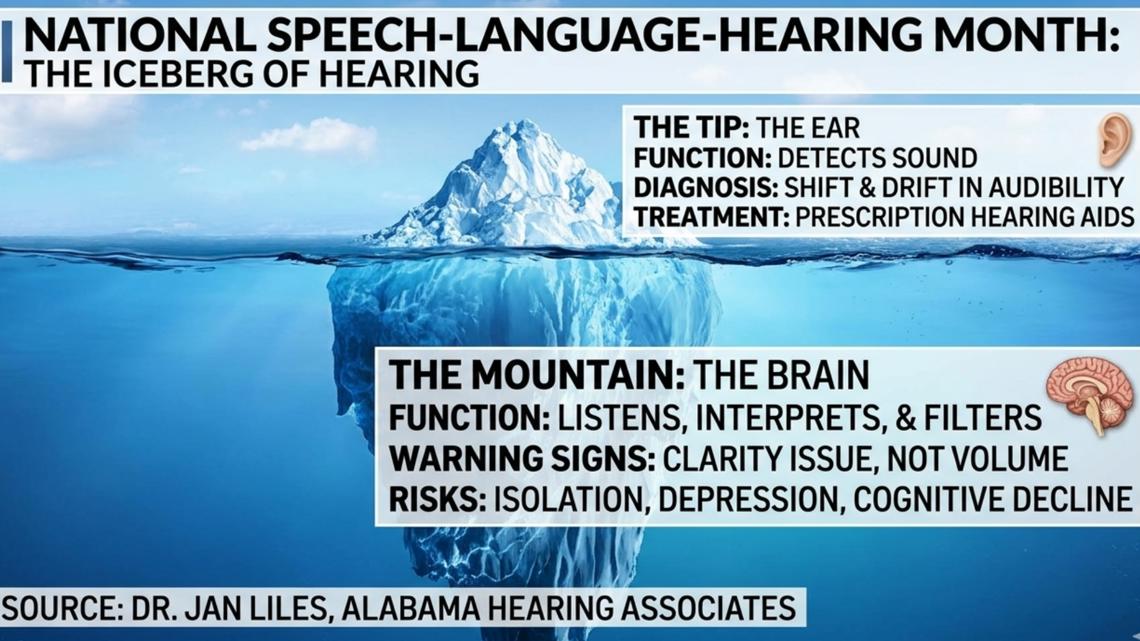
Dr. Liles explains that many people misunderstand how we actually process sound. She uses the analogy of an iceberg to describe the relationship between our ears and our minds.
“I like to use the analogy of an iceberg,” Dr. Liles says. “The ear is the detector of sound—it’s just the tip. The real mountain is below the water, where you can’t see, and that’s the brain. You hear in your ears, but you listen in your brain.”
When hearing loss occurs, it is typically because the patient is only hearing parts of words rather than nothing at all. This causes the brain to lose its ability to filter out unimportant background noise, making meetings, restaurants, and family gatherings physically and mentally exhausting.
“When people have hearing loss, it’s typically not that they can’t hear anything, it’s that they’re hearing parts of words. So they may be saying, ‘Well, I heard you say that, but I didn’t understand exactly what it was.’ That’s what’s happening.”
THE DANGER OF ISOLATION
The role of an audiologist goes far beyond fitting devices; it’s about preventing the social and mental decline that often follows untreated hearing loss.
“Isolation affects relationships; isolation is like not getting out and ever exercising,” Liles explains. “If you’re not able to get out and connect with other people, depression happens. There are a lot of unintended side effects.”
PROFESSIONAL CARE VS. DIY SOLUTIONS
With 25 years of experience in the Huntsville community, Dr. Liles notes that while over-the-counter options exist, hearing is a complex medical issue that requires professional intervention to ensure the brain is processing sound correctly.
“Hearing loss is complicated. It is not just a loss of audibility,” she says. “We can’t replace a brain that doesn’t filter correctly anymore… that takes professional help.”
HOW TO START THE CONVERSATION
If you have a loved one who seems to be pulling back from conversations, Dr. Liles suggests approaching them with love rather than frustration.
“I think you have that conversation with love, and you have that conversation by saying, ‘I want you to hear me and I want to hear you. I don’t want you to isolate. I want you to enjoy our family gatherings. I see you pulling back… I wonder if maybe you have a hearing loss.’”