7 Mins Read
Australian precision fermentation startup Eden Brew has been cleared to sell its cow-free casein protein in the US, and pivoted its immediate focus to health and supplements.
Just months after filing the first regulatory application for precision-fermented dairy in Australia and New Zealand, Eden Brew has already progressed on this front across the Pacific.
The Melbourne-based startup self-affirmed its recombinant beta-casein protein as Generally Recognized as Safe (GRAS) for use in like-to-like dairy replacements in early March, its founder and CEO Jim Fader tells Green Queen on the sidelines of the 2026 Future Food-Tech Conference in San Francisco.
The company now plans to notify the Food and Drug Administration (FDA) of its GRAS conclusion, a key move given that the self-determination pathway may be on the outs.
“We’re very well positioned with that,” says Fader. “The process we went through to get the FSANZ [Food Standards Australia New Zealand] dossier together was comprehensive, and we’re progressing well through that. We filed that in November, and that had us very well positioned also to have our conversation with the FDA.”
As for the application in its home market, the 12-month legislated timeline means Eden Brew could get the FSANZ green light by November. “The clock can stop if there are questions and we need to go get more data. We haven’t experienced that so far,” the CEO notes.
“We’re a reasonable way through [the process]. We do have a public consultation coming up as part of that process. I haven’t gone through one of those before,” he adds. “Obviously, businesses like Vow have really kind of paved the way for complex approvals in Australia. So, we’ve been watching the space. We’re very confident we’ll stick to the timeline.”
After the US and Australia, Eden Brew is “axe-sharpening” for regulatory engagements in “as many jurisdictions as we can”.
Why Eden Brew is putting dairy on the back burner (for now)
Eden Brew’s US breakthrough comes amid a shift in its commercialization strategy: it had planned to sell dairy products under its own brand, but it is now eyeing the health and supplements industry first.
“We definitely started out as milk without the cow in 2021. So quite a while ago, and obviously, the market shifted, the world shifted, investors have shifted. But I always felt that we would grow through dairy consumer products and get into health,” says Fader.
His background in the food industry – he has had two managerial stints at Woolworths, Australia’s largest retailer – has always revolved around formulating food with a health focus.
“I think it’s the platform that we need to focus on in this sector. And so intuitively, I felt you scale through consumer products and then you get into specialist health. But actually, we’re going to go about it the other way, which, in hindsight, is logical – slightly high prices, making more specialist products,” he says.
“We’ve got a real product market fit, I think, bringing dairy functionality, but also doing things that dairy can’t do because of the way we manufacture our proteins. There’s a little bit of secret sauce in that. So things like iron delivery, dairy doesn’t do, [but] we do very well.”
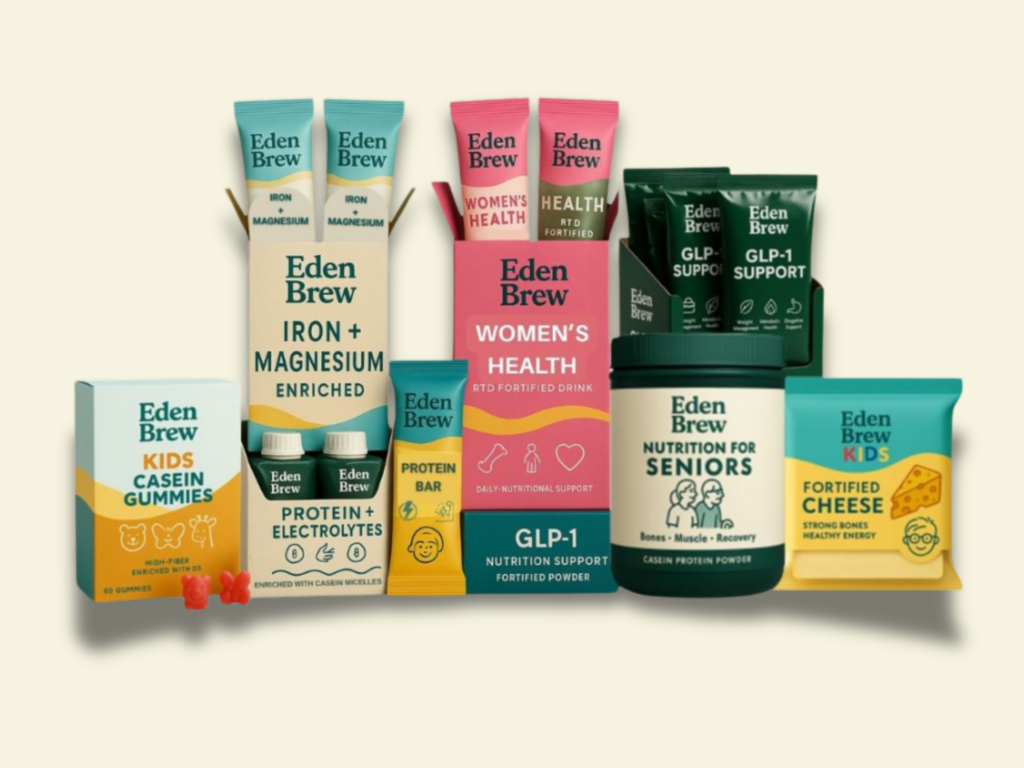
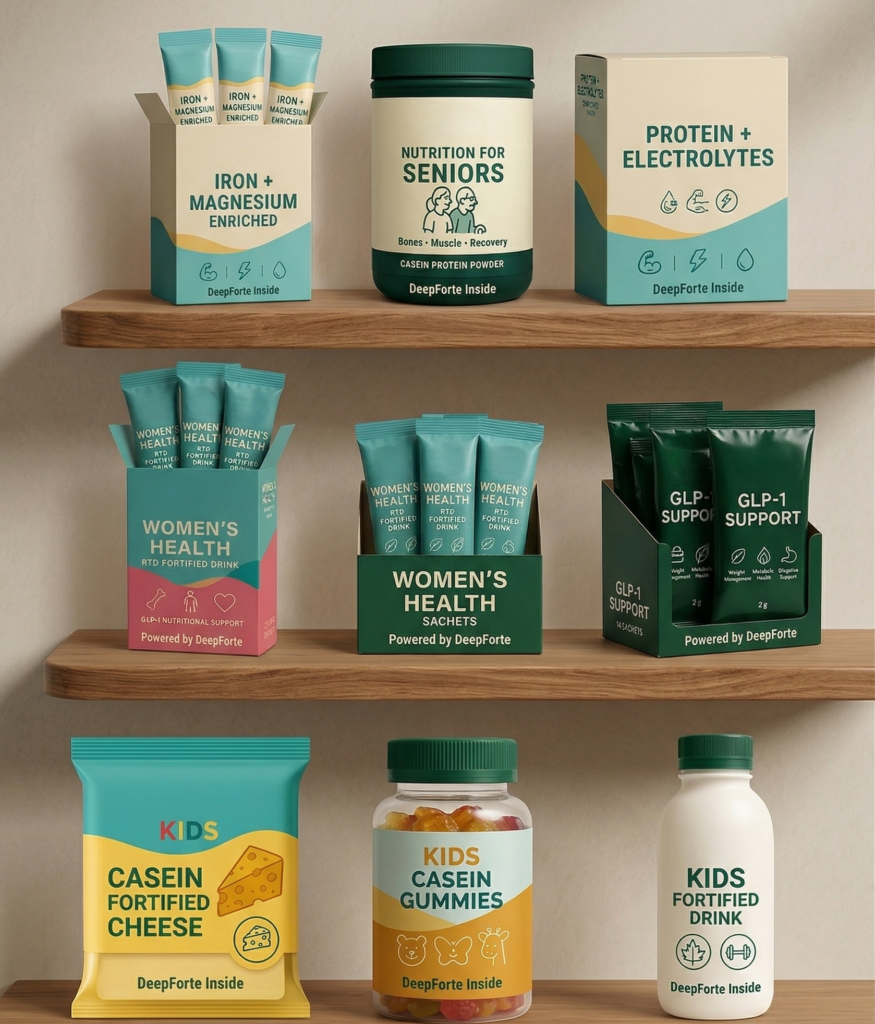
Still the pivot doesn’t mean dairy is no longer part of the pipeline. “We use the term ‘loaded dairy’. Dairy is synonymous with health and nutrition anyway, but imagine a cheese slice for a kid at school in his sandwich, but it’s high in iron or magnesium. So that’s where we see our value proposition,” Fader explains.
The startup is scaling up its production capacity with a co-manufacturer. “We’re ready for production. Our first production will be in a 50,000-litre tank,” he says, adding that this will allow it to produce around a tonne of finished products.
“We’ll do two or three of those before we jump to 190,000, which is where we will do most of our production capacity out,” he notes. It means Eden Brew could be producing nearly four tonnes of its protein per year when scaled up to this level.
The firm has previously indicated that it aims to achieve price parity with conventional dairy by 2029. Asked about its current costs, Fader says: “We’re doing well enough to have customer offtakes, which have supported us to get to that point on manufacturing.”
Casein micelles can fit into supplements, nutraceuticals and food fortification
 Courtesy: Cellular Agriculture Australia/LinkedIn/Green Queen
Cow’s milk contains four kinds of casein proteins that self-assemble into micelles, which are highly hydrated spherical structures that serve as a building block for the functional and nutritional attributes of dairy products.
Eden Brew’s DeepForte platform enables micelle formation to match dairy’s nutrition delivery, sensory experience and heat stability. Micelles have an enormous carrying capacity for calcium, phosphorus, protein and other nutrients, which they release slowly. The startup can further fortify the micelles with iron, magnesium and zinc.
“When they’re consumed, they form a curd and slowly break down. And that process is also a slow-release process for delivering calcium. So we’ve focused over the last two years on building out that capability to be a mineral, vitamin, and nutritious oil delivery system that’s got strong traction in the vitamin supplement industry, nutraceuticals, and then in food fortification and clean labels,” notes Fader.
“We’re making at a sufficient scale and an efficient cost to sell into that industry, to load up products with nutrients like high iron or high magnesium, to the point that we can make claims around RDI [recommended daily intake] and to deliver functionality like slow-release or encapsulation.”
He continues: “We’ve got an offtake agreement with a supplement business in Australia, and we’re now focusing on building out our pipeline in that sector as our first port of call.
“This is certainly an opportunity to get into food fortification. So we are talking to customers, particularly in the plant-based area, where we can bring dairy functionality. And I think it’s a good opportunity for clean-label projects. There’s a lot of synthetic emulsifiers, gums, starches and other inclusions to get product formats that obviously casein functionality brings naturally.
“So we can be a protein, fibre and mineral inclusion that also removes the need for a lot of those other inclusions and provides a cleaner label.”
Eden Brew plots $20M Series B fundraise
 Courtesy: Eden Brew
To date, Eden Brew has secured around $15M in funding from private and public investors. It’s now kicking off a Series B round to raise around $20M to fund its scale-up efforts, which it plans to close towards the end of this year.
Fundraising in the food tech industry is harder than ever before. Fermentation startups alone experienced a 44% dip in investments last year. How does Fader plan on navigating through these choppy waters?
“I’ve got a noose, I’ve got a gun, I’ve got a knife,” he says in jest.
“In all seriousness, I think it is tough. It’s tough at the best of times. It’s even tougher when three-quarters of venture capital funds go into pure-play AI, so we’re changing our name to EdenBrew.ai,” he jokes again.
“But look, we’ve got a really clear product market fit and customer traction. We don’t necessarily pitch ourselves as just an alt-protein food company anymore. We are really clearly finding ways to add value where it comes to slow-release delivery systems, encapsulation, food fortification and clean labels, and I think that is going to be more than enough business that gets us well past break-even.
“And we have techno-economics that are now proven and established positive margins from day one. We’re not subsidising our early sales as a business, so we’ve got a clear pathway to break even. And I think that that’s the kind of box-ticking that you need to achieve as a precision-fermentation-based technology to have a credible conversation with investors.
“So from our perspective, we’re sober to the task of raising money, but I think businesses that are cutting through, showing clear differentiation – but also financial discipline and business acumen – can have those conversations. And we’re comfortable with where we’re positioned with investors at the moment.”
Fader suggests the company’s biggest hurdle right now is to put all the scale disciplines into place to expand production without adding inaccurate costs. “We’ve been a very lean organisation. We’ve outsourced a lot of our specific R&D to certain service providers, and we’re not building our own production plant,” he says.
“So we’ve always prided ourselves on being capital light in terms of people operating costs, but also in terms of infrastructure, and we want to stick true to that and scale quickly. You’ve got to be quite thoughtful about mapping out your needs, but also how you can automate the template and work smarter, not harder, as you scale.
“So we’re putting a lot of time and effort into that to be locked and loaded, and then beefing up the commercial side of the business to go sell some stuff, because Eden Brew is open for business.”

Anay is Green Queen’s resident news reporter. Originally from India, he worked as a vegan food writer and editor in London, and is now travelling and reporting from across Asia. He’s passionate about coffee, plant-based milk, cooking, eating, veganism, food tech, writing about all that, profiling people, and the Oxford comma.