




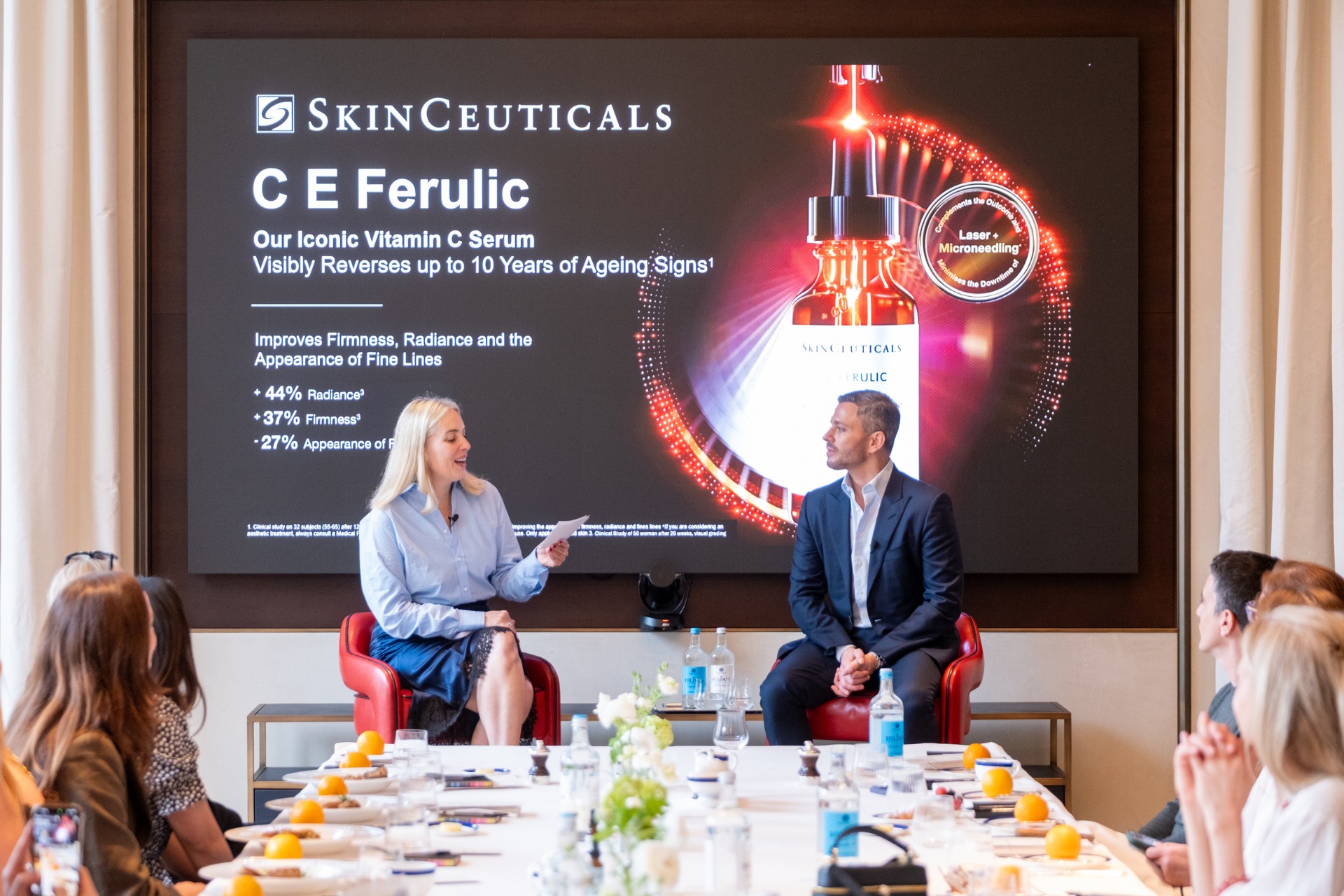
Last week, London’s in-the-know beauty set flocked to the capital for an intimate breakfast hosted by Country & Town House in collaboration with SkinCeuticals. Sitting down in the beautiful Pavilion at The Chancery Rosewood, guests were invited to take part in a panel led by C&TH’s Annabel Jones and leading skincare expert Dr Wassim Taktouk – who discussed all things C E Ferulic and the importance of antioxidants in our skincare routine.
And with an expert ear on hand to answer all of our questions around antioxidants, we put some of the biggest myths surrounding vitamin C to the test. Here’s Dr Wassim Taktouk’s take on antioxidant skincare.

(c) James Mason Photography
A Guide To Vitamin C With Dr Wassim Taktouk
Myth: Vitamin C Treats Skin Issues
Reality: Vitamin C Is Preventative Skincare
‘Often when we talk about skincare, we’re thinking about corrective treatment,’ Wassim begins. ‘What can I use for my pigmentation? What can I use for my rosacea? What can I use for skin damage, for fine lines, for wrinkles? And we never really thought to go right back to the beginning.
‘Antioxidants come into their own category altogether, as prevention,’ he continues. ‘The idea is that if you use an antioxidant daily, you’re never going to get to those skin concerns that would need correction.’
Wassim adds that one of the most famous antioxidants is vitamin C, which should be applied first thing in the morning. ‘We are exposed to environmental stressors all the time – pollution, the ozone, smoking, lifestyle – and this impacts our skin by introducing reactive oxygen species. These are essentially unstable atoms that steal from the atom next to them; they take an electron and then the next one takes an electron from the one next to it, and you start entering a cascade of reactions. It ultimately ends up with the degradation of our collagen and the speeding up of ageing processes.
‘That’s where antioxidants come in: they effectively donate an electron to the unstable atoms and calm things down, preventing the changes in ageing that would happen without them.’
Myth: You Only Need Vitamin C Later In Life
Reality: It’s Better To Start Early
Knowing that vitamin C sits on the preventative end of skincare, it makes more sense to use it earlier on in life where possible. ‘Young people definitely need their antioxidant protection,’ confirms Wassim. ‘It’s a lifestyle thing. It fits in the preventative category of your skin. So an antioxidant needs to be started as soon as possible.’
He does add, however, that it doesn’t need to be used in combination with a TikTok-famous multi-step skincare routine. ‘I think it is difficult for teenagers, because social media is bombarding them with skincare regimes and narratives that say they must use whatever product is on their screen – that they have to layer 20 different serums,’ says Wassim. ‘It’s important to remember that their skin is greater. If you play around and start adding things on, you can irritate and sensitise their skin.
‘The key pillars of any skincare regime – especially for young people – is SPF, that’s your protection, and an antioxidant, because that’s your prevention,’ he adds. ‘If you’re working to neutralise free radical damage that would happen with their skin, just an antioxidant and an SPF is really all you need. If someone’s got young, bouncy, healthy skin, they really don’t need to be applying skincare (with actives) onto it.’
Myth: It Doesn’t Matter What Order It Goes On Your Skin
Reality: Vitamin C Goes On First (And In The Morning)
The order you apply your skincare does matter – especially when it comes to vitamin C, which should be applied after a cleanser and/or toner and before any other serums, moisturiser and SPF. ‘It’s not the final step in your skincare routine,’ emphasises Wassim. ‘You want it to go on first so that it sinks in, and the antioxidants really get into the skin.’
From there, you can proceed with your usual skincare routine: ‘Once the vitamin C has had a moment on your skin, you can then go in with corrective serums – things that target pigmentation or rosacea, for example – and then, finally, moisturiser and SPF. You don’t need a 20-step routine, just the building blocks that will prevent damage and protect your skin.’
He adds that vitamin C should be in your morning rotation, every morning. ‘An ideal routine would be vitamin C in the morning, alongside SPF, and retinol in the evening.’
Watch
You can tune in to our event with SkinCeuticals below.
Explore