




When my algorithm delivered up an Instagram post claiming that Taylor Swift’s nervous system had earned her $2bn, I felt like I’d entered into a brand new corner of our tech dystopia – one where online wellness scams and get-rich-quick schemes had formed an unholy alliance to convince me that a 30-second “vagus nerve reset” could not only improve my health, but also – somehow – make me a billionaire.
Now, every time I open any social media app, I am flooded with videos of beautiful people talking to camera about how I can “reset my nervous system” in just a few minutes. Am I burnt out, they ask. Stressed? Tired? Unproductive?
In exchange for my money and engagement, they promise to fix all of these symptoms by teaching me how to “reset” my vagus nerve. These posts only make me more stressed, though, because I know these offerings are a scam.
As someone with a long-term post-traumatic stress disorder diagnosis, I have received actual nervous system treatment at Khiron Clinic, a trauma recovery centre backed by world-leading experts including Bessel van der Kolk, Janina Fisher and Stephen Porges.
Khiron specialises in stabilising and regulating the nervous system the scientific way – and so I know, from experience, that it is a slow, complex, and highly specialised process.
Its aesthetic is not a ring-lit, beauty-filtered, heavily-edited Instagram reel. Its aesthetic is realising there is still glue in your hair from a neurofeedback session as you boil the kettle for your fourth consecutive mug of decaf tea before heading to group therapy in your pyjamas. It is not quick, and it is certainly not easy. But it works.
It certainly cannot be done in 30 seconds with the help of an influencer and it cannot be bought, and anyone who tells you otherwise is lying to you for money. And using your trauma and your technology-dependence to do it.
I asked some experts if they’d noticed this too. They had. Sometime in the last few years, neuroscientists told me, the nervous system became a massive wellness trend online, which led to it being chronically oversimplified and underexplained – and some people are making huge profits on the back of this misinformation.
“These days we are all subjected to the opinions of so-called experts or influencers who may or may not have the knowledge base to back up those opinions,” said Dr Navaz Habib, author of Activate Your Vagus Nerve. “It’s one thing to do that, but it’s another to create hope in people and then make money off of that hope.”
❝
What we know now about the vagus nerve is only the tip of the iceberg. But then we have people racing ahead of the science and profiteering from that grey area
Kevin Tracey, neurosurgeon and author
Wellness enthusiasts shilling breathing exercises as “nervous system resets” are engaging in “psychological hocus pocus,” said Kevin Tracey, a neurosurgeon and biomedical researcher and the author of The Great Nerve: The New Science Of The Vagus Nerve. Researchers don’t actually definitively know yet how such a reset would work in human beings, let alone how to induce one.
The nervous system is one of the most important and complex networks in the body. It is the system of neurons that carry messages to and from the brain and spinal cord, and is therefore responsible for a broad array of movement, organ functions such as those of the gut and the lungs, and brain function. It is anchored by the vagus nerve, which makes up the longest pathway in the autonomic nervous system, serving as a communication route between the brainstem and the heart, lungs and digestive tract.
It acts as a kind of on/off switch for the body’s “rest and digest” state. When the vagus nerve becomes dysfunctional, it can cause myriad physiological and psychological problems, including autoimmune disease, digestive issues and chronic stress.
Many online grifters peddle the idea that if you experience chronic stress or burnout, for example, you can chalk this up to vagus nerve dysfunction – and therefore experience relief from a “vagus nerve reset”. But it’s not that simple.
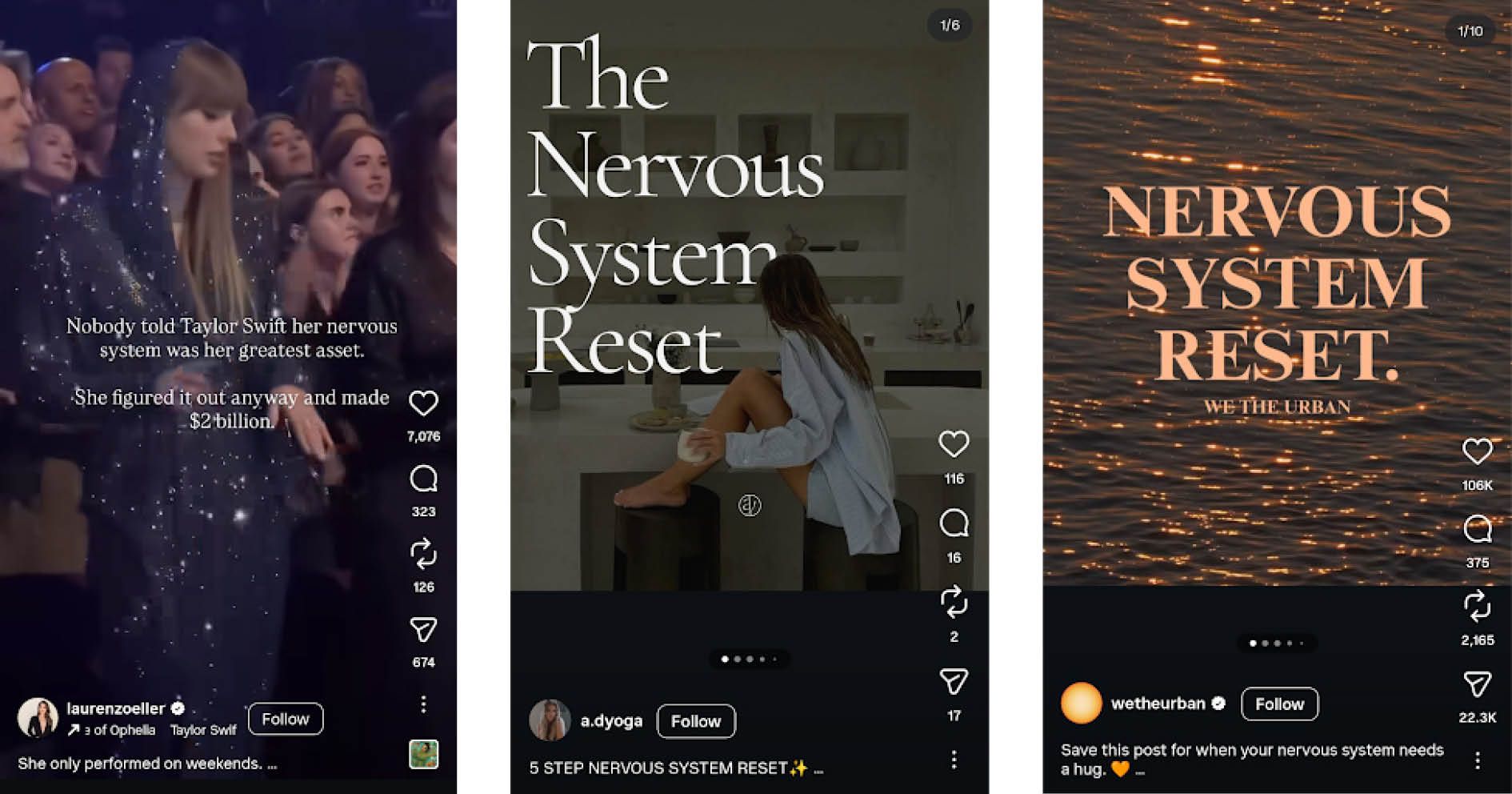
Examples of wellness posts on Instagram
Vagus nerve dysfunction is not something you can self-diagnose based on feeling stressed or burnt out, Habib said. It’s a medical condition, and a complex one – it requires a battery of blood tests and medical assessments to be carried out by a trained neurologist.
Even if you do have a diagnosable problem, none of these wellness fixes are capable of treating it, Tracey said. Referring to the digital devices, often worn around the head and neck, that are pushed on social media sites as “vagus nerve stimulators”, he said there was no evidence to suggest that these were capable of doing what is claimed for them.
“The most we can say is they can stimulate the skin close to the vagus nerve,” he said.
The only evidence-based way to stimulate the vagus nerve at present, Tracey explained, is through surgery carried out by a trained medical professional.
And yet one retreat leader, who says she does not have any nervous system training, offers a three-day “reset retreat” for £499 which promises to teach guests how to “reset and balance your nervous system”. Another retreat, which promises to leave you restored with a steady nervous system for £1,299, is run by two people without any formal training in therapy or neuroscience.
The experts I spoke to emphasised that these people are likely to be well-meaning, but that their lack of formal training renders them unaware of potential unintended consequences of their interventions.
While these exercises cannot create a “reset”, as advertised, they can create a reaction in the nervous system which can actually be very damaging when not handled by a professional, Lucy Allen, the Clinical Lead at Khiron Clinics, told me. Things such as breathwork and “cold plunges”, as advertised on some of these websites, can bring to the surface feelings or experiences that are difficult to process.
“They’re working with nervous system responses but without the expertise required for that work, so things such as types of breathwork that are precursors to trauma release can trigger really strong reactions in the body, such as panic, dissociation, and flashback,” Allen explained.
“A person needs to have a stabilised nervous system first, so they know how to regulate themselves, otherwise they’re left wide open with potential looping trauma responses that they might not be able to close, and with no professionals around to help them close it.”
Activating trauma without professional help can be particularly dangerous if these wellness leaders have not taken a full history and understand a patient’s risk profile, Allen said.
These ethical concerns are heightened given that there is a clear financial incentive involved, experts say. “There’s an opportunity for these people to prey on people who are really suffering,” Habib said, adding that people who are at a very low point are often the least able to discern between qualified and unqualified professionals – which makes the use of unrealistic guarantees in advertising particularly unethical.
As the misinformation rises, the actual science behind the nervous system is still emerging, Tracey said.
There have been randomised clinical trials testing the role of the vagus nerve in conditions such as rheumatoid arthritis and some other medical conditions, he said, but scientists are only just beginning to create an evidence base to understand the broader nervous system mechanisms.
There is evidence showing that vagus nerve stimulation – using the proper surgical intervention – reverses depression 50% of the time for people who are “totally out of options”. Another study found in 2025 that vagus nerve stimulation – again, using a surgically implanted medical device – was able to reduce symptoms of post-traumatic stress disorder in 100% of patients when paired with expert therapy. The study, conducted by Dr Michael Kilgard at the University of Texas, showed that all nine participants in the phase one trial experienced a significant reduction in symptoms and no longer met the criteria for a PTSD diagnosis.
“What we know now is only the tip of the iceberg,” Tracey said. “But then we have people racing ahead of the science and profiteering from that grey area.”
This could damage the progress of the actual science, he said. “We cannot discount the harm this misinformation does to real scientific development. It took us 30 years to figure out how this works in people who are really suffering with conditions such as rheumatoid arthritis.
“You can’t underestimate the impact of these influencers sowing disinformation – there’s no other way I can think to describe it – when it comes to the development of the actual science behind the nervous system.”
Lucia Osborne-Crowley is an investigative reporter and features writer at the Nerve. She is also the author of three books including The Lasting Harm, a survivor-centred, award-winning account of the Ghislaine Maxwell trial.
The Nerve is a fearless, independent media title launched by five former Guardian / Observer journalists: investigative journalist Carole Cadwalladr, editors Sarah Donaldson, Jane Ferguson and Imogen Carter and creative director Lynsey Irvine. We cover culture, politics and tech, brought to you in twice weekly newsletters on Tuesdays and Fridays (sign up here). We rely on funding from our community, so please also consider joining us as a paying member. You can read more about our mission here.