




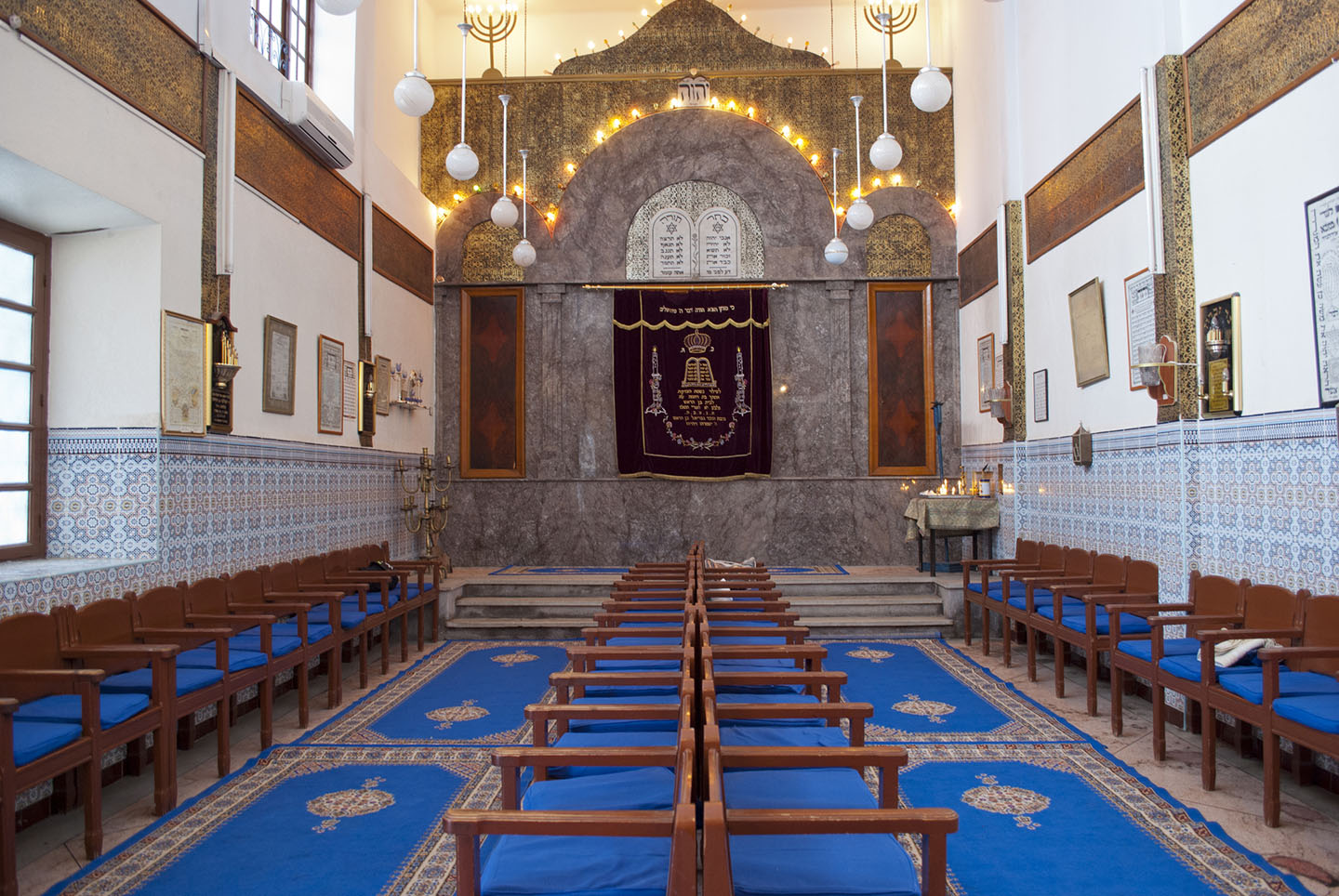
We arrived in Morocco feeling a bit anxious. With everything happening with Iran and throughout the region, many of us wondered: was it safe to be here now?
Yet the StandWithUs Jewish Heritage Mission to Morocco generated tremendous interest and filled up almost immediately. In fact, there were additional people who wanted to come, who were placed on the list for the mission to Morocco next year.
It’s understandable. Who wouldn’t want to visit Marrakesh, with its colorful markets, fragrant spices and unforgettable couscous? Who wouldn’t enjoy staying in the beautiful hotels of Fez and Casablanca while exploring centuries of Jewish history? Who wouldn’t look forward to visiting the synagogues still in use, pray at the grave of Rabbi Pinto the Kabbalist, visit the synagogue he built and meet members of Morocco’s remaining Jewish community?
The participants on this trip became close very quickly, as we absorbed the history of the Jews who lived here during the last 1,800 years. We also realized we were not the only Jews drawn to Morocco. Along the way, we encountered other groups, including a Jewish Heritage mission from New York and a delegation organized by the Utah Jewish Federation. We all ended up having a beautiful Shabbat dinner together at an active synagogue in Marrakesh.
For security reasons, we hired two bodyguards who remained in close contact with local authorities. As it turned out, armed Moroccan police officers accompanied us throughout our travels. Despite regional tensions, Morocco itself felt vibrant, colorful, safe and welcoming. And we were incredibly fortunate to have a most knowledgeable and interesting guide: Jacob Shoshan.
Jacob enriched our journey and opened up extraordinary, inspiring doors. He showed us that beneath the beauty of Morocco, lies a complicated, often tragic and familiar Jewish history.
Jewish people first arrived in Morocco approximately 1,800 years ago. As recently as 1948, approximately 250,000 Jews lived throughout the country, creating thriving communities rich in scholarship, commerce, music and religious life. Today, however, only a little more than 1,000 Jews remain.
What happened?
Like Jewish communities throughout the Arab world, Moroccan Jews lived at the mercy of changing rulers and political climates. There were periods of relative coexistence and prosperity, but also devastating waves of violence, persecution, forced conversions, discrimination and expulsions.
Fez, once a great center of Jewish learning, also became the site of repeated massacres. In 1033, thousands of Jews were murdered during attacks led by a Muslim Berber ruler. In later centuries, Jews again faced riots, forced conversions and deadly violence. Entire Jewish communities were sometimes wiped out.
Rumors, libels and accusations against Jews repeatedly fueled persecution. As happened elsewhere throughout Jewish history, periods of instability often became dangerous for Jewish communities.
And yet, despite everything, Jews kept rebuilding.
Again and again, Jewish families returned, reopened businesses, restored synagogues, rebuilt schools and attempted to create stable lives. Morocco became home to generations of rabbis, scholars, merchants, musicians and ordinary families who deeply loved the country while maintaining their Jewish identity.
During World War II, King Mohammed V became a rare and courageous figure in the Arab world when he resisted pressure from the Vichy regime and refused to fully cooperate with anti-Jewish measures targeting Moroccan Jews. He refused to send his Jewish citizens to France to later be transferred to concentration camps.
Then came 1948 and the rebirth of the State of Israel.
Like Jews throughout the Arab world, Moroccan Jews increasingly faced riots, hostility, fear and uncertainty. Many lost homes, businesses and possessions. Over time, the overwhelming majority left. Some fled persecution, others left because they no longer believed there was a future for Jews in Arab lands.
Today, walking through Morocco evokes mixed emotions.
The streets are colorful and alive. The markets are truly exciting. The hospitality is warm. The architecture is breathtaking. Jewish history is visible everywhere: in synagogues that are in use and those that are not, Jewish cemeteries and stories passed down through generations.
And yet underneath the beauty is a deep sense of loss.
One cannot help but wonder: why did Jewish communities continue returning after each tragedy, always hoping that this time would be different? Perhaps because Jews are, by nature, optimists and builders. Wherever they went, they planted roots, built communities, created scholarship, raised families and contributed to society with hope and resilience.
That spirit is part of the Jewish story everywhere.
Our trip to Morocco was not simply a tour. It was an encounter with both the beauty and fragility of Jewish life in exile. It reminded us how ancient Jewish history is, how vulnerable Jewish communities have been and how extraordinary it is that the Jewish people continue not only to survive, but we always choose to rebuild, contribute and thrive. It also reminds us how important the State of Israel is for the survival of the Jewish people.
And perhaps that’s the real lesson of Morocco. Not only what was lost, but the remarkable resilience of a people who never stopped believing in the possibility of renewal.
Today, the majority of the descendants of Morocco’s Jewish community have carried their energy, traditions, creativity and entrepreneurial spirit to Israel, where they have helped build and strengthen a thriving society and nation. Moroccan Jews have contributed enormously to Israel’s culture, music, scholarship, politics, business, military and spiritual life. Their story is ultimately not only one of exile and survival, but of renewal, contribution and hope.
In many ways, the story of Moroccan Jewry is also the story of the Jewish people themselves: enduring hardship, preserving identity, rebuilding after loss and continuing to create vibrant communities wherever the opportunity exists to live freely and proudly as Jews.