




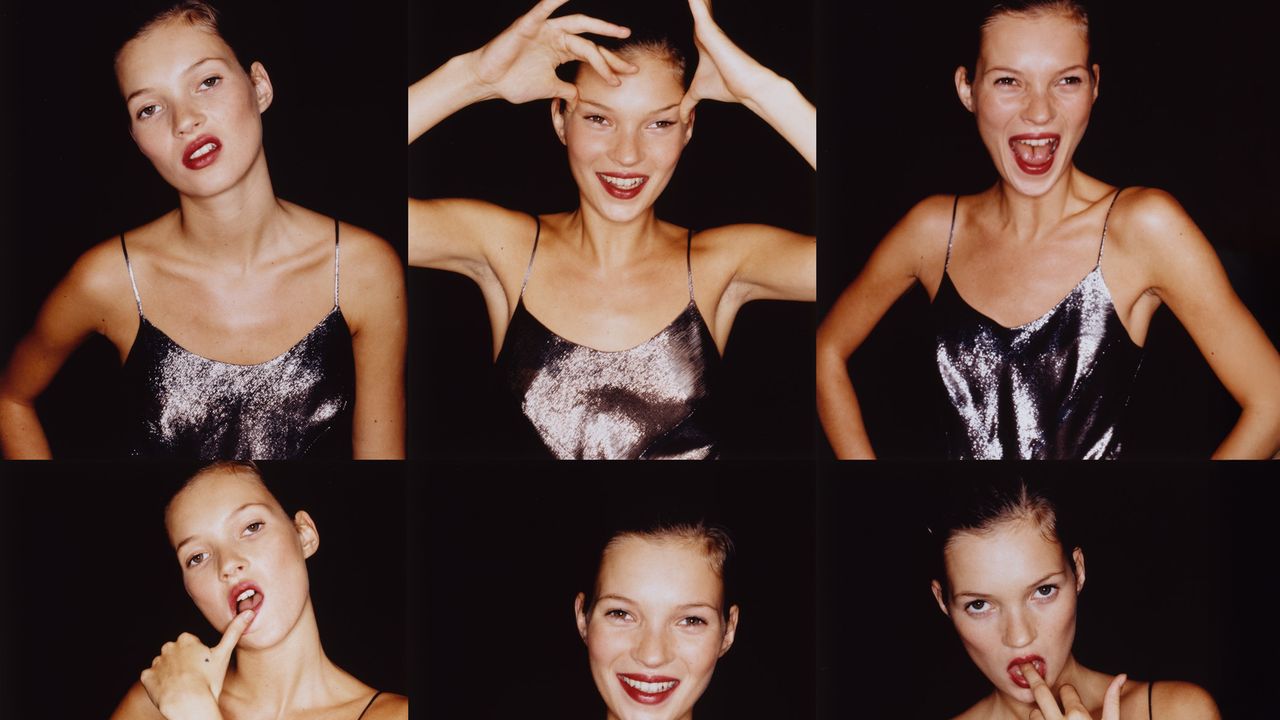
These days, I take photographs for one reason only: proof of life, my equivalent of that ubiquitous ’80s graffiti scrawl, “I woz here.” But I’d be lying if I said the process was any less panic-inducing. TikTok offers a myriad of wisdom: use the 1.4x zoom as it reduces facial distortion; follow face-mapping tutorials that come complete with arrows, grids and diagrams explaining where to tilt your chin, place your tongue, angle your eye; find your angles, know your angles, make triangles… These shenanigans might be futile anyway because the problem isn’t simply down to technique, it’s perception.
One reason photographs often don’t translate is that they’re not how we experience ourselves. We see ourselves in motion, in three dimensions. Cameras, on the other hand, flatten and reduce depth. A photograph is not a mirror, it’s an interpretation – sometimes a bad one (in our eyes, at least).
It doesn’t help that we live in a culture of relentless self-surveillance: Zoom calls, front-facing cameras, selfies… No wonder we’ve become hypercritical of our images; we are examining our faces with a level of forensic interest once reserved for crime scenes.
Then there’s the golden ratio. This mathematical proportion, identified in ancient Greece, was believed to represent perfect balance, harmony and beauty. Renaissance artists loved it. Architects worshipped it. Today, quelle surprise, it’s been enthusiastically adopted by beauty apps – and many cosmetic surgeons – to map faces, score attractiveness and basically tell us our genes are cursed. The “divine proportion”, however, like so many beauty ideals presented as objective, is rooted in Eurocentric standards. So when filters, algorithms and cosmetic interventions use it as a benchmark, they are reinforcing an incredibly narrow idea of what a human face is “supposed” to look like.
Tech offers another layer of complexity. Facial recognition is still predominantly trained on lighter faces, which means the camera often arrives with predetermined conclusions. Add to that the quality of the camera, lighting, angles, autoexposure and the skill – or lack thereof – of the person taking the shot, and it becomes clear how little control we actually have over the final result. Hence we see people taking hundreds of snaps of the same shot just to get the “perfect” one, which will then pass through filters to reshape jawlines, narrow noses, thin necks, smooth skin and enlarge eyes. Meanwhile, IRL, they are also simultaneously sliding down the slippery slope of cosmetic interventions. Is it me or is our collective obsession with shaping our image tipping into insanity?
Perhaps “How to look good in photographs?” isn’t the right question. While I can tell you that a bright lip, exfoliated skin and glossy hair makes everyone look less comatose, and that bad lighting is a friend to no one, the real question should be whether we can make peace with what a photograph shows us. Will we ever stop seeing an off picture of us as a personal failing? Will we stop attaching shame or embarrassment to the image, as if being badly captured is a moral lapse? Maybe the way forward is less about learning a new trick or angle. Maybe we just need to relinquish the idea that what we see in our pictures is a full reflection of everything we are. This, admittedly, is much harder than shouting “Money!” at the camera.