


During the tour facilitated by Women in Nutraceuticals, NutraIngredients visited Adept Life Sciences, Arizona Custom Blends and 21st Century HealthCare to see how that process unfolds across multiple stages of the supply chain — starting with raw ingredients, moving through formulation and manufacturing, and ending with the finished products consumers find on shelves.
Michael Shields, CEO, Adept Life Sciences, said that all incoming ingredients undergo identity and microbiological testing before entering production. Ingredients are first placed in quarantine while QA teams collect samples and send them to a lab for analysis. “Once everything meets our spec it’s released and we can use it for production,” he said.
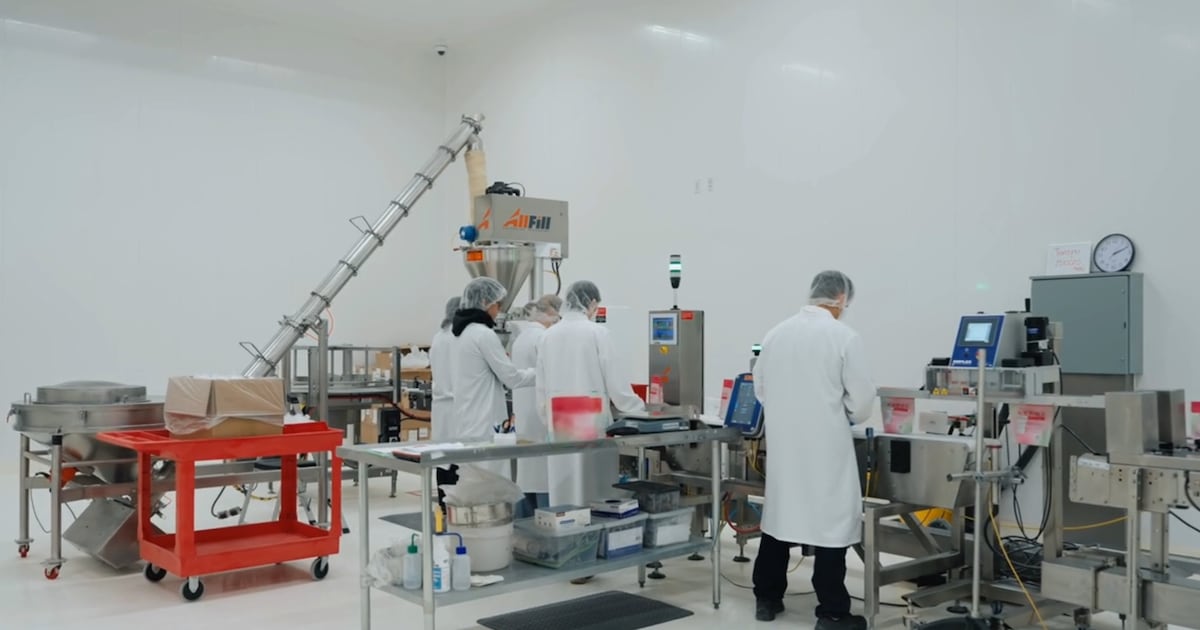
Once approved, ingredients move into formulation and manufacturing, where they are blended, measured and processed with precise specifications.
Arizona Custom Blends’ CEO, Jeff Weintraub, described the company as a contract manufacturer focused primarily on powders and capsules, with tablet production beginning to expand. He explained that clients typically bring the company a formulation, which then undergoes R&D review to confirm viability before the team creates batch records, sources materials and moves through weighing, sifting, blending, encapsulation, bottling, labeling and final quality checks.
Finished products then undergo final testing, bottling, packaging and distribution before reaching consumers.
21st Century HealthCare manufactures a wide range of nutritional products, including multivitamins, herbals and specialty formulas, producing tablets, capsules and powders both for its own brands and private-label partners. Kirk Neil, president and CEO, 21st Century Health Care, explained that the company manages the process in-house, from raw material sourcing and testing to blending, encapsulation, packaging and direct distribution to customers without relying on third-party distributors.
The complexity behind the bottle
Behind every bottle is a story rarely seen by the consumer, one shaped by sourcing, testing, manufacturing, quality checks — and sometimes even viral demand spikes.
“Things will go viral on TikTok and we need to support our brands, be able to help them scale up,” said Shields. “So oftentimes we encourage brands to not be too particular with complicated formulas because we want to be able to source raws easily. Sometimes there’s a branded material and there’s only one source on it. It becomes challenging at times if they don’t have a good supply chain or they’re not stocking proper levels that we might need. We do our best to support brands with recommendations.”
“Contract manufacturing is a very difficult line of work,” said Weintraub. He explained that each product presents unique manufacturing challenges, requiring extensive quality checks to confirm the correct materials are received, properly identified and free from microbial contamination. He noted that ingredients are measured with precise accuracy — sometimes down to the milligram — before moving through the production process.
“All these pieces need to come together and there’s so many places where something can go wrong. So we have to make sure we put in enough checks to make sure that the finished ingredient, when it’s done, meets its finished good spec and all of our end users get an excellent product,” Weintraub added.
“What would surprise most people about what we do here is the complexity,” said Neil. “There’s a lot of talk that the vitamin industry is unregulated – that’s not true.”
Neil noted that while dietary supplements do not undergo the same pre-approval process as pharmaceuticals, manufacturers are still regulated by the FDA and inspected for current Good Manufacturing Practices (cGMPs) compliance. He added that consumers are often unaware of the complexity involved in producing supplements, citing the extensive raw material sourcing, testing and manufacturing procedures required for products ranging from multivitamins to herbal formulas.
From raw materials to the retail bottle, the dietary supplement process depends on far more than just ingredients. It requires precision, consistency, regulatory standards and quality control at every stage.