




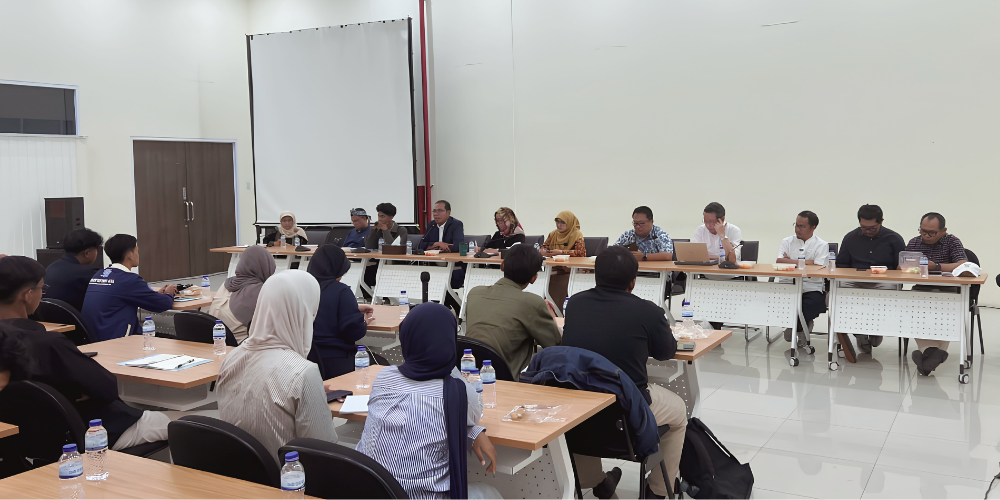
IPB University held an open dialogue with students to clarify various pieces of information regarding the university’s involvement in the Free Nutritious Meals (MBG) program.
During the dialogue forum, IPB University Rector Dr Alim Setiawan Slamet expressed his appreciation to students who remain active in voicing criticism and feedback on various national issues, including IPB University’s involvement in the MBG program.
He noted that the dialogue forum serves as a key step to clarify information circulating in the public. “We opened this dialogue forum because much of the information circulating is incomplete, leading to misunderstandings,” he said.
Through the forum held at the Startup Center Building, Taman Kencana Campus, Bogor (5/8), the Rector emphasized that from the outset, IPB University had decided not to be directly involved in the operational management of the kitchens or the Nutrition Provision Service Units (SPPG), due to considerations regarding various technical risks and food safety.
“The role taken by IPB University is more strategic, namely as the initiator of the Center of Excellence (CoE) for National Nutrition Fulfilment (PGN) together with the National Nutrition Agency, Bappenas, UNICEF, and various other partners,” the Rector stated firmly.
Through this CoE, he emphasized, IPB University plays a role in developing academic studies, training, quality standard development, and strengthening data-driven monitoring systems. Additionally, IPB University is also promoting the establishment of regional CoEs in various parts of Indonesia, such as Papua, East Nusa Tenggara, and East Java.
Reinforcing the Rector’s statement, Prof Erika B. Laconi, Chairperson of the International Research Institute for Food, Nutrition, Health, and Halal, emphasized that IPB University does not conduct SPPG operations on campus.
She noted that universities play a primary role in advancing scientific knowledge and strengthening systems. “IPB University is not the operational site for SPPG. Our task is to ensure that the ecosystem of science, research, and quality control runs smoothly,” she explained.
Prof Erika also added that students have ample opportunity to contribute through research, field monitoring, food innovation, and the development of food and nutrition based startups. Thus, the involvement of the academic community is expected to strengthen the quality of the implementation of the national nutrition fulfillment program.
Regarding the SPPG, it is not IPB University that directly builds and manages the SPPG, but rather PT Bogor Life Science and Technology (BLST), an IPB-owned holding company, through a foundation established specifically for this purpose. This foundation is a legal entity managed professionally, separate from IPB’s educational and academic operational budgets. Thus, the campus’s governance structure and academic mandate remain intact.
Dr Luhur Budijarso, Director of PT BLST, who was also present at the forum, explained that BLST’s development of the SPPG was carried out through a thorough risk assessment over the course of more than a year.
He emphasized that BLST’s primary focus is not merely operational profit, but rather building a sustainable agribusiness ecosystem and food supply chain.
“This SPPG business model is not about profiting solely from kitchen operations, but about developing the value chain all the way to farmers, livestock breeders, and food processors,” he explained.
He added that BLST has established partnerships with farmers, livestock breeders, and local micro, small, and medium enterprises (MSMEs) in the targeted SPPG locations namely Ciampea and Sukajaya sub-districts to ensure food availability and safety for program beneficiaries. Additionally, he stressed that food quality is a top priority in managing the SPPG.
“We need to make it clear that this SPPG is not located on the IPB campus, does not use campus facilities or resources, and is not intended for the procurement of MBG for students,” he added.
On that occasion, the President of the IPB University Student Executive Board-Student Association (BEM KM), Muhammad Abdan Rofi, stated that this open dialogue was organized to provide a more comprehensive understanding of IPB University’s role in the program.
He emphasized the importance of student involvement in overseeing the policies agreed upon collectively.
“We are part of the academic community, so we are expected to act as guardians, supervisors, and contributors in supporting this Center of Excellence. A space for dialogue has also been opened so that students can participate in observing and overseeing the implementation of policies that have become a shared commitment,” he said. (dr) (IAAS/LAN)