




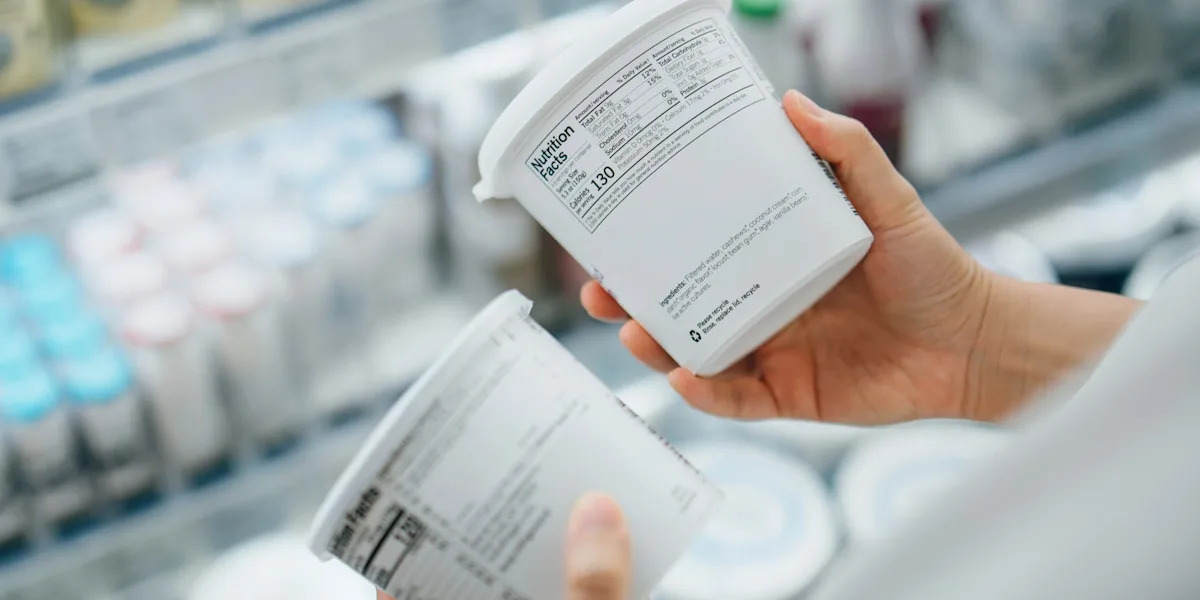
With increased scrutiny of ultra-processed foods, people are reading nutrition labels more closely than ever before. Brands are responding too, and many products have been reformulated to meet growing consumer demand for better-for-you foods.
Two phrases that show up constantly on newer packaging are “sugar free” and “no sugar added.” At face value, they sound almost interchangeable. If sugar wasn’t added, that should mean there’s no sugar in the product at all, right?
Not exactly. It turns out these two claims have very different meanings in the eyes of the FDA. And if you’re not familiar with the distinction, the labels of certain foods can be more misleading than helpful. To understand the difference between “sugar free” and “no sugar added,” we spoke with Vandana Sheth, RDN, CDCES, FAND, to break it all down.
What Does Sugar Free Mean?
Unlike terms like natural, premium, and grass-fed, the FDA enforces a specific legal definition of the term “sugar free.” According to Sheth, it “means that the product has less than 0.5 gram of sugar per serving.” It also can’t include ingredients that are themselves a type of sugar.
Sugar-free foods, however, can still taste sweet. These products can still contain sugar substitutes, which fall within the FDA’s guidelines for the claim. Ingredients like aspartame, stevia, and xylitol can be artificially or naturally derived. But no matter where they come from, they’re often highly processed and, in excess, may cause unpleasant side effects like digestive issues.
So if your goal is to cut back on processed foods, sugar-free products may not always line up with that. Still, Sheth, who specializes in diabetes care, says, “For someone managing diabetes or blood sugar balance, sugar-free products may allow for more flexibility and choices without causing blood sugar spikes.”
What Does No Sugar Added Mean?
Depending on the product, this claim might also appear as “no added sugars” or “without added sugar.” But all three make the same FDA-regulated claim: “no sugar has been added during processing or packaging of the product,” Sheth explains.
That also means the product cannot include other sugar-packed ingredients such as honey, jam, syrups, and concentrated fruit juice. But no-sugar-added products can still contain sugar substitutes as well as naturally occurring sugars, such as those found in fruits, vegetables, and dairy. Depending on what you’re buying, that can still add up to a significant amount. “When it comes to no sugar added options, keep in mind that they may still have a lot of carbs,” Sheth says.
It’s also worth noting that these labeling rules are not always as straightforward as they seem. A good example is certain cranberry products. Cranberry juice cocktail, for instance, can contain multiple types of concentrated fruit juice—like apple, white grape, and pear—and still use a “no sugar added” label.
A 2019 FDA document explained that the agency loosened some of its labeling requirements for cranberries “to address concerns raised by stakeholders” (presumably Big Cranberry). Dried cranberry products and cranberry beverages can include concentrated fruit juice as a sweetener and still keep the no-sugar-added claim, as long as the final sugar level does not exceed that of similar products made from other fruits.
What Should Shoppers Consider When Buying These Products?
Neither of these terms is automatically a nutritional scarlet letter. However, you should still be mindful when buying and consuming “sugar-free” and “no sugar added” foods. “Don’t automatically assume a food product is healthy based on these labels,” Sheth says. “For example, a sugar-free cookie is still a cookie.”
The best thing shoppers can do is read closely. Look at the ingredient list and nutrition facts, especially total carbs and added sugars. Sheth also recommends checking what ingredient is actually being used to provide sweetness in sugar-free products.
And, as always, the key is moderation. “Pay attention to the serving size,” Sheth explains. “When a product is sugar free for one serving, but you have multiple servings, the calculation changes.”
You Might Also Like