


Professor Phil Hodgkin
Ken has a unique ability to apply sophisticated mathematics to biology. It’s rare to work with someone with such a depth of mathematical expertise who can help to solve biological problems. His contributions to my team’s work are an integral piece of the puzzle.
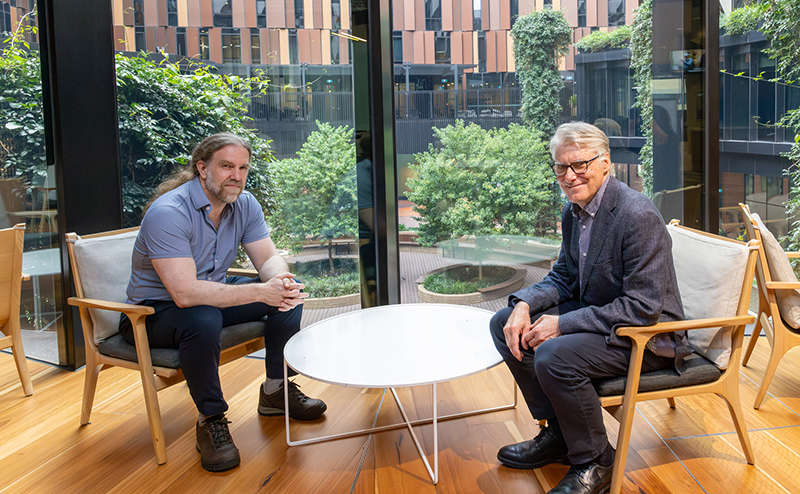
This project builds on years of collaboration. When we first met in 2007, we bonded over the idea that randomness might play a key role in immune cell behaviour.
At the time, I was developing a model to explain differences between cells as the result of random processes. Ken’s expertise in probability theory made him the perfect partner.
Together, we’ve analysed experimental data and refined our understanding of immune cell fate. One of our key findings was that cell division, death and differentiation occur independently but are all influenced by random factors. This insight became a foundation for our current methods.
My lab developed the original Cell Timer (Cyton) model before I met Ken, but the current version, Cyton2, was shaped through our collaboration.
That work, lead by our PhD student HoChan Cheon, is now central to our efforts at the Snow Centre.
“What excites me most is the potential to explain how complex immune disorders arise consistently across the population. It’s a bold step toward our long-term goal: being able to predict an individual’s immune journey to guide diagnosis and treatments.”
Using the cell timer model, we’re gathering detailed data on B and T cell behaviour to simulate immune trait inheritance and assess the genetic propensity to developing an immune disorder.
We’re layering this with DNA sequencing and AI tools to link genetic differences to immune cell behaviour. If successful, we’ll compare gene testing with functional cell-based tests – an essential step toward better diagnosis and treatment.
If I had to name one achievement from our partnership, it’s that we’ve uncovered rules for immune cell control that are fundamental to how the immune system works.
Our shared vision is to use these rules to make immunology predictive – much like physics. And with Ken’s expertise, we’re well on our way!