




I haven’t had health insurance for seven years.
It’s largely a financial decision and not one I feel great about. But it’s the reality I manage. I avoid risky behavior, manage my weight and blood pressure as best I can, and pray that I don’t wake up deathly ill.
Sadly, the same is true for millions of Americans.
Even for those with coverage, the system often feels like a labyrinth, which takes you months to get a 15-minute appointment with the right specialist. You wait months for an unexpectedly high bill to arrive, which sucks you back into the labyrinth, arguing with their billing specialists and wondering why this routine visit costs more than your monthly rent.
Then, in your one moment of need, when a doctor advises a necessary procedure, your provider comes up with evasive reasons to avoid covering it.
You’ve already heard the horror stories.
Monthly premiums for adequate coverage are simply out of reach for most. So perhaps we shouldn’t be surprised people are turning to collagen powders, ice plunges, and adaptogens. Perhaps it is less about people being gullible to social media schemes, and more them looking for affordable ways to manage their health.
What’s morbidly fascinating is that—we live in one of the least healthy developed nations, yet people spend incredible sums of time and money trying to be healthy.
Here’s why and how we got here.
The macro view
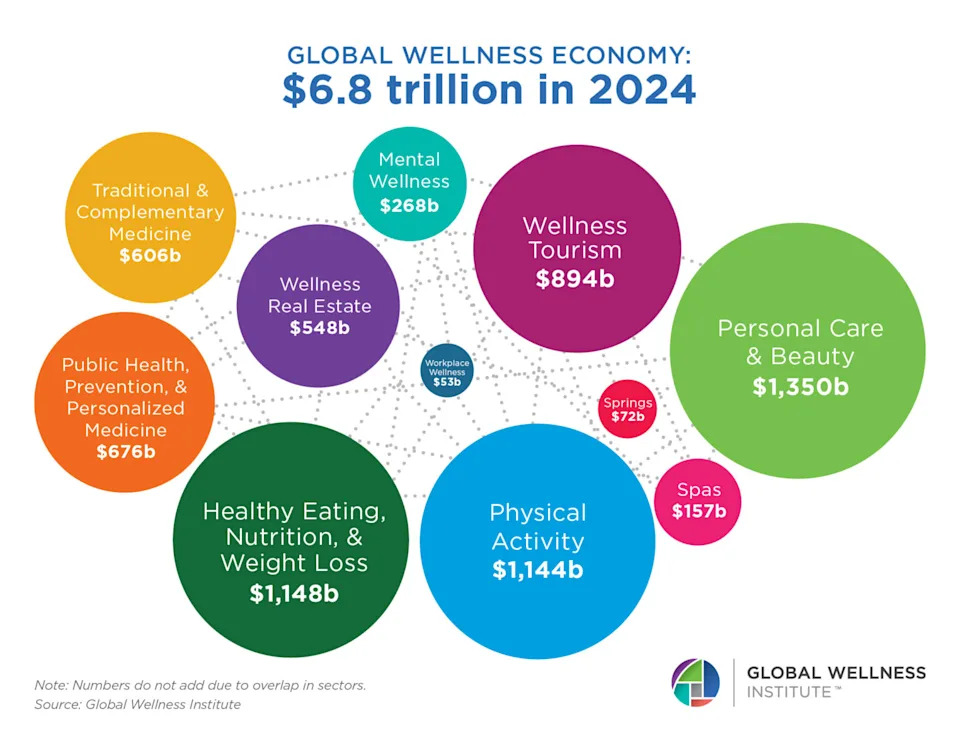
The global wellness industry is now worth $6.8 trillion per a 2025 report by the Global Wellness Institute.
Nearly one third of Americans lack adequate access to primary care and around 40% of adults say they’ve skipped or delayed their doctor’s visits out of concerns about the costs.
If there’s any silver lining, it’s that this booming wellness industry is helping some patients fulfill needs the traditional healthcare system can’t provide.
One of my ghostwriting clients owned a health and wellness center just outside of New York City. Their target clientele were high flying white collar workers. Many of them had just retired, were thinking about doing so, or were young people who made a change. These clients were often burnt out from the many years of grinding and the toll it took on their mind and body.
The wellness center featured many alternative medicine practices—meditation, tai chi, acupuncture, breathwork—and other esoteric treatments that would make a few of you scoff in disbelief.
Yet these services still provide prevention-related care that helped with their quality of life.
The other reality
The unfortunate irony is that the traditional healthcare people pay for often leaves them bitter and resentful towards the system. Research has found that the most common source of dissatisfaction for patients isn’t their health outcomes, but the breakdown in trust, communication, and empathy from their healthcare providers.
People often pursue these wellness options, like the aforementioned center, because they provide a humanistic element they see missing. It becomes a source of community and place where people can feel heard and understood. They can pursue preventative practices and reduce their stress and, sometimes, their pain.
Dealing with this status quo
The influence of this industry is increasingly powerful, with a wellness influencer, Casey Means, nearly becoming our Surgeon General. This isn’t to make an indictment or political point—but more to illustrate how deeply wellness culture is now embedded in American society.
In Amy Larocca’s book How to be Well: Navigating Our Self-Care Epidemic, One Dubious Cure at a Time, she argues that America has elevated good health from being a basic human right, to being a luxury commodity. And those who can’t afford this commodity face uncertain options.
Not everyone has money to pay for access to saunas and ice plunges, meditation retreats, or customized supplements and gym memberships that can run in the thousands of dollars per year.
Yet there is still a low enough entry point for many people to buy wellness products that may or may not be helpful.
For example, “moon dust” jars are often sold for just under $40. They aren’t actual moon dust, but instead contain a blend of ingredients such as ashwagandha, rhodiola, reishi, and schisandra (actual moon dust is quite toxic). These adaptogenic supplements might be helpful—and certainly use ingredients associated with the reduction of stress and inflammation. But they are heavily hyped on social media as doing much more—and are consequently, quite overpriced.
Wellness culture, at its core, appears to fill a genuine void. It gives people agency and the ability to navigate an environment that leaves them feeling powerless.
Would it be good for millions of Americans to be self-medicating with functional mushroom powders? I can’t say.
What’s clear is that, within this wellness boom, your mileage may vary.
Some of it works. Some is nonsense. And much of it is probably somewhere in between. Most of us are just trying to get by in a healthcare system that is financially punishing, emotionally exhausting, and difficult to trust.
Just tread carefully in how you spend your money and where you get health advice.
In the words of Bishop from the incomparable space horror film Alien, “I can’t lie to you about your chances…but you have my sympathy.”