




Global Wellness Institute releases new data on a sector experiencing explosive 23.5% annual growth since 2019. GWI also unveils new case studies series on groundbreaking real estate projects in Saudi Arabia and the UAE—two of the world’s fastest growing markets
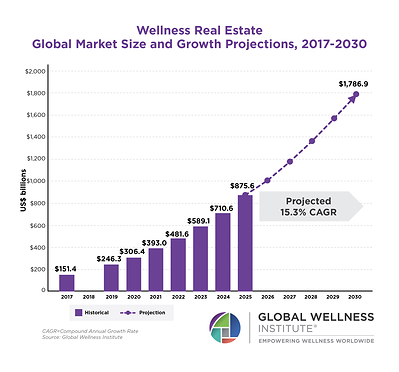
MIAMI, May 12, 2026 /PRNewswire/ — The non-profit Global Wellness Institute (GWI), the leading research organization for the global wellness industry, today unveiled new data on the wellness real estate market, revealing it remains by far the fastest growing wellness sector. After expanding from $151 billion in 2017 to $876 billion in 2025, it is projected to more than double to $1.8 trillion by 2030. The US ($254B), China ($218B) and the UK ($51B) are the three largest national markets, while Italy, Spain and Saudi Arabia saw the biggest annual growth gains from 2019 to 2025, at 50%, 46% and 34% respectively. The numbers released today are a data preview of the full update on the market in the 2026 Wellness Economy Monitor to be released this November at the Global Wellness Summit in Phuket, Thailand.
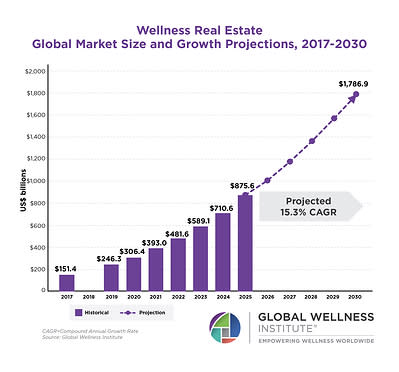 Wellness Real Estate’s Unstoppable Growth
The GWI also unveiled Build Well to Live Well: Case Studies, Volume 2, an in-depth look at pioneering projects in Saudi Arabia and the United Arab Emirates, two countries seeing incredible wellness real estate growth. Saudi Arabia’s market grew 85% annually from 2017 to 2025 (the highest rate in the world), while the UAE’s market experienced 21% growth per year over the same period. The case studies reveal a unique market, defined by audacious, large-scale projects, along with powerful commitments to sustainability, community wellbeing and local heritage.
The research was presented today at the Global Wellness Summit’s Wellness Real Estate & Communities Symposium in New York City.
Graphs and photos are HERE.
I) Wellness Real Estate’s Unstoppable Growth:
Market size, 2017-2030
2017: $151 billion
2019: $246 billion
2024: $711 billion
2025: $876 billion
Projected 2030: $1.8 trillion
GWI defines wellness real estate as “built environments proactively designed, built and operated to support the holistic health of occupants, visitors and the community.” Every year since the GWI first quantified the market in 2013, it has been the undisputed growth star in the 11-sector wellness economy. Its 23.6% average annual growth from 2019 to 2025 is roughly double that of the next fastest-growing wellness market, mental wellness, at 12.4%. The market is forecast to top $1 trillion for the first time in 2027 and will expand, on average, 15% yearly from 2025 to 2030, when it will reach $1.8 trillion. A little perspective: from 2024 to 2025, wellness real estate grew 23% while overall global construction only grew 3%.
The Regional Picture (2019–2025):
2019
2024
2025
Annual Growth
Asia-Pacific
$88B
$278B
$350B
25.8 %
North America
$100B
$240B
$274B
18.3 %
Europe
$48B
$152.5B
$205B
27.3 %
Middle East–N. Africa
$8.7B
$36.6B
$42.6B
30.3 %
Latin America-Caribbean
$600M
$2.8B
$3.7B
36.4 %
Sub-Saharan Africa
$200M
$400M
$500M
13.2 %
Asia-Pacific is the largest regional market ($350B), followed by North America ($274B) and Europe ($205B). Together, these regions make up over 95% of the market. Every region has seen strong growth from 2019 to 2025, with the largest percentage gains in Latin America-Caribbean and Middle East-North Africa.
Top 15 National Markets:
Market Size 2025
Annual growth 2019-2025
United States
$254B
18 %
China
$218B
30.5 %
United Kingdom
$51B
29.5 %
Australia
$38B
16 %
France
$35B
24.2 %
Japan
$34B
20.2 %
Germany
$29B
22.1 %
Saudi Arabia
$28B
33.9 %
Spain
$22B
46.1 %
Italy
$21B
50.2 %
India
$20.5B
26.5 %
Canada
$20B
22.2 %
South Korea
$16.5B
19.5 %
UAE
$15B
25.1 %
Netherlands
$13B
29.1 %
The US and China are by far the largest wellness real estate markets. And it’s hard to single out “growth stars” given that every one of the top 20 markets experienced at least 15% annual growth since 2019. The leaders among the top 20 markets are: Italy (50% annual growth), Spain (46%), Saudi Arabia (34%), China (30.5%) and Singapore (29%).
II) Case Studies, UAE and Saudi Arabia: Extraordinary Growth and Scale
The GWI’s first case studies report detailed standout projects in the US and UK. The new report analyzes eight important wellness real estate projects across Saudi Arabia and the United Arab Emirates. It reveals a distinct market, defined by incredible growth and ambitious, large-scale projects—all fueled by massive government investment. Saudi Arabia’s market exploded from $200 million in 2017 to $28 billion in 2025, while the UAE’s skyrocketed from $3.3 billion to $14.6 billion. For both countries, wellness real estate now represents over 12% of all construction and the two countries have over 555,000 wellness-focused residential units in the pipeline. Many projects are huge by global standards: from 1,500 to over 150,000 residences.
As GWI senior research fellows, Katherine Johnson and Ophelia Yeung, observed: “These exemplary projects show how wellness real estate can be created at scale, while putting sustainability, placemaking and inclusivity at the center of their design, construction and operation. The wellness benefits to their communities will be vast.”
The report is packed with info. It details each project’s “distinctive approaches to wellness” and how it addresses GWI’s six dimensions of wellness real estate: physical, mental & spiritual, social, civic and community, environmental, and economic and financial. It identifies 10 key takeaways for global developers, from how sustainability is increasingly becoming a burning priority and more holistic concept, to how powerful demographic shifts are creating new markets, from co-housing to senior living. It also spotlights dozens of other noteworthy and future projects across the countries.
Download the free report HERE.
The Projects:
AMAALA Triple Bay, Red Sea Region, Saudi Arabia
The world’s largest (over 100-million-acre) master-planned wellness tourism destination, with nine wellness resorts (1,500 keys) and 160 for-sale residences.
Takeaway: National priorities and government mandates are driving the development of a healthy and sustainable built environment.
Sports Boulevard, Riyadh, Saudi Arabia
The world’s largest linear park (84 miles long) and urban regeneration project, creating over 990 acres of new green/public spaces and more than 50 sports facilities, with 32.3 million square feet of new, mixed-use private development.
Takeaway: Wellness real estate is a response to—and a correction of—past “unwell” development.
The Sustainable City Yas Island, Abu Dhabi, UAE
New master-planned, mixed-use, 99-acre community, with 865 condos and townhomes and 32,300 square feet of retail/F&B space.
Takeaway: Sustainability is a top priority and has become more holistic.
Expo City Dubai, Dubai, UAE
Master-planned, mixed-use and wellness-focused “city of the future”: the 865-acre adaptive reuse project has 74 acres of open space and will serve 35,000 residents and 40,000 workers.
Takeaway: Nature, culture and heritage are important assets in wellness real estate and help ground it in a sense of place.
Aldar Square Hdq., Yas Island, Abu Dhabi, UAE
The headquarters office of the UAE’s leading real estate developer/manager, located in converted retail spaces: 200,000 square feet in a three-story building with 1,052 workstations.
Takeaway: Wellness real estate should create welcoming, inclusive and accessible spaces for all.
Red Sea Global Hdq., Riyadh, Saudi Arabia
Headquarters of the pioneering Saudi multi-project developer: 226,000 square feet on three floors in a 43-story building that serves 1,600 employees.
Takeaway: Developers of wellness real estate should also take pride in caring for the wellbeing of their employees.
Ghaf Woods, Dubailand, Dubai, UAE
New master-planned, mixed-use, 182-acre “forest living” community, with an 18.7-acre forest and 5,000 mid/high-rise apartments, retail/F&B/entertainment spaces and a mall.
Takeaway: Driven by strong demand, wellness real estate can be a market differentiator and a profit driver.
Misk City & Schools, Riyadh, Saudi Arabia
The preK-12 school is the first asset open in a new master-planned, mixed-use, 791-acre urban district, with 40% preserved open space, 7,500 residential units, two schools, 1.1 million square feet of retail/F&B/leisure space and 3.2 million square feet of commercial space.
Takeaway: Demographic changes will open new markets and opportunities for wellness real estate in the future.
About the Global Wellness Institute: The Global Wellness Institute (GWI), a nonprofit 501(c)(3), is considered the leading global research and educational resource for the global wellness industry and is known for introducing major industry initiatives and regional events that bring together leaders to chart the future. GWI positively impacts global health and wellness by educating public institutions, businesses and individuals on how they can work to prevent disease, reduce stress and enhance overall quality of life. Its mission is to empower wellness worldwide.
 Global Wellness Institute Cision
View original content to download multimedia:https://www.prnewswire.com/news-releases/wellness-real-estate-market-reaches-876-billionforecast-to-hit-1-8-trillion-by-2030–302768982.html