



image:
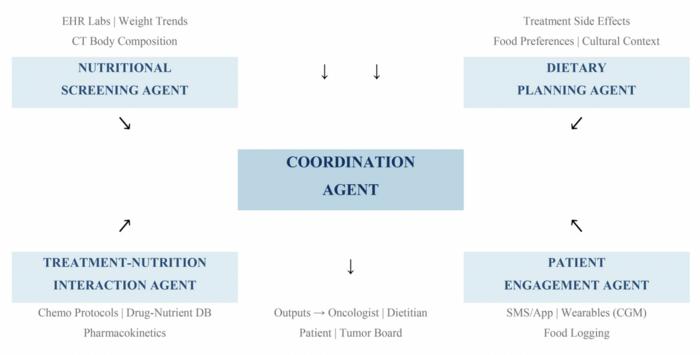
Figure 1: Proposed multi-agent architecture for agentic nutritional oncology. The Coordination Agent orchestrates four specialized agents, each drawing on distinct data sources, with graduated human oversight governing the autonomy of clinical actions.
Credit: Copyright: © 2026 Sarkar and Singh-Wolkenhauer. This is an
open access article distributed under the terms of the Creative
Commons Attribution License (CC BY 4.0), which permits
unrestricted use, distribution, and reproduction in any medium,
provided the original author and source are credited.
“Cancer-related malnutrition affects up to 80% of patients and contributes to 10 to 20% of cancer deaths.”
BUFFALO, NY – May 11, 2026 – A new editorial was published in Volume 17 of Oncotarget on May 4, 2026, titled “Artificial intelligence in nutritional oncology: From isolated screening tools to agentic intervention systems.”
The editorial was authored by first author Arnab Sarkar and corresponding author Yashbir Singh-Wolkenhauer, who is affiliated with the Mayo Clinic Department of Radiology. In this editorial, the authors examine how emerging forms of artificial intelligence may help address one of oncology’s most persistent yet underrecognized challenges: cancer-related malnutrition. Although nutritional complications affect a large proportion of cancer patients and are associated with poorer treatment tolerance, prolonged hospitalizations, and reduced survival, access to specialized nutritional care remains severely limited in many healthcare settings.
The article focuses on the growing role of “agentic AI,” a new class of autonomous AI systems capable of reasoning across complex clinical information, using external tools, maintaining memory, and adapting to changing patient conditions over time. Unlike conventional AI tools that perform isolated tasks such as malnutrition screening or dietary counseling, agentic AI systems are designed to coordinate multiple functions simultaneously and support ongoing clinical decision-making throughout a patient’s treatment course.
“Where a conventional model answers the question “Is this patient malnourished?”, an agentic system pursues the goal ‘Optimize this patient’s nutritional status throughout their treatment course,’ autonomously decomposing that objective into sensing, reasoning, and acting steps.”
The authors outline a proposed multi-agent framework for nutritional oncology that includes specialized AI agents responsible for nutritional screening, dietary planning, treatment-nutrition interaction monitoring, and patient engagement. These agents would operate together under a centralized coordination system capable of integrating laboratory data, imaging findings, treatment-related side effects, food preferences, wearable device data, and electronic health records in real time. The proposed architecture is illustrated in Figure 1 of the paper (page 2), which depicts how multiple AI agents could coordinate patient-centered nutritional support across oncology workflows.
Importantly, the editorial emphasizes that clinical oversight remains essential. The authors propose a graduated autonomy model in which lower-risk functions, such as recipe recommendations or symptom-triggered dietary advice, may operate with minimal supervision, while higher-risk decisions involving enteral or parenteral nutrition would continue to require direct clinician authorization.
The article also highlights several major barriers that must be addressed before widespread clinical implementation becomes possible. These include AI hallucination risk, regulatory uncertainty, privacy concerns involving integrated patient data, and the potential for algorithmic bias when systems are trained predominantly on Western dietary and clinical datasets. The authors further note that no randomized controlled trials have yet evaluated AI-driven nutritional interventions against major oncologic outcomes such as survival or treatment completion.
Overall, the editorial presents agentic AI as a potentially important next step in supportive cancer care. By integrating nutritional assessment, personalized dietary planning, and longitudinal patient monitoring into coordinated AI-driven systems, these technologies may help close longstanding gaps in oncology nutrition services while supporting more individualized and responsive patient care.
DOI: https://doi.org/10.18632/oncotarget.28874
Correspondence to: Yashbir Singh-Wolkenhauer – singh.yashbir@mayo.edu
Keywords: artificial intelligence, cancer
Click here to sign up for free Altmetric alerts about this article.
________
To learn more about Oncotarget, visit Oncotarget.com and connect with us on social media:
X
Facebook
YouTube
Instagram
LinkedIn
Pinterest
Spotify, and available wherever you listen to podcasts
Click here to subscribe to Oncotarget publication updates.
For media inquiries, please contact media@impactjournals.com.
Method of Research
Commentary/editorial
Subject of Research
Not applicable
Article Title
Artificial intelligence in nutritional oncology: From isolated screening tools to agentic intervention systems
Article Publication Date
4-May-2026
COI Statement
Authors have no conflicts of interest to declare.
Disclaimer: AAAS and EurekAlert! are not responsible for the accuracy of news releases posted to EurekAlert! by contributing institutions or for the use of any information through the EurekAlert system.