




Price: A Significant Difference
The $99 Fitbit Air is more affordable than the Oura Ring 4 ($349 for the base titanium model). The Oura Ring 4 comes with one free month of membership, while the Fitbit Air gives you three months included.
With Oura, you essentially need to sign up for a membership, which costs $69.99 per year, to access most of your data in the app (available for Android and iOS). With the Fitbit Air, you can use the free version of the Google Health app (available for Android and iOS) to check all of your stats, and even get your Daily Readiness Score, indicating how hard to push yourself each day. The premium version of Google Health costs $99.99 per year and gives you access to a Gemini AI-powered wellness coach, along with guided workouts and mindfulness sessions. You’d have to keep both devices for more than eight years to spend less in total on the Oura Ring; otherwise, the Air is cheaper.

Additional Fitbit Air bands start at $34.99 (Credit: Andrew Gebhart)
Ceramic versions of the Oura Ring cost more than the titanium model at $399. I haven’t tested it yet, but the upcoming Oura Ring 5 starts at $399, with premium colors priced at $499. The Fitbit Air has additional bands that you can switch the sensor between to change up your look. These bands start at $34.99.
Winner: Fitbit Air
Design: Minimal Tech, Maximum Personal Style
Both the Fitbit Air and the Oura Ring 4 are well-designed options in their respective categories. The Fitbit Air sensor measures 1.4 by 0.7 by 0.3 inches (LWD) and is water-resistant to 164 feet. The Oura Ring 4 measures 0.31 inches wide and 0.11 inches thick, and it’s available in sizes 5 through 15; a sizing kit is included with your order. The Oura Ring 5 is even thinner, measuring 0.24 inches wide by 0.09 inches thick.
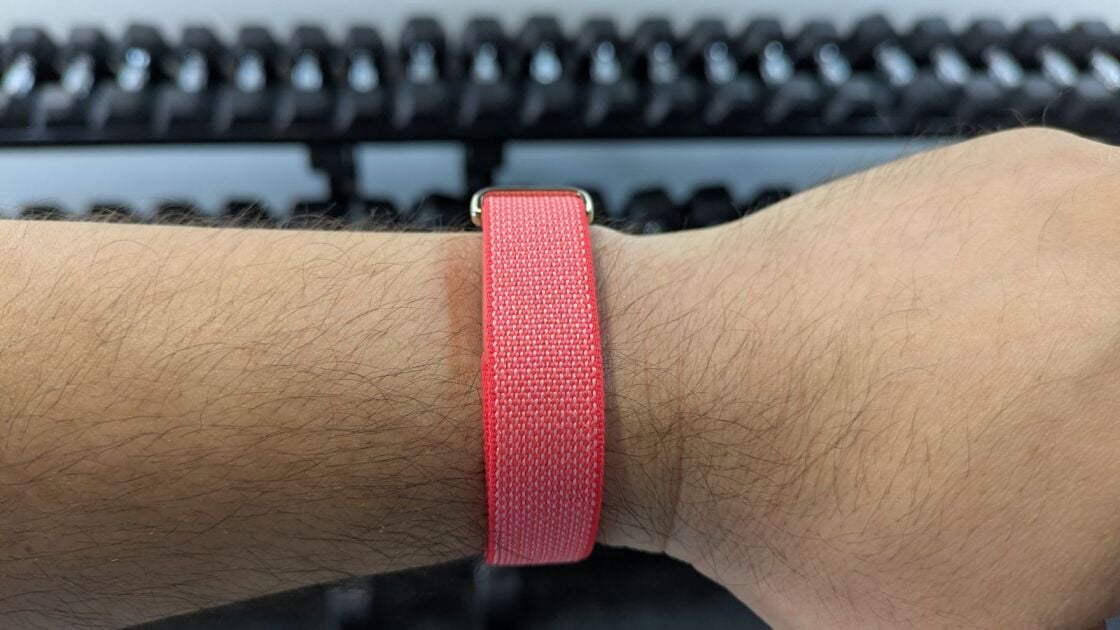
The Fitbit Air comes in multiple color options, including Berry (red), Fog (silver), Lavender (purple), or Obsidian (black). The default band is a durable cloth called the Performance Loop. Optional accessory straps for the Air include the rugged plastic Active Band and the more stylish plastic Elevated Modern Band.
The Oura Ring has style and color choices as well. You can get the titanium version in black, brushed silver, gold, rose gold, silver, or Stealth (dark gray). The ceramic version comes in Cloud (off-white), Midnight (metallic black), Petal (blush pink), or Tide (pastel blue-green).
With the Fitbit Air, you can switch styles, as the sensor easily pops in and out of different bands. Once you settle on your Oura Ring of choice, you’re set on that color and style without buying an entirely new ring.
I found both devices quite comfortable during testing, though the Fitbit Air is so light that I regularly forgot I was wearing it. I also preferred the feel of the Fitbit Air while at the gym, as it never got in my way. I would occasionally shift the Oura for comfort when lifting weights.

The Oura Ring 4 looks like ordinary jewelry (Credit: Andrew Gebhart)
On the other hand, the Oura Ring 4 certainly looks fancier. The Fitbit Air isn’t entirely utilitarian—it doesn’t detract from a nice outfit —but the Oura Ring 4 looks like jewelry. It adds a bit of elegance to a dressed-up look.
The winner of this category is mostly a matter of personal preference. The Fitbit Air has a slight edge in flexibility and utility, as you can switch bands and forget you’re wearing it. The Oura has the edge in style.
Winner: Tie
Sensors and Features: Raw Data vs. AI-Driven Guidance
Despite looking like jewelry, the Oura Ring 4 packs a lot of advanced tech under the surface, including red and green infrared LEDs to measure blood oxygen saturation (SpO2), heart rate, heart rate variability, and respiratory rate, plus skin temperature sensors and an accelerometer. It can track 40 different types of exercises, your movement throughout the day, sleep duration and stages, and stress levels.
The Fitbit Air is similarly equipped to track activity, exercise, sleep, and stress. It uses an optical heart rate monitor, a three-axis accelerometer, a gyroscope, a temperature sensor, and red and infrared sensors for health tracking. It monitors heart rate, movement, and SpO2, and can detect atrial fibrillation (AFib, an irregular heartbeat). The Air also has a wide range of trackable activities and exercises in its repertoire. With Google Health Premium, you can import the data from other services like Peloton, or even just snap a picture of the daily workout on a gym whiteboard and let the AI parse the details.

Both devices track activity, exercise, sleep, and stress (Credit: Andrew Gebhart)
Oura encapsulates all data into three scores. The Activity and Sleep scores are self-explanatory, and a Readiness score encompasses the rest of your data on a scale from one to 100 to let you know whether you’re prepared for activity or in need of rest. Over time, Oura also measures your cardio capacity, cardiovascular age, and sleep regularity.
Fitbit also scores your Readiness and Sleep, and offers a metric called Cardio Load that reflects weekly strain on your cardiovascular system and provides a broad exercise goal. While the Fitbit Air doesn’t have the same long-term metrics as Oura, its AI-powered Health Coach is particularly impressive. With a chat-based interface, it structures a fitness plan for you based on your schedule and goals, and is highly responsive to specific requests and schedule changes.
Winner: Fitbit Air
Battery Life: A Rare Near-Draw in Real-World Use
You can wear both the Oura Ring 4 and the Fitbit Air for days at a time without taking them off to charge, allowing them to collect holistic health data as you go about your day and sleep at night. The Oura Ring 4 powered through just over seven days in my battery rundown test, while the Fitbit Air lasted eight days. That said, the Oura Ring 5 could have the edge here, with an estimated nine days of power on a charge, but I’ll have to verify that when I test it, so stay tuned for my full review.
Winner: To be determined
Recommended by Our Editors
Exercise Tracking: Fitbit Pulls Ahead on Workout Detail
Neither the Fitbit Air nor the Oura Ring 4 offers as much convenience as a wrist-based device with a screen for tracking workouts. Part of the difference is obvious—a screen allows you to check your stats on the fly without pulling out your phone. But also, categorically, screenless trackers typically capture fewer workout details than GPS-equipped smartwatches.
During outdoor running, for instance, the Oura Ring and Fitbit Air directly measure heart rate, calories, and time, and use your phone’s GPS to track distance and pace. Neither one tracks advanced running form metrics like cadence and stride length, which have become table stakes for modern smartwatches.
Despite their limitations, both accurately track heart rate, according to my testing. The Oura Ring 4 shows less detail than the Fitbit Air, offering information on heart rate zones, but not specific numbers. The Fitbit Air shows specific beats per minute (bpm), and those values proved precise in testing, accurately reflecting the varied intensities of interval training sessions.
Winner: Fitbit Air
Sleep Tracking: Oura Turns Overnight Data Into a Cleaner Story
The Oura Ring 4 is a particularly skilled sleep tracker. It monitors sleep duration, efficiency, latency, restfulness, stages, and timing, as well as health metrics such as average heart rate variability, breathing regularity, resting heart rate, and SpO2. It makes all your overnight metrics easy to review, offers a sleep score to quickly gauge the quality of your rest, and provides advice to improve it.

The Oura app shows clear and helpful sleep data (Credit: Oura/PCMag)
The Fitbit Air is no slouch on this front, either. It measures your sleep duration, quality, and heart rate. It also gives you a sleep score and shows contributing factors such as time to sound sleep, total sleep time, restlessness, interruptions, and time fully awake. The AI-powered health coach is more conversational with its sleeping advice than Oura’s app, but Oura provides more detailed metrics.
I also prefer the way Oura lays out its sleep information, as it puts stats and charts front and center, and makes all of its data easy to understand at a glance. The Google Health app combines data with prescriptive advice, which is fine, but it can take some fiddling to find a specific piece of information.
Winner: Oura Ring 4