




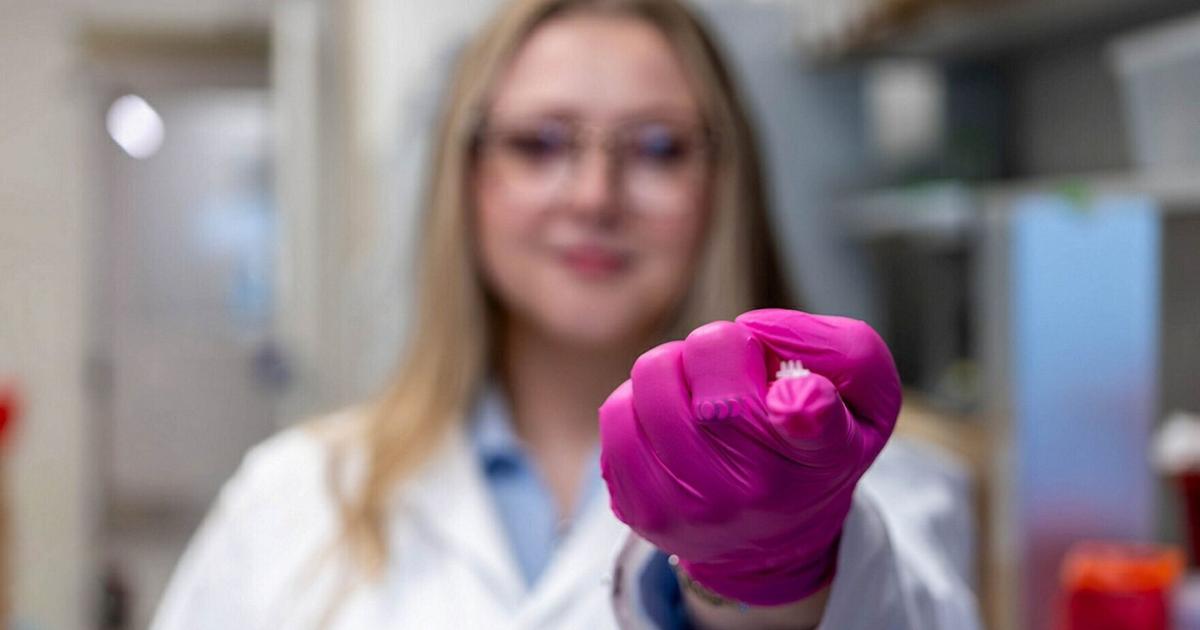

Elizabeth Kelley holding a cytokine-secreting patch. (Jared Jones / Rice University via SWNS)
By Stephen Beech
A new “living bandage” accelerates the healing of wounds, according to new research.
The high-tech patch delivers healing proteins from engineered cells in a mini “factory” around the clock to different types of injury, say American scientists.
Chronic wounds remain a significant clinical challenge, partly because it is difficult to deliver sustained, localized immune signals that coordinate tissue repair.
While small proteins that act as chemical messengers in the body, called cytokines, play a key role in regulating inflammation and healing, doctors say conventional delivery approaches are often limited by rapid degradation and poor retention at the wound site.
Now, researchers at Rice University in Texas have developed a cytokine factory patch designed to address the challenge by continuously producing and delivering therapeutic cytokines directly within the area of the wound.
The team explained that the cytokine factory patch is a cell-based delivery platform that uses encapsulated, engineered cells as on-site “factories” to secrete cytokines, signaling proteins that regulate immune activity and tissue regeneration, over extended periods of time.

Christian Schreib and Elizabeth Kelley. (Jared Jones/Rice University via SWNS)
By Talker
By localizing cytokine production at the wound site, they say the system is designed to maintain therapeutic levels of the molecules where they are needed most.
The device, developed in the laboratory of Omid Veiseh, encapsulates ARPE-19 cells engineered to secrete specific cytokines, including IL-10, IL-12 and Transforming Growth Factor-beta (TGF-β).
The cells are housed within a biocompatible matrix that allows nutrients and therapeutic proteins to pass through while shielding the cells from the host immune system.
The findings of preclinical studies, published in the journal Nature Biomedical Engineering, showed delivery of cytokines using the patch supported accelerated wound healing in both rodent and pig wound models.
Veiseh says the animal trials showed the potential of sustained, localized immunomodulation to enhance natural repair processes.
He said: “The findings show how continuous, localized cytokine delivery can support key biological pathways involved in tissue repair.
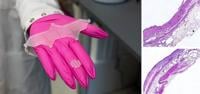
Wound-healing patches can vary in size and present indentations housing cytokine-secreting cells (right). In preclinical studies, delivery of cytokines using the patch supported accelerated wound healing: histology image show healed healthy skin (top left) vs. wounded skin (bottom left). (Jared Jones / Rice University / Veiseh lab via SWNS)
By Talker
“By maintaining a consistent presence of these signaling molecules at the wound site, we can more effectively engage the body’s natural healing response.”
At the cellular level, the engineered cells showed activation of key wound-healing pathways, which was validated through RNA sequencing.
Veiseh, faculty director of the Rice Biotech Launch Pad, said: “Analysis revealed coordinated upregulation of genes associated with tissue regeneration and immune modulation, providing a mechanistic basis for the functional improvements observed.
“The platform is designed to be modular, allowing the engineered cells to be adapted to produce different combinations of cytokines, growth factors or other therapeutic proteins depending on the clinical application.”
He says the system also incorporates an optimized hydrogel matrix that supports integration with the wound environment and may be further adapted to work alongside bioelectronic components.
Study co-author Christian Schreib said: “The ability to tune both the type and timing of cytokine delivery opens the door to more precise control over the healing process.”
He added: “Future work will focus on expanding the flexibility of the platform, including approaches such as optogenetic control to regulate cytokine secretion in real time.”
The researchers say the cytokine factory approach could in future be expanded beyond wound healing to tackle diseases where treatment needs to be delivered to a specific site on the body.