




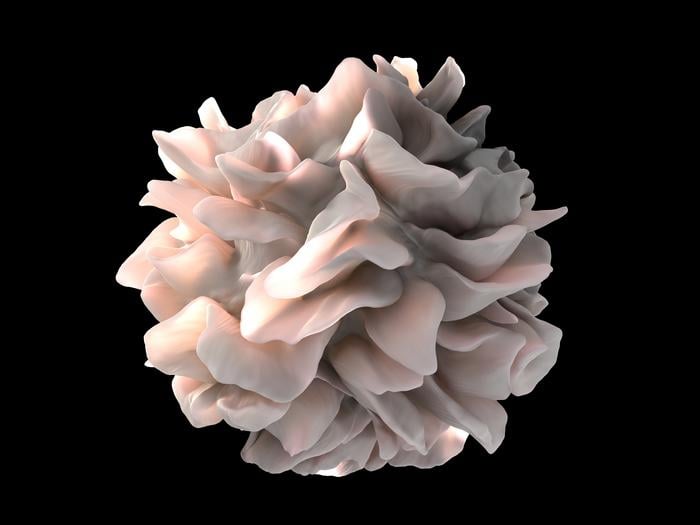
Inside a growing tumour, a dendritic cell is doing the most thankless job in the immune system. It grabs a scrap of the tumour, a telltale fragment, and carries it off to show the body’s killer T cells exactly what to attack. But it is working in hostile country. The tumour hoards nutrients, starves its neighbours, and the dendritic cell, running low on fuel, starts to flag. And a flagging dendritic cell raises a weak alarm.
What if you could keep that cell’s batteries charged? Researchers at UCLA think they have found a way, and it involves something startlingly mundane: creatine, the same white powder that athletes and bodybuilders have been scooping into their shakes for decades.
The study, published in April in iScience, builds on earlier work from the same lab showing creatine powers the killer T cells themselves. This time the team went looking one step upstream, at the cells that give those killers their orders. They started by reading which metabolic genes were busiest in dendritic cells that had pushed their way into mouse tumours. One stood out. The gene encoding the creatine transporter, the little protein that hauls creatine into a cell, was running far hotter inside tumours than in healthy tissue. The cells, it seemed, were already reaching for the stuff.
So the team took the transporter away. Dendritic cells engineered to lack it survived poorly, activated weakly, and made a feeble case to the T cells they were supposed to recruit.
Then they did the opposite. They gave mice with melanoma a daily dose of creatine, and the tumours grew more slowly. The treated animals had more of the potent antigen-presenting cells crowding into their tumours, and those cells were buzzing, churning out chemical signals that pull yet more immune reinforcements into the fight.
A battery for the immune system
Why should a muscle-building supplement do any of this? The answer is that creatine is, in a sense, a rechargeable battery. Inside the cell it shuttles high-energy phosphate back and forth, soaking up spare energy and releasing it on demand, keeping levels of ATP, the molecular currency that powers nearly everything a cell does, steady even when the surroundings turn lean. The metabolomics bore this out: creatine-fed dendritic cells held onto more ATP and kept their inflammatory machinery humming. Take the transporter away and that energy buffer collapses, and with it the signalling that tells a dendritic cell to switch on.
“Immunotherapy has shown remarkable promise, but it only works for a subset of patients,” says Lili Yang, the study’s senior author and a professor of microbiology, immunology and molecular genetics at UCLA. Most approved immunotherapies aim squarely at the killer T cells at the end of the chain, yet only roughly 20 to 40 per cent of patients respond. The thinking here is to support the whole apparatus instead, the cells that spot the threat and set everything in motion, not just the soldiers who finish the job.
“Understanding how to metabolically support dendritic cells is about supporting the entire anti-tumor response, not just the killer T cells at the end of it,” says Elliot Kang, a co-first author who worked on the study as an undergraduate in Yang’s lab.
From the gym to the clinic, maybe
The effect was not confined to mice. When the researchers treated human dendritic cells, the kind grown from blood and used to build dendritic cell cancer vaccines, creatine sharpened them up too, improving their ability to rouse human T cells against a cancer target. That hints at two rather different uses. “The potential we see here is that creatine could be used in two complementary ways: as a supplement to enhance the immune response of patients already receiving immunotherapy, and as a tool to improve the quality of dendritic cell-based vaccines before they’re administered,” says James Elsten-Brown, a co-first author and graduate student in the lab.
A note of caution, and the researchers are firm about it. This was done in cells and mice, not people. Nobody should be reading it as a reason to start dosing themselves mid-treatment, and anyone on cancer therapy should talk to their doctor before adding any supplement at all. There is a further wrinkle worth keeping in view: creatine is a ubiquitous energy metabolite, and a handful of studies suggest tumour cells can hijack it too, using it to fuel their own spread. The full picture, across immune cells and malignant ones alike, is not yet settled.
Still, creatine is cheap, and after decades of use in gym bags its safety profile is about as well documented as any supplement going. The team now hopes to work with physicians on trials that would test whether it actually helps patients on immunotherapy. The humble scoop of powder has had a long career building biceps. Its second act, it seems, might be fought somewhere far less visible, in the starved interior of a tumour, one tired immune cell at a time.
Frequently Asked Questions
How does creatine actually help fight cancer?
It does not attack tumours directly. Instead it acts as an energy buffer inside dendritic cells, the immune cells that identify a tumour and direct killer T cells to attack it. By keeping those cells supplied with ATP even in the nutrient-starved environment of a tumour, creatine helps them stay active and raise a stronger alarm, which in turn mounts a more aggressive T cell response.
Should people with cancer start taking creatine?
Not on the strength of this study. The work was done in cells and mice, not patients, and the researchers explicitly warn against drawing any medical conclusions from it. Anyone undergoing cancer treatment should consult their doctor before adding creatine or any other supplement, particularly since some research suggests tumour cells can also exploit creatine.
Why does immunotherapy only work for some patients?
Most approved immunotherapies target killer T cells directly, but only about 20 to 40 per cent of patients respond. One reason may be that the supporting cells that activate those T cells, including dendritic cells, are themselves worn down inside tumours. Energising that wider infrastructure, rather than the T cells alone, is the strategy this research points toward.
Could creatine improve cancer vaccines?
Possibly. Dendritic cell vaccines are made by growing a patient’s own dendritic cells in the lab, and these are the most common cells used in such platforms. Adding creatine during manufacturing boosted the activating power of human dendritic cells in the study, suggesting it might be used to make more potent vaccines, though this remains to be tested in clinical trials. You can read the full study in iScience.
Quick Note Before You Read On.
ScienceBlog.com has no paywalls, no sponsored content, and no agenda beyond getting the science right. Every story here is written to inform, not to impress an advertiser or push a point of view.
Good science journalism takes time — reading the papers, checking the claims, finding researchers who can put findings in context. We do that work because we think it matters.
If you find this site useful, consider supporting it with a donation. Even a few dollars a month helps keep the coverage independent and free for everyone.
Related