Between the quiet cuddles and coos of newborn bliss, medical staff have buzzed around brand new families administering vital, lifesaving post-natal care without question for decades.
Until now.
Across Australian maternity wards, a growing number of parents are now pushing back against a simple treatment doctors deem essential.
When babies are first delivered, they are born with naturally low levels of vitamin K, as very little crosses the placenta. Breast milk also doesn’t carry enough of it to help.
It puts infants at risk of a rare but deadly condition known as vitamin K Deficiency Bleeding (VKDB).
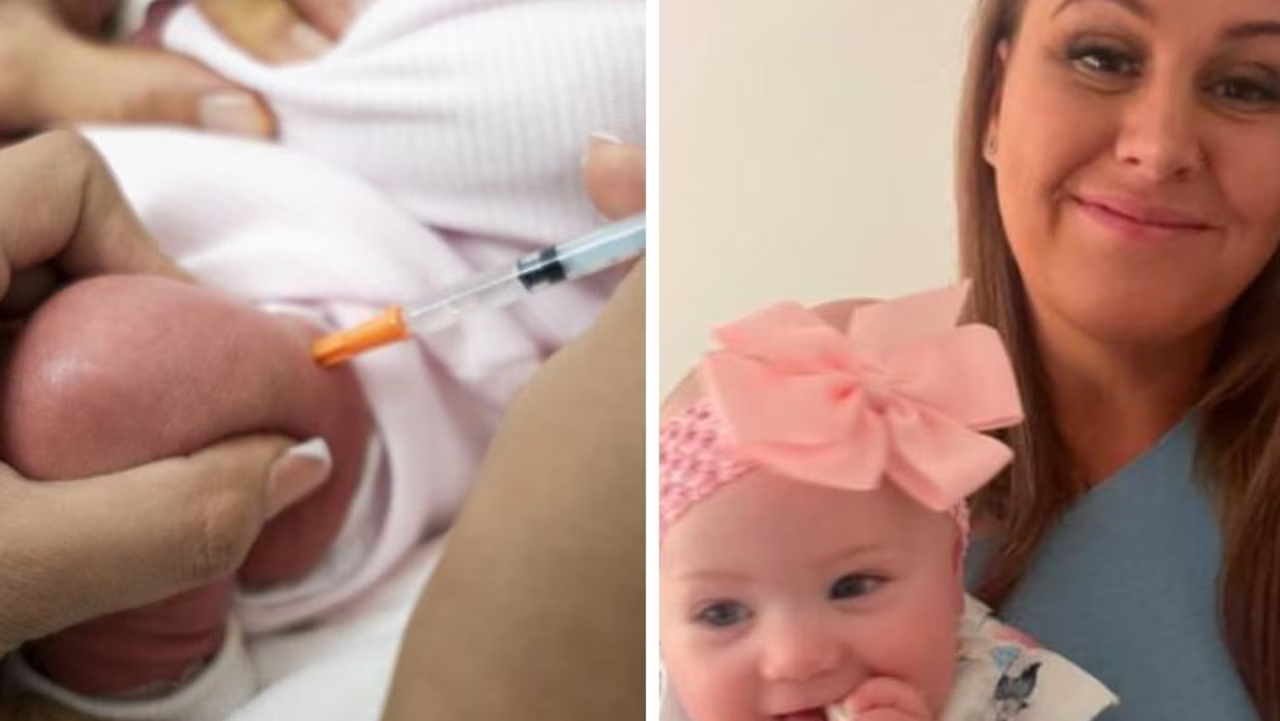
Thankfully, it is easily prevented with a routine injection of vitamin K at birth – something that has been administered to Aussie newborns since the 1960s.

The shot – which is not a vaccine – helps babies’ blood to clot properly, preventing internal bleeding which in severe cases can lead to seizures, permanent injury to the brain or tragically, even death.
The discovery and analysis of vitamin K was so groundbreaking that the scientists behind it won the 1943 Nobel prize in medicine.
Since the injection was first introduced, only one case of an allergic reaction has been reported globally, and none have ever been recorded in Australia, according to the National Health and Medical Research Council.
It’s been a standard part of newborn care for more than half a century that has rarely been questioned.
But that’s now changing.
And experts are sounding the alarm.
Grim trend sweeping Australia
Last year, 2572 babies in Queensland didn’t get the vitamin K injection, a huge increase from 2020, when just 1005 QLD babies missed out.
It’s a similar story in Tasmania, where coverage dropped from a near-perfect score of 99 per cent in 2021 down to 97 per cent in 2025, leaving 159 babies without the protective treatment last year.
New South Wales, Victoria, South Australia and Western Australia either don’t track the data or don’t have it publicly available, although health experts expect a similar pattern is occurring across the country.
For Sydney mother Nicole Arentz-Ferguson, the decision to forgo the vitamin K shot for her second baby was made after years of infertility and an 11-year age gap between her girls.
“It was actually one of the most researched decisions I had ever made,” the 37-year-old told news.com.au.
After having her firstborn when she was in her 20s, the mother followed all the standard recommendations.
But with the birth of her 17-month-old, the stakes felt higher.
“I had spent almost nine months growing and protecting her. I felt a responsibility to understand every intervention being offered after giving birth,” Ms Arentz-Ferguson explained.
“This time I just wanted to make the decisions based on my own research and understanding rather than because something was considered routine.”
She says she spent months researching and taking the information she found to doctors to understand the vitamin’s purpose, risks and benefits, and recalls feeling judged and dismissed.
“I often felt the conversations focused more on encouraging me to accept the injection rather than generally discussing my concerns or answering the questions that I had,” she said.
But once her daughter was placed into her arms, she felt “comfortable and confident” in her decision.
“I was able to decline something that basically, to me in my personal experience, is putting poison in my baby,” she said.
After refusing the heel prick examination, which is designed to check a baby’s blood for signs of rare medical issues, and the vitamin K injection, the mother was asked by the hospital to sign documentation.
“I understand hospitals have policies and legal obligations around informed refusal, but emotionally it reinforced the feeling that my decision was something that needed to be challenged rather than respected,” she recounted.
“I believe parents should be given balanced information, to be able to ask questions without feeling judged, be supported to make decisions for their own children even if these decisions differ from the standard recommendation.”
CT scan ‘showed multiple areas of bleeding’
Doctor Samuel Heitner, a Sydney pediatrician and the founder of pediatric telehealth service Telebaby, is now regularly having similar discussions with patients.
“I have noticed more parents questioning whether vitamin K is needed, and occasionally refusing it,” Dr Heitner told news.com.au.
“Often, it is not an immediate refusal. Parents may have read something online, seen concerns raised on social media, or feel worried about their newborn having an injection so soon after birth.”
And Dr Heitner has seen the implications of refusing the vitamin K jab first-hand in Sydney’s Westmead Hospital.
“Recently, while working in the emergency department, I cared for a four-week-old baby who presented following a relatively minor head injury. There was no obvious swelling, but the baby was lethargic and had vomited several times,” he recounted.
“A CT scan showed multiple areas of bleeding inside the skull. The baby had not received vitamin K after birth. Although it was not possible to say with certainty whether vitamin K deficiency contributed to the bleeding, the case made me question whether the severity of the outcome might have been reduced or prevented.”
He, along with many health experts, attributes the rise in vitamin K hesitancy to misinformation found online, from influencers to Facebook mum groups.
“A healthy pregnancy, an uncomplicated birth or a healthy-looking baby does not remove the risk,” he warned.
“Concerns raised in the past about a possible link between the vitamin K injection and childhood cancer have been extensively investigated, and research has found no evidence that vitamin K injections increase the risk of childhood cancer.”
Dangerous trend explodes
The vitamin K refusal trend has also exploded in the United States, where opt out rates have nearly doubled in the last decade, according to the Journal of the American Medical Association.
It has been bolstered by figures such as US health secretary and longtime vaccination sceptic Robert F Kennedy Jr, who in May found himself at the centre of fierce criticism for refusing to agree that the vitamin is safe and necessary.
Anti-vaccine influencers have also been sharing content online that continues to frame the shot as an unnecessary risk, with emotive labels like “murder weapon” being thrown into the debate.
It has led to a spike in babies bleeding to death in the US in recent years as a direct result of vitamin K refusal – a tragic, and almost completely preventable result.
When news.com.au consulted each Australian state’s health authority, the stance was unanimous – all strongly urged parents to accept the vitamin K treatment for their little ones.
But despite the warnings and the statistics, parents like Ms Arentz-Ferguson stand firmly by their decision.
“Every parent wants the same thing. A happy, healthy child. I think we should be able to acknowledge that even when we make different choices,” she said.