
As you know, most countries have imposed Covid-19 lockdowns, preventing people from moving freely. Lockdowns however cannot last forever.
So how can governments decide on which people should be allowed to move around freely?
References:
Script:
Hello Everyone
We all know what a passport is.
It is a travel document, usually issued by a country’s government to its citizens for the purpose of international travel.
But do you know what an immunity passport is ?
This term is more recent and has to do with the Corona Virus crisis.
As you know, most countries have imposed lockdowns, preventing people from moving freely.
Lockdowns however cannot last forever.
So how can governments decide on which people should be allowed to move around freely?
One proposed idea is that people who test positive for anti-bodies to Covid-19 should be allowed to move around.
This is based on the assumption that possession of such anti-bodies prevents re-infection.
And it is such people that will be issued with immunity passports.
So is the immunity passport a good idea?
More importantly, are we sure that people with anti-bodies will never get re-infected?
In this video, we will try and answer these questions.
Let us first talk a little about how our immune system responds to a pathogen.
In biology, a pathogen, is anything that can produce disease- and this includes a bacterium, virus, or other micro organism.
And what is the immune system?
The immune system protects our body against disease or other potentially damaging foreign bodies.
Ok, so what makes up our immune system?
Good question – The main parts of the immune system are:
white blood cells,
antibodies,
the complement system,
the lymphatic system,
the spleen,
the thymus,
and the bone marrow.
Now let us see how our immune system tackles a pathogen such as the Corona virus.
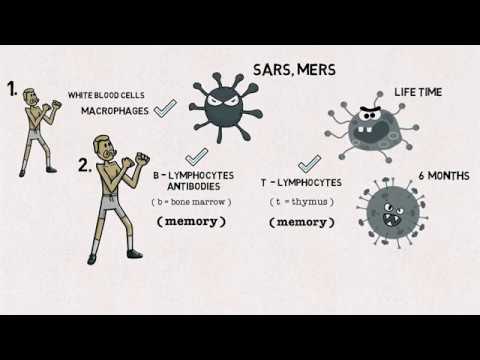
When someone’s immune system is exposed to a pathogen, its first response is to seek the help of white blood cells called macrophages to slow the invaders’ progress.
Five to ten days after infection, 2 other resources jump in to fight the pathogen.
One involves the production of antibodies, by cells known as “b” lymphocytes that are related to the bone marrow. Antibodies are specially tailored proteins that latch onto a pathogen. Some, called neutralising antibodies, make the pathogen inoperative.
The other immune system resource comes in the form of “t” lymphocytes , which mature in the thymus. These recognise and kill infected body cells.
Now if the combined efforts of macrophages, b cells and t cells are sufficient, the pathogen will be beaten back and eventually cleared from the body.
But there is another very cool thing that happens.
Once the pathogen is defeated, specialised “memory” b and t cells will help the immune system remember the pathogen, and also how to respond efficiently if it returns.
And it is here that things get very interesting.
The length of that memory depends on the pathogen.
For measles, protection lasts a lifetime.
For influenza, it can last just six months.
And covid-19 ?
Well we do not know for sure —for the simple reason that Covid-19 has not yet been around long enough to find out.
That does not sound good. But could there be any clues?
Yes, there are clues.
One set of clues comes from SARS and MERS, two potentially lethal diseases caused by coronaviruses closely related to Covid-19. Those who have recovered from these illnesses have detectable antibodies in their blood for two years after infection in the case of sars and three years for mers.
Similarly, around half of those who survived sars still had strong t-cell responses a year later, while t-cell responses to mers have been detected up to four years after infection.
But given the high stakes involved CLUES are NOT good enough.
The WHO too claims that there is not enough evidence about the effectiveness of antibody-mediated immunity to guarantee the accuracy of an “immunity passport”
The fact is that a true understanding of the immune response to Covid-19 and of how that virus has spread through the world will, take years to emerge.
Unfortunately there are no concrete answers at the moment. As with all things related to Covid19, the situation will undoubtedly change as new information emerges.