
UK
Cases, 293,239 or 2,800,000 or 5,600,000
Deaths, 55,233
293,239 CFR = 19%
2,800,000 CFR = 1.9%
5,600,000 CFR = 0.98%
70% of 326, 700, 000 = 228, 690, 000 = 2, 286, 900
70 % of 66, 460, 000 = 46, 522, 000 = 465, 220
ONS
England and Wales, w/e 3 July 2020 (Week 27)
Community based survey (not hospitals or care homes)
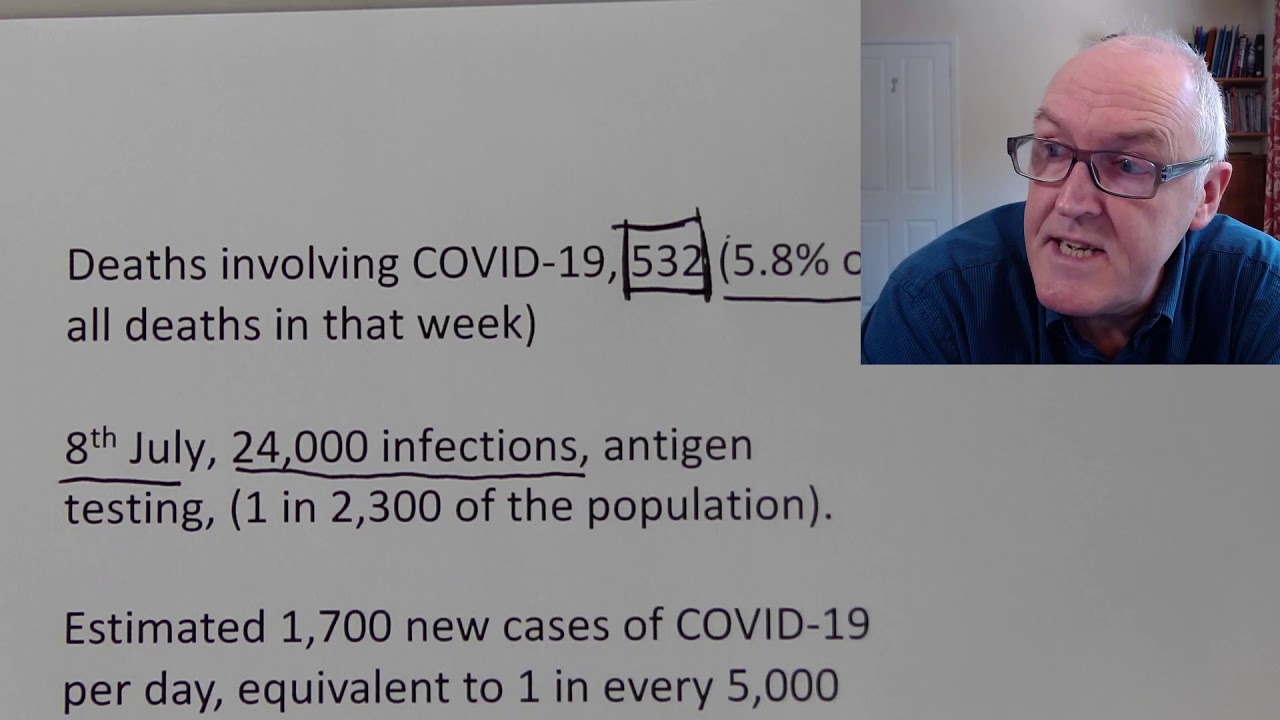
Deaths involving COVID-19, 532 (5.8% of all deaths in that week)
8th July, 24,000 infections, antigen testing, (1 in 2,300 of the population).
Estimated 1,700 new cases of COVID-19 per day, equivalent to 1 in every 5,000
Modelling shows evidence that the decrease in COVID-19 rates has levelled off
COVID-19 Infection Survey
Data up to 8th July
Based on 4,309 blood samples received since the start of the study on 26 April 2020
1 in 16 people (6.3%) who provided blood samples up to 8 July 2020 tested positive for
COVID-19 antibodies
This equates to 2.8 million people in England
Face coverings when outside the home
8 to 12 July 2020
61% reported wearing a face covering when leaving their home in the past seven days
up from 52% the week before.
10% had used a pub or restaurant
9% hairdresser
Oxford Vaccine Group, Coronavirus immunity in children
Oxford Vaccine Group, Public Health England, National Institute for Health Research
750 families in the trial
Prevalence of COVID-19 in children
Checking for coronavirus antibodies
3 % to 4 % of children tested positive for antibodies
Possible underestimate
Higher percentage in London
Of those who tested positive, fewer than 10 % showed any symptoms of COVID-19
Therefore children have similar infection rates to adults but a higher proportion are asymptomatic
Very few children and teenagers are experiencing COVID-19 symptoms
Less ACE-2 receptors
Cross immunity with other recent coronaviruses
Children are very good at spreading the influenza virus
But not so good at spreading COVID-19
Memory T cells
May mean we have more immunity than antibodies indicate
Stockholm
IgM first 23 days
IgG up to 49 days
Blood donors in May
15% had antibodies, 30% had memory T cells
If you would like to donate to this educational project, please use the following link, thank you,