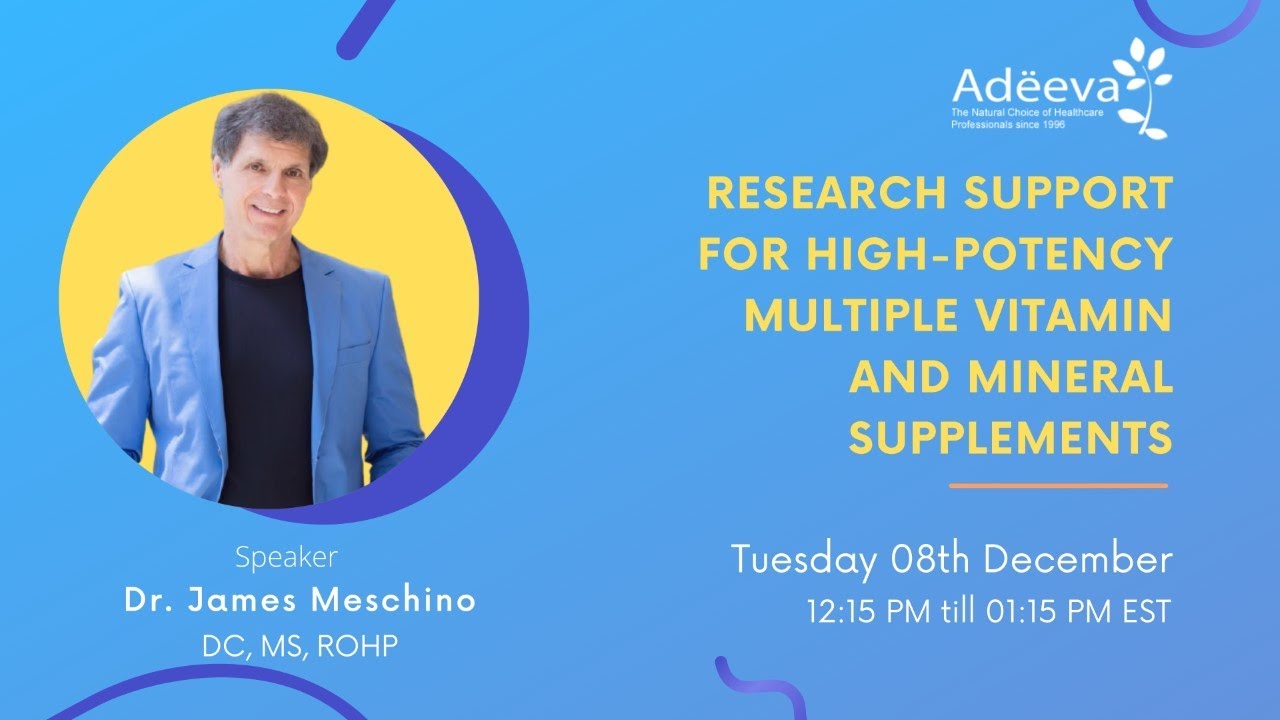
Research Support for High Potency Multiple Vitamin and Mineral Supplements.
Presentation Slides & References:
https://adeeva.com/wp-content/uploads/2021/02/The-Research-Support-for-High-Potency-Multiple-Vitamin-and.pdf
Buy Adeeva All-in-One Multi-Vitamin & Mineral Today:
https://adeeva.com/product/all-in-one-multi-vitamin-mineral/
📺Subscribe To Keep Up to Date with New Health Research Articles and Videos:
https://www.youtube.com/c/DrJamesMeschino?sub_confirmation=1
Supplements Formulated by Dr. Meschino: https://adeeva.com/product-category/supplements/
Supplements for Men (20% OFF): https://adeeva.com/product-category/supplements-for-men/
Supplements for Women (20% OFF): https://adeeva.com/product-category/supplements-for-women/
About Adeeva Nutritionals:
Experience the New Way of Aging with the Adëeva Anti-aging Supplement Program, which is designed to enable you to have a disease-free, more highly functional body and mind for the longest period. Breakthrough studies in recent years prove that you don’t have to age like your parents or grandparents did. Studies have shown that targeted nutritional supplements can counter the genetic time bombs of aging and disease, keeping your mind and body highly functional — an outcome that drugs alone can not provide.
The Adëeva Supplement Program simplifies your ability to implement a healthy aging strategy, helping you attain and maintain a high level of quality of health and life.
About Dr. James Meschino:
Dr. James Meschino, DC, MS, ROHP, RAP, is recognized as a leading expert in nutrition, anti-aging, fitness and wellness. He is a published author of four books and over 200 research review papers on nutritional medicine. Dr. Meschino is the creator of the online Meschino Health Test and is the Chief Formulator for the Adëeva Nutritionals brand of supplements and natural health products.
To learn more about Dr. James Meschino please visit: https://www.meschinohealth.com/
Meschino Health Test (100% FREE): https://naturalhealthtest.com/
Download Free Wellness App:
Android: https://play.google.com/store/apps/details?id=com.SEB.MeschinoWellness
IOS: https://apps.apple.com/us/app/meschinowellness/id1484185617
Follow us on:
Facebook: https://www.facebook.com/AdeevaNutritionalsInc/
LinkedIn: https://www.linkedin.com/in/james-meschino-a138686/?originalSubdomain=ca
Adeeva Nutritionals Support:
Email: support@adeeva.com
Call: 1-888-251-1010
#MultiVitamin #AdeevaNutritionals #DrJamesMeschino
hello everyone and welcome to this webinar on research support for a high potency multiple vitamin i’m very grateful that you would spend this hour uh with us today so um thank you so much for joining us and uh i think we’ll get started right away i hope everybody’s uh enjoying the pandemic as much as i am not okay so um these are my introductory remarks and that is that you often see uh media coverage that you know studies are showing that multiple vitamins don’t really do anything they’re not really helpful but when they’re looking at multiple vitamins this way they’re looking at these very low dose multiple vitamins that you would buy in a drugstore that have you know 60 milligrams of vitamin c and 15 ius of vitamin e and get two milligrams of the b vitamins i mean those things are very unlikely to make a very big difference but the research does support if you’re using meaningful doses of vitamins and minerals that are really targeted to what the research shows then you actually start to see very significant clinical outcomes and so that’s what i want to present to you today is the peer-reviewed clinical studies that we have showing that meaningful doses of vitamins and minerals taken on a daily basis can actually have a tremendous impact on people’s health in terms of preventing problems and helping to improve outcomes for some existing health conditions and it’s from this research over the years that i put together the adiva high potency multivitamin which i will show you at the end so let’s start with free radicals and antioxidants so um you know in just a normal metabolism as your body’s generating energy as the uh the hydrogen electrons are moving down the cytochrome chain in the mitochondria some electrons are leaking out of the chain and into a very oxygen rich environment and so they form uh with oxygen the super oxide anion which is a very uh reactive free radical or reactive oxygen species that can do a lot of damage then sometimes two of those superoxide anions will attach together to form hydrogen peroxide and then in the presence of a trans transition metal like iron it’ll form two hydroxy radicals well these are the types of free radicals the body’s making all the time so there’s always this background free radical damage happening to our tissues then of course you can make it worse by exposing yourself to other free radicals from polycyclic aromatic hydrocarbons and hydrocyclic amines nitrosamines alcohol cigarette smoke things in air pollution radiation including ultraviolet radiation from the sun affecting the eyes and the skin and so you see all the different sources of free radicals that the body’s dealing with at any given time uh irradiation possibly cigarette smoke or secondhand smoke air pollution environmental toxins some things that we’re ingesting even the inflammatory process generates free radicals that can damage tissue and here’s the cellular metabolism i was talking about where hydrogen electrons are being converted two to five percent of them as they go down the electron transfer chain they leak out of this mitochondrial membrane and they react with oxygen to form these reactive oxygen species so there’s always some background level of free radical damage going on that’s causing corrosion to our tissues and the tissues that get affected that are damaged by free radicals are dna so it can lead to aging of the dna but some of the mutations can lead to base pair mutations where you’re actually increasing the risk of cancer you also can damage the the mitochondria itself and the mitochondrial dna so your mitochondria don’t work as well so you can’t produce energy as well as you get older because of mitochondrial dysfunction you can damage enzymes in the cell you damage the cell membrane if you cause free radical damage to the cholesterol in your bloodstream the ldl it sticks to the walls of the artery and you have more atherosclerosis also you know ultraviolet light from the sun can damage the lens of the eye causing cataracts in behind the eye around the optic nerve it can cause macular degeneration which is the leading cause of blindness in people over the age of 55. and the brain uses 20 of the body’s oxygen at any given time so it generates a lot of free radicals over time it leads to a like a corrosive effect that hasn’t that impacts dementia and many neurodegenerative diseases as i’m about to show you and of course ultraviolet light affecting the skin can cause skin wrinkles and also of course skin cancer so are there studies where people take antioxidants which quench these free radicals and sort of push them back try to contain the free radical damage that’s going on if you take antioxidants at meaningful doses has been shown to be helpful and the answer is yes so the first study i want to show you here is the alzheimer’s cooperative study back in the year 2000 they took alzheimer’s patients who were in early stage disease they gave a certain group of them 2 000 ius of vitamin e every day versus placebo and the group that got the vitamin e it significantly slowed the progression of the disease versus the placebo because the a lot of what’s happening in alzheimer’s diseases is related to oxidative stress and free radicals it’s not the whole thing that’s happening but it’s part of it and you know sometimes you see studies where vitamin e can cause heart disease and cancer these are older people taking high doses of vitamin e it did not increase the risk of heart disease or cancer that’s a totally ridiculous statement then in 2009 they wanted to confirm what they saw in the first study so they said let’s take alzheimer’s patients again almost you know 850 of them and let’s give half of them uh vitamin e 1000 i use twice a day let’s give another half of them vitamin e plus standard alzheimer’s drugs and let’s give another group of them you know no treatment whatsoever so here’s what happens the group that got the vitamin e and reduced their mortality by 23 compared to the other groups the group that got the drug they actually had an increased mortality but the group to got the vitamin e with the alzheimer’s drug actually did the best they had a 30 reduction in mortality so um i’m being told that you can’t see my slides i don’t know why that is arlene are you listening in um yes i am can you see my slides no oh my goodness why is that i don’t know i’ve chosen the right screen how about now there we go oh my goodness i’m so sorry everyone okay so uh we’re in this uh study uh that started um back here um the 2009 study where they’re giving people vitamin e or the alzheimer’s drug or um you know the combination or they’re giving them nothing and uh the group that does the best is the group that gets the vitamin e with the alzheimer’s drug so it tells you that vitamin e is even safe to take uh if you’re an alzheimer’s patient and you’re on the standard drugs and the outcomes have been better then with macular degeneration so macular degeneration is the leading cause of blindness in people over the age of 55. so there was this large air red study uh this sort of eye disease study back in 2001 by the national eye institute they said it looks like a lot of macular degeneration is caused by free radical damage to the back of the eye around the optic nerve so this is a large double-blind placebo control study of uh you know over 3000 people with early stage macular degeneration and they tried different combinations and what they saw was that participants with the best results were given antioxidants vitamin c at 500 milligrams vitamin e at 400 ius beta carotene zinc copper and the results indicate that zinc plus antioxidants significantly slowed the progression of their disease and even so that’s why if you go into a drug store today you’ll see in and into health food stores you’ll see supplements like optivite and op division and all that and it’s actually those supplements are derived from these studies but in our high potency multivitamin we cover the gamut of things that are necessary and then we go beyond that same with cataracts you know studies are showing that higher intakes and and blood levels of vitamin c and selenium are linked to decreased risk of developing cataracts and one study showed that adults who use vitamin c and e supplements for more than 10 years decreased the progression of their nuclear cataracts because you’re slowing down free radical damage in the lens of the eye now you know one a day multi or center with low doses of cne are not going to give you that kind of a of an outcome then in parkinson’s disease we know that there’s men a lot of different moving parts in parkinson’s disease but there is a lot of free radical damage that’s going on in the in the basal ganglia so we know the free radicals contribute to the progression and possibly part of the cause of parkinson’s and other neurodegenerative conditions so here’s a 10 year study where they gave early stage parkinson’s disease vitamin c and vitamin e at pretty high doses and it showed that it actually uh delayed the need for drug therapy by an average of two and a half years so it slowed down some of the free radical damage in the brain so that they had better quality of life for a longer period of time but what’s more important to me is how do you prevent it some studies are showing that supplementation with vitamin c and vitamin e are associated with a decreased risk of developing parkinson’s disease in the very first place now one in 500 canadians actually develop parkinson’s disease in their lifetime so i’ve included all the references here in the slides i’ll be happy to send these slides to you you can go and do your own independent research on this but these diseases have a major free radical component and when you help to contain some of the free radical damage going on outcomes are better and often the risk of developing the problem in the first place is significantly less what about vitamin c well it’s more than just an antioxidant but studies indicate that the sub-optimal that sub-optical vitamin c levels which is known as hypovitamin osis c is identified as a plasma vitamin c level less than 23 um um uh millimoles per liter that should actually be micro moles i’m so i’ll just change that which is actually very common in western society and a vitamin c deficiency is where you’re under 11 and that should be micro moles per liter so you have to change that again sorry but the 2007 to 2010 u.s national health and nutrition examination surveys of approximately 16 000 children adults found that almost 40 percent of people have low levels of vitamin c and 80 percent 88 of the us population don’t meet the daily requirement for vitamin e which enhances vitamin c function so vitamin c and vitamin e works because they can they can recycle each other back to uh active forms of the antioxidant but what’s really important to know here that the ingestion of 250 milligrams per day of vitamin c and otherwise healthy people has been shown to enhance many aspects of immune function you can’t get 250 milligrams of vitamin c from food it’s very hard to do that and from a low dose multiple vitamin you’re not going to get 250 milligrams of vitamin c the goal is actually to have a blood vitamin c level that’s at or above 50 micro moles per liter that’s where you start to have more optimal vitamin c function to do that you need at least 100 to 250 milligrams of vitamin c a day and then if there’s other compounding factors you’re going to need more than that so as we get older immune system function declines some studies suggest that the combination of a thousand milligrams of vitamin c a day and 200 iu’s of vitamin e per day improves immune function in people over the age of 60. so as you get older you need higher doses in our high potency multivitamin you get the 1000 ius of vitamin c right in that product and you get 400 ius of vitamin e right in that product studies have shown that when fighting the common cold supplementation with 200 milligrams a day vitamin c helps to reduce the severity and duration and the incidence of the common cold if you’re exposed to physical stress this level of vitamin vitamin c intake may also reduce common cold frequency if you previously had low vitamin c blood levels below 45 micromoles per liter very importantly higher levels at a thousand milligrams a day has been shown to prevent the decline in vitamin c depletion within white blood cells during an infection here’s a quote from a really important research paper regarding lung infections and pneumonia and vitamin c the researchers say beneficial effects of vitamin c on recovery have been noted in pneumonia in elder elderly people hospitalized because of pneumonia who were determined to have very low vitamin c levels administration of vitamin c reduced the respiratory symptom score in the more severe cases in other pneumonia patients low-dose vitamin c of up to 800 milligrams a day reduced the hospital stay by 19 compared to no vitamin c supplementation whereas higher dose up to 1600 milligrams a day reduced the hospital stay by 36 percent and it wasn’t just the person subjectively felt better the vitamin c supplementation group showed a positive effect on normalizing the chest x-ray reduce temperature and decrease erythrocyte sedimentation rate so vitamin c supplementation is huge for immunity and people don’t get enough from food most people walk around with low blood levels people need at least five hundred to a thousand milligrams a day especially during the pandemic what about vitamin e well they’ve done vitamin e to see if it helps to prevent cancer they say no it doesn’t really help in fact it might make things worse because they don’t use the form of vitamin e that actually has the vitamin e anti-cancer properties which is vitamin e succinate take a look at the multivitamin that we created it has vitamin e succinate in it the most studied member of vitamin e with respect to cancer is actually vitamin e succinate studies have demonstrated that vitamin e succinate is a potent growth inhibitor of a wide variety of epithelial cancers types including prostate breast lung colon cervical endometrial as well as many uh uh hematopoietic lymphoid leukemias lymphoma and melanoma in vitro in fact at least 50 types of cancer cell lines tested so far these are human cancer cell lines have shown a high level of apoptosis that means programmed cell death when challenged with vitamin e succinate for different types of cancer so what i want to get to is that studies show that vitamin e succinate the way that it works is only vitamin e succinate gets into the mitochondria and it targets the the second cytochrome in the respiratory chain and it basically disrupts it so the electrons can’t flow down the electron mic uh cytochrome chain so you can’t produce energy if the cell can’t produce energy it undergoes apoptosis or programmed cell death the evidence on this is so strong that a few years ago they said let’s let’s test it because we saw experimentally that vitamin e succinate inhibits and kill get cells to commit suicide that are mesothelioma cells that type of lung cancer due to asbestos exposure so they said let’s try it on a patient to see if it helps so they took an individual who had mesothelioma there’s no medical treatment for mesothelioma is effective they gave the patient vitamin e succinate at a specific dosage and they saw that over time that the tumors in the lung on cat scan were actually shrinking and the person’s outcomes were doing better so as a result of that they have set up a very large study now with mesothelioma cases and we’re waiting to see what the outcomes are but vitamin e succinate is the only form of vitamin e that’s actually been shown to have anti-cancer behaviors and the way that it works as i was showing you earlier suggesting earlier is that it it through its its effects down through the caspase enzymes it induces apoptosis via a number of receptors on the cell surface and then also within the cytoplasm of the cell it also upregulates tumor suppressor gene p53 tumor suppressor gene which also is going to induce apoptosis of emerging cancer cells so it in a multimodal way vitamin e succinate has these effects so the the multiple vitamin you want to take every day if you want to have vitamin e in it it should be vitamin e succinate it has to be a meaningful those 400 ius a day is a meaningful dose of vitamin a what about breast cancer survivors is there any evidence that if they take vitamin c and vitamin e antioxidants that they get better outcomes less recurrence and better quality of life there’s three gigantic studies that have shown this the first one was in nov was in 2011. they looked at breast cancer patients a large group of them a two-year follow-up studies and you can see that the women in the top 25 percent uh following a healthy lifestyle who regularly took a multiple vitamin c had 60 to 70 reduction in the risk of dying from any cause during the study so it was the addition of the multivitamin and mineral that actually gave them the outcome because the group the women who didn’t take a multivitamin didn’t get that additional benefit in 2012 we we have what’s called the lace study which is life after cancer epidemiology these are breast cancer patients they followed almost 2 300 of them these are from the kaiser permanente in northern california and also from utah in the cancer registry the results showed that with the with average five-year fall of the frequent use of vitamin c and vitamin e in the period following breast cancer diagnosis was associated with decreased likelihood of recurrence we also observed that frequent use of vitamin c and vitamin e after diagnosis was associated with reduced risk of all cause mortality deaths from all causes in these women with breast cancer including preventing breast cancer recurrence only the women who chose to be on vitamin c and vitamin e supplements and they weren’t taking 60 milligrams a day in 15 iu’s a day they were taking meaningful doses of c and e then the shanghai breast cancer survival studies showed exactly the same thing almost 5 000 breast cancer survivors looking to see if vitamin c vitamin e or multivitamins had an effect the results showed after four years women who used antioxidants uh ec and multivitamins had an 18 reduced mortality risk and a 22 reduced recurrence risk the inverse associated was found regardless of whether the vitamin was used concurrently with chemotherapy or after the therapy so uh but if they’re but with but they shouldn’t take these vitamins after having radiation therapy only with chemotherapy so the what what women are told is not to use any antioxidants during chemotherapy because it might actually make that make their results worse but here’s a study showing that that that advice is actually wrong so we need more evidence to really support this view but we certainly see that in breast cancer survivors the ones using antioxidants like vitamin c and vitamin e at meaningful doses are doing better in terms of prevention of recurrence and progression of the disease and also all cause mortality so that’s just free radicals and antioxidants what about b vitamins i’m speaking very quickly because there’s a lot to cover here what about b vitamins well the oxford project to investigate memory and aging huge study they wanted to understand they knew that b vitamins played a very important role in lowering homocysteine we know that homocysteine can damage the brain so they took 168 of these older individuals older than 70 years old gave them 3b vitamins folic acid b12 and vitamin b6 at significant and meaningful doses from supplementation versus the placebo what they want to see is that does it can it slow down the rate at which the brain is atroph atrophying as you get older the brain shrinking on average b vitamins slowed the rate of brain atrophy by 30 percent in some cases up to 53 and we know that a greater rate of atrophy is associated with decreased cognitive test scores so by slowing down atrophy of the brain you preserve brain function to a large degree folic acid and b6 and b12 also are important in preventing the rise in homocysteine we know that high homocysteine levels can actually cause brain a damage and atrophy and b vitamins like this are needed for neurotransmitter synthesis so the brain can keep making the neurotransmitters for cognition and for other purposes what we know is that over the age of 60 most people who don’t have any brain impairment of any kind still have a shrinkage of their brain by point five percent a year if you have mild cognitive impairment the brain shrinkage is one percent if you have alzheimer’s degree the rate of brain atrophy is 2.5 so if you can slow that down that’s meaning so thus far there are no drugs that can do this only b vitamin supplementation has been shown to slow brain atrophy in aging persons now b vitamin supplementation is most effective in those that had a high homocysteine level that’s about a third of the population and when you combine it with omega-3 fats in this study the person actually the outcomes were even better what about niacin vitamin b3 it has an important effect on the brain so niacins needed to make atp energy in our in all your cells because it becomes nad but what’s not appreciated that niacin also preserves the tau protein that holds the microtubules together in the brain neurons so i’ll show you what the microtubules are in a moment but they’re basically the little tubules that allow proteins to go from the nucleus down through the axon to keep the axon alive and functioning normally and one of the things that happens in alzheimer’s disease is the the microtubules break down and you form neurofibrillary tangles and the patient dies so the early in the early evidence for this was from the russia institute of health aging study in chicago where they looked at almost 3 000 people who were older residents in three chicago neighborhoods for more than five years they also performed neurocognitive tests on over 800 of them they found that those who got the least nice and were 70 percent more likely to develop alzheimer’s disease than the group that got the highest amount so the group that was getting the highest amount we’re getting a minimum of 45 milligrams a day you can’t get that from food you can’t get that from a low-dose multivitamin these are people who are buying you know b-50 complex vitamins like we have in our multivitamin the benefits of higher niacin intake began in women and then at who are just getting above 17 milligrams a day which you still are not going to get from food but it became really significant once you got to 45 milligrams a day so here is what happens so if you look at an axon here of a nerve in the brain these are microtubules uh that sort of send the little peptides down from the nucleus so if you blow up the microtubules see these little these little blue beams here that are sticking out these are the tau protein and they need niacin to support their stability and synthesis and so what happens when you’re nice and levels are not optimal as you get older the risk is that the microtubules break down and they form neurofibrillary tangles the microtubules break down and you can’t transfer information properly along the axon and the nerve dies that’s one of the major features of alzheimer’s when it becomes more advanced so they looked they did animal studies recently as well and they showed the same thing if you breed animals to have alzheimer’s disease and you deprive them of of niacin the alzheimer’s incidence is very high but if you give them high doses of niacin to preserve the tau protein then the tau protein doesn’t break down and the animals don’t develop the cognitive impairment giving them the nicotinamide supplementation improved many aspects of memory and cognitive performance so because these animals were very prone to alzheimer’s disease just the way they were read the amount of niacin that it took to preserve the tau protein in these high risk animals the human equivalent would be one thousand milligrams three times a day that’s a very very high dose high doses of niacin can actually cause some liver damage so you can’t just be giving this these high doses to your patients indiscriminately i’m just showing this research because i want you to see that these nutrients are meaningful but you have to get them in at meaningful doses what we’re seeing is that to help prevent these the tau protein breakdown in humans you want to be getting at least 45 milligrams a day of nice and you need a b50 complex basically to do that then with respect to folic acid and b12 as they affect depression and anxiety and schizophrenia and birth defects and cancer prevention there’s a very important pathway that i want to point out here when folic acid enters the body in order for the cells to use it folic acid has to go down all these steps to become five methyl folate we’ll just call it 5-methylfolate but this enzyme known as the methylene tetrahydrofolate reductase this enzyme in sixty percent of caucasians had there’s polymorphism that means that the the body doesn’t make it that well but if you give extra folic acid it improves the function of the enzyme and you can make this form of folate or of folic acid and this form of folate is critical because here it is over here so here’s the folate coming into the body here’s the methylene tetrahydrofolate reductase enzyme allowing it to become the the methylated form of folic acid that methyl group is then handed to vitamin b12 and methionine synthase to form methionine from homocysteine from there you make acidental methionine so you need that form of folic acid and b12 and these enzymes working properly to make acidental methionine and then that methyl group can be handed to methylate dna to make the neurotransmitters in the brain this is important for mental health to make certain phospholipids to make creatine for detoxification purposes and for you know for women to actually have children that don’t have spinal birth defects that’s why women take extra folic acid when they’re pregnant but look at in the brain all the different places where you needed to make neurotransmitters like adrenaline and noradrenaline and dopamine you need folic acid here you need folic acid here you need vitamin b6 here you need vitamin c here you need here’s escidentio methionine you need folic acid and b12 for this reaction so you need to be able to make that esodemocion methionine same for serotonin and melatonin here’s folic acid is required to make this is a tetrahydrobiotarium you need folic acid for this this is a decarboxylation right reaction you need vitamin b6 here here’s um you need pantothenic acid here and here’s acidencio methionine so we’re seeing that as people have many people have this methyltetrahydrofolate reductase enzyme polymorphism and it increases their likelihood of mental health issues and sometimes they don’t respond to their their drugs well enough for depression and anxiety and giving them folic acid and b12 often can be a very big help so the addition of 400 micrograms a day of folic acid and 50 micrograms a day of b12 50 milligrams of b6 a day can help the body recycle homocysteine make more acidental methionine and overcome some of this mild genetic susceptibility to a defect that many people have and b12 is in the same category we see that vitamin b12 especially as people get older a lot of people run out of vitamin b12 and the reason is you absorb it less as you get older because you make less stomach acids so you secrete less intrinsic factor which you need to absorb b12 a lot of older people are on ant acids and proton pump inhibitors which are decreasing their acidity even further including histamine blockers and so the liver stores about two to three years worth of vitamin b12 but slowly over time the person will use that up and then they go into an early stage of vitamin b12 deficiency and the first thing that shows up in a vitamin between b12 deficiency are personality changes depression and memory loss in fact one-third of geriatric hospitalized patients who went who are admitted for depression show low blood levels of vitamin b-12 upon hospital admission and giving people b12 or for these b vitamins has been shown to actually help them overcome and improve mental function and reverse depression and clinical trials so you see the references there here’s a report in the new york times of a woman her mother was 85 years old showing signs of alzheimer’s disease the doctor put the mother on an alzheimer’s drug the person actually got worse instead of better but the doctor had the good sense to test the woman’s b12 blood level saw that it was low gave her vitamin b12 injections lo and behold her memory came back her personality came back and her depression was improved so these things are slipping through the cracks all the time you need acedenticel methionine to methylate these the um this is the cytosine residues at certain parts on your dna chain if you don’t have enough methylation uh uh methyl groups on the targeted cytosine residues you end up in a state of what’s called hypomethylation which is highly linked to cancer so a lot of cancer occurs because people don’t ingest enough folic acid or have sufficient vitamin b12 status they don’t form acidental methionine and so what happens is the when you methylate these uh segments of the dna it inactivates the gene so the cells are not dividing and dividing and dividing when you have hypomethylation the cell starts to divide at a faster rate and it forms more genetic mutations you get genomic instability which leads to an increased risk of cancer so lots of evidence shows this that hypomethylation leads to cancer production because cells are dividing and the genome becomes very very unstable when you methylate the dna at the right parts of the cytosine residues you silence certain genes so that the cell is not dividing in a way that is abnormal and a lot of people are walking around in a in a hypo state in terms of not enough folic acid daily because you can’t store folic acid you have to get it every single day with b12 you can store but over time often people run into deficiencies what about vitamin d well the ideal range for vitamin d for immunity and for osteoporosis prevention and to prevent cancer and ms you need to have a blood range that’s at 75 to 85 nanomoles per liter up to 115 animals liter we think that is actually the sweet spot 68 68 of canadians have a vitamin d level below 50. the evidence shows that even with a thousand ius a day which we have in our multivitamin gets people from below 50 often to over 75 animals per liter a day some people will need a little bit more vitamin d than that but it’s very inexpensive to add it of course during october to may you can’t make it even on a sunny day you can’t make vitamin d in your skin so canadians are very very susceptible now the maximum amount of vitamin d that health canada allows you to put into a multiple vitamin is a thousand ius of vitamin d or i would have put even more in there but vitamin d blood levels above 75 nanomoles per liter have are associated with with decreased acute respiratory distress syndrome in children less pulmonary infections faster recovery from respiratory infections than adults and improved immunity across the board because vitamin d is required for macrophages and other cells to make cathalocidine and defenses and other molecules that actually are are used by immune cells to ward off infections right at point of contact now uh in a couple of weeks i’m going to do a whole webinar just on nutrients and immunity which you should we’ll get into the more details on this but we’ve seen in covid19 patients where they have if they have low blood vitamin d levels the outcomes are much worse and we recently saw in spain which i’ll cover for you next time a supplementation study of cova patients entering the hospital given vitamin d supplements in a random way the ones that got the vitamin d no deaths very few had to ever go to even intensive care hospital emissions are much shorter so now they’re doing a very large scale study with vitamin d but we saw this just this in recent months where the the vitamin d status of a mother at the sec during the second tremendous trimester pregnancy affects the child’s iq when you test them when they’re four to six years old and that’s because vitamin d crosses the placenta and the and the fetal brain at just for the 12th week after conception is already expressing vitamin d receptors vitamin d is required for the development of the brain so 13 of white us pregnant women and 80 of black us pregnant women show vitamin d levels below 15 animals per liter during the second trimester of pregnancy which puts them at risk for having children whose iq is significantly lower so the recommendation now is for all women who are pregnant to get or who want to get pregnant to get their vitamin d blood tested but throughout your entire life you need to have a blood vitamin d level that’s above 50 or 75 nanomoles per liter because it’s also associated with decreased osteoporosis and fractures onset of multiple sclerosis diabetes heart disease helps to keep blood pressure lower alzheimer’s risk is lower all these different things parkinson’s disease decrease influenza decreased risk even of macular degeneration i’m not making this up i’m providing the references for you if you want to go and read about the impact that these nutrients have if you get them into the body at meaningful doses what about calcium well the national health and nutrition examination surveys so that 42 percent of americans and same with canadians don’t get the required amount of calcium each day so you see most people are missing about 500 milligrams a day that’s the amount that i put into the diva high potency multivitamin because when you get it it helps you get into these higher ranges which are really related to decreasing risk of osteoporosis and osteopenia so most adults are are not getting the uh the recommended amount of calcium but 500 milligrams can make a huge difference and the other thing to know about this is that studies published recently when you look at all the meta-analysis you see that for every 300 milligrams of calcium a person ingests it reduces the risk of colon cancer by eight to nine percent so helping people get 1200 milligrams a day through food and supplementation so the average person if they’re getting you know six or seven hundred milligrams for food and we give them another 500 from our multivitamin they get to 1200 milligrams a day it reduces the risk of colon cancer by 32 to 36 percent you’re saying well how is that possible it’s because the calcium that you don’t absorb that stays in the gut slows down the rate of cell division of the intestinal epithelial cells and when you slow down the cell division rate you don’t perform mutations as well also the calcium in the gut will bind with bile acids so they can’t be converted into secondary sterols which are known to cause cancer to develop in the colonic epithelial cells we understand the mechanism how calcium prevents colon cancer colon cancer is the second leading cause of cancer death in our society these nutrients are vitally important to get at the ideal range of course when you ingest lutein it goes to the back of the eye it forms a free radical shield around at the maculo lutea the the yellow tinge that you see when you look through an ophthalmoscope at the back of the eye that yellow tinge that you’re seeing that pigment is from lutein and the more lutein you get the thicker is the antioxidant defense so you don’t damage the optic nerve dr johannes seddon at harvard university says that six milligrams per day of lutein has led to 43 lower risk of macular degeneration we have lutein in our in our multivitamin and what about lycopene and prostate cancer all kinds of studies show that in a linear fashion as you increase your lycopene intake you decrease your risk of prostate cancer significantly so because they saw all the mechanisms through which lycopene can reduce prostate cancer risk there have been six studies so far where they took individuals who had localized prostate cancer or more advanced prostate cancer or pre-cancerous conditions in their prostate gland and they gave them lycopene supplementation at different doses and in every case these are the studies i will send you these slides and every single case the outcomes were the group that got the lycopene did better slowed the progression of disease brought the psa down um improved outcomes even in complicated cases of prostate cancer where you have androgen independent prostate cancer you can read the studies for yourself and the the experimental studies say that lycopene probably also has a protective effect in terms of lung cancer esophageal cancer stomach cancer colorectal pancreatic breast and also cervix everybody needs to get that extra lycopene most people don’t get enough from food i put six milligrams right in the adiva multivitamin what about zinc 55 of us adults don’t ingest the zinc that’s required same in canada and you don’t store saying you know you store iron in your liver but you don’t store saying you have to get the awful melon every day 30 of elderly patients individuals are are already mild to moderate zinc deficiency and just shows you that with the blood tests you know it shows you with the blood markers we most people don’t do a blood test for zinc but if you did it would have to be around 100 micrograms per deciliter give or take 10. values below 80 or a moderate deficiency below 50 you’ve got a very severe zinc deficiency the recommended amount is 15 milligrams a day which i agree with in north america adults get about 11 milligrams a day from food and older people over the ages are only getting eight milligrams a day so the chronic just sub-optimal intake of zinc over your lifetime leads to immune suppression so the immune system can’t work nearly as well you become immune compromised just from that alone what else you can’t taste your food well love you have less dark adaptation your lean mass gets catabolized and you don’t your wounds don’t heal very well what do older people tell you as patients i’m more prone to getting sick i don’t taste my food as well if i bang my arm and i get a bruise it stays there for three or four months right these are signs of marginal zinc deficiency just a simple multivitamin with 15 milligrams of zinc a day reverses the whole clinical picture and here are the references for zinc i’m not pulling this stuff out of the sky and these are recent ref uh references and for selenium they they say that most people get the selenium that the government recommends but that amount of slamming at 55 micrograms a day it’s probably not the ideal amount of selenium studies have shown that higher blood levels of selenium and toenail concentrations of selenium why would they look at toenail concentrations because the amount of selenium in your toenails is a really good snapshot of your long-term intake of selenium they’re associated with decreased cancer at various tissue sites individuals taking 200 micrograms a day saline per day were often those that had the most ideal uh blood and toenail levels so in our multivitamin we have 200 micrograms of selenium there have been some clinical challenge studies with selenium that have been a bit disappointing but overall selenium compounds have shown tremendous promises anti-cancer nutrients and i believe that 200 micrograms of selenium is highly meaningful for most people it’s well below any level that’s going to produce toxicity see the reason i say that is because the selenium experimental studies are incredible showing all the effects including heightening immune system function stabilizing dna inducing apoptosis of human cancer cell lines cutting off the blood supply from tumors so they can’t metastasize i mean it just does so many different things that uh that getting that extra selenium seems to be a logical thing and we’ll talk about more about the selenium studies on covid19 patients in a couple of weeks at the next webinar vitamin a most people are not getting the amount of vitamin e that the vitamin a that they should be getting for all the different functions that it does immunity and for you know vision and dark adaptation and growth and differentiation for preventing cancer from developing but the vitamin vitamin a is a bit tricky of course because if you get too much vitamin a it leads to liver damage and it also leads to osteoporosis and bone fractures so you can’t be giving people high doses of preformed vitamin a remember that one-sixth of all the beta-carotene that you consume the body can convert it into vitamin a if you need it but if you don’t need that vitamin a it’ll stay as beta-carotene and have its own independent antioxidant properties as beta-carotene and its own anti-cancer properties as beta-carotene in terms of reversing we’ve seen it reverse certain pre-cancerous conditions like leukoplakia and cervical dysplasia so at the end of the day you want to get a safe amount of vitamin a no more than 2500 ius a day of pre-formed vitamin a from a multivitamin and you can you know i i put 15 000 milligrams 15 000 iu’s of uh beta-carotene into our multi because that’s a reasonably safe thing to do what about chromium evidence suggests most people get the chromium that their government says is beneficial but that level is not high enough from the studies we have from richard anderson showing that when you give people additional chromium at 50 to 100 or even 200 micrograms a day that improves insulin receptor function lowers their blood glucose improves insulin function helps to decrease hemoglobin a1c and improve glucose regulation in our world of this epidemic of type 2 diabetics that additional 50 micrograms of chromium is a great baseline level that people should get each day to improve their insulin function what about magnesium well it does all these incredible things everyone knows magnesium is a wonderful mineral that has you know over 200 enzymes alone use magnesium and it easily gets depleted by stress alcohol caffeine exercise refined sugars most people don’t get the magnesium that is recommended from government agencies which you see as 420 milligrams for men and 320 milligrams for women and men older than 70 and teenage girls and boys are most likely to have very low magnesium intakes when the amount of magnesiums you’ll get from food and dietary supplements is combined so a lot of people take magnesium supplements in some form either a multivitamin or as part of calcium magnesium supplements when they get that they often get their magnesium into the more ideal range more recently we’ve seen that magnesium may help to lower the incidence of stroke by two percent for every 200 milligrams that a person’s consuming but here’s what really caught my eye this year is this review of all the studies looking at colon cancer prevention that was published uh just you know a couple of months ago in the british medical journal gut it said that regarding protection against colon cancer just getting magnesium intake above 255 milligrams a day or at least 255 milligrams a day that alone was associated with a 22 percent lower risk of developing colorectal cancer we’ve never seen that before so uh that’s and because in our multivitamin there’s 200 milligrams of magnesium to at least so from food alone you’re going to get way beyond that amount but then they showed other things like the role of folic acid and eating dairy products is protected because you’re getting the calcium that does all those great things that we talked about eating more fiber is helpful soy beans are helpful the factors that increase colorectal cancer red meat processed meat all the things that you know you you’ve seen over the years that are that can be harmful including alcohol so as we start to wind down here i want to show you the adiva high potency or the edivia alt the adiva all in one multivitamin that i put together because it’s everything in one bottle 2500 ius of vitamin a so you don’t give anybody vitamin a toxicity that’s very important fifteen thousand ius of beta carotene so you’re taking two capsules twice a day because you couldn’t put this all in one caplet or you wouldn’t be able to swallow it the government would would not allow a catholic that big anyway so you’re taking two caplets twice a day so over the course of the day you’re getting your 1 000 milligrams of vitamin c in two divided doses of 500 milligrams there’s the 1000 i use the vitamin d here’s the 400 ius of vitamin e succinate the anti-cancer form of vitamin e here’s the b50 complex so you’re completely covered with all those b vitamins that we saw were doing all those great things here’s the 500 milligrams of elemental calcium a little bit of iron not enough to be toxic there’s the 200 milligrams of magnesium the 15 milligrams of zinc 200 micrograms of selenium the little bit of copper there’s the manganese that you need to activate the superoxide dismutase enzyme here’s the 50 micrograms of chromium molybdenum for detoxification bioflavonoids lutein and lycopene at six milligrams so if you were to go out a person buys a multivitamin a regular multivitamin and then they want to get this added protection they’d have to go and buy extra c and extra e and extra selenium and a b50 complex and some maybe lycopene and lutein extra extra calcium they’re buying eight different vitamin bottles to get what we’re giving people in one bottle if that’s antioxidants enriched a b50 complex 500 milligrams of elemental calcium a thousand ius of vitamin d and everything you need from vitamin a to zinc plus bioflavonoids lutein and lycopene and the form of vitamin e is vitamin e succinate go and try and find a multivitamin in the marketplace that’s using vitamin e succinate good luck you won’t find one so that’s one bottle instead of eight bottles and it’s more economical for the person to purchase so it’s practical they only have to have one bottle as opposed to eight so the compliance is automatically going to be better number two it’s it’s more cost effective a little over a dollar a day they have everything they need in one bottle they just take two caplets