



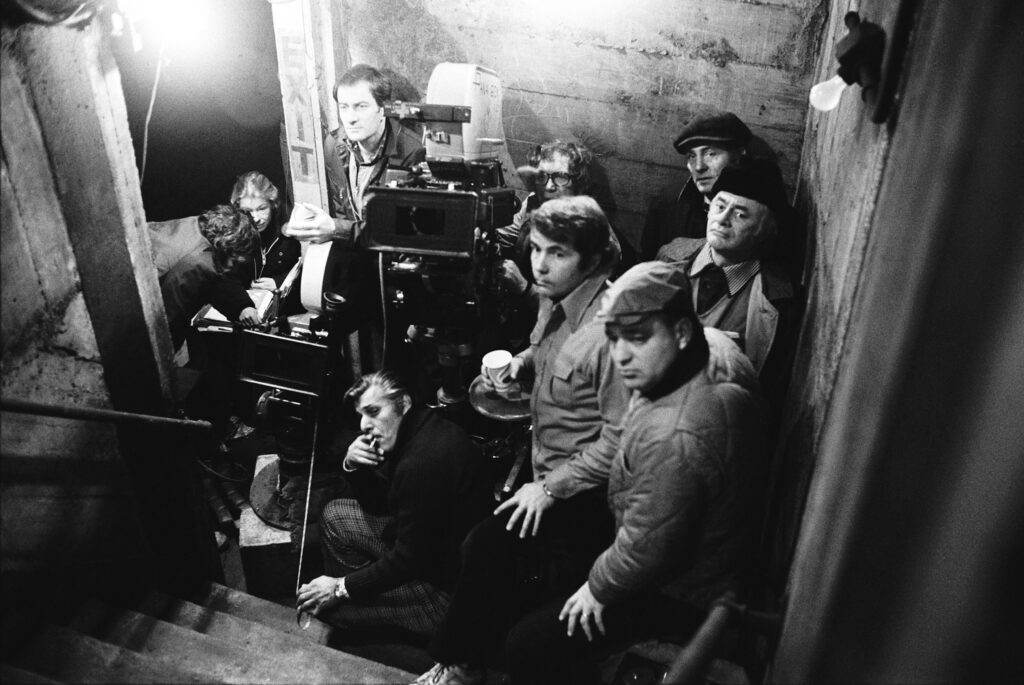
Books that promise a “behind-the-scenes look” at filmmaking tend to focus on the creatives: the director, the screenwriter, the actors. Cinematic Immunity takes a different approach. You get the inside scoop from prop masters. Set decorators. Gaffers. Wardrobe assistants. Scenic artists. Sound mixers. Cinematographers. In other words, the people who do the actual down and dirty physical labor in getting a film made: the crew!
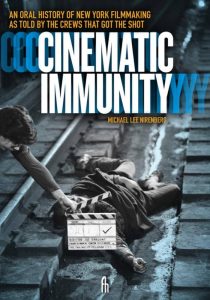
Cinematic Immunity: An Oral History of New York Filmmaking As Told by the Crews That Got the Shot
By Michael Lee Nirenberg
Feral House; 384 pages
Author Michael Lee Nirenberg has painstakingly assembled a rollicking, no-holds-barred oral history from these folks that’s simply irresistible. When you first check out the table of contents, you’ll likely do what I did; flip straight away to the film that interests you the most. I’ll ‘fess up; for me it was Cruising, the 1980 thriller about a psychopath targeting men in Manhattan’s gay sexual underground, where I found this gem:
Gary Muller (assistant camera operator): We did ninety-nine fucking takes of Al [Pacino, the film’s star] mumbling to himself over two days. That was it. Ninety-nine fucking takes. I asked Billy [Friedkin, the director] about it years later: “Just forget it. That guinea couldn’t give me what I wanted.”
Ah — a book that, once picked up, you don’t want to put down.
More on Cruising later. Cinematic Immunity — the title refers to being able to get away with errant behavior because you’re working on a movie — covers a broad range of movies and TV shows, from On the Waterfront (1954) through The Sopranos (1999-2007). The focus is on mainstream union-made productions, as that’s where Nirenberg himself worked as a scenic artist — and the reason he has so many contacts in the industry.
There’s also an emphasis on stories that will entertain you, heavy on quotes that go off with a bang. Like set decorator Susan Kaufman’s sole observation about working on the “sexual thriller” 9 1/2 Weeks: “I would say it was one of the most unpleasant experiences of my career and probably couldn’t happen today.” Conversely, Nirenberg explains that the more highly-regarded Taxi Driver isn’t included in the book because the interviews he did with the crew “just didn’t have enough insights” (he concedes he may also have not talked to the right people).
Now, you might think that a book that draws on anecdotes from the technical side of moviemaking would be kind of dry. And there is a lot of detail, but those factoids can also be interesting. For example, if you thought you saw snow falling “up” in older movies shot in California, your eyes weren’t deceiving you. West coast film crews used chicken feathers as fake snow, amazing their counterparts in NYC, who much preferred using small pieces of plastic polythene (“It really looked beautiful”). Or check out special effects artist A.D. Flowers’ recipe for the blood used in The Godfather: Karo syrup, dish soap, red dye no. 2 and blue dye no. 1, the latter ingredient because it “preserved the proper color value on Technicolor film.” Remember that one at Halloween.
And some of that detail is key to understanding just how iconic scenes were created. The crew of Saturday Night Fever added a special rig to a dolly (a wheeled cart or platform where a camera is mounted) for camera operator Tom Priestley to lie on when shooting the riveting opening sequence of star John Travolta strutting down the street. The crew could then slowly pull Priestley up so his camera could capture Travolta from his brown patent-leather shoes to his eyes and quiff.
Or how about the horse’s head in The Godfather? That beauty was kept in a special two-level box, with dry ice on the bottom level to keep the head frozen until it was needed. Apparently actor John Marley, playing the unfortunate film producer whose prime horse is decapitated, was kept in the dark about a real animal’s head being used in the scene. On pulling back the sheet to reveal the grisly sight, “The guy just lost his mind,” says set dresser Troy Adee. No second take was necessary.
Elsewhere, you’ll find plenty of insights on other juicy topics. Like money. Michael Burke, electrician on The Warriors, reveals you could avoid having taxes taken out of your pay by claiming a high number of dependents (say, ninety-nine of them): “So, you would get an envelope with $4,000 on a Thursday night and then people would buy a house from one job.” Or drugs. “It used to snow, like you were on Kilimanjaro,” says Chris Markunas, key carpenter and shop foreman on the TV series Oz. “Everybody had it. Everybody did it.”
 And, of course, sex. Lloyd Kaufman, a location executive for Saturday Night Fever, says the film’s original director, John Avildsen, was fired because he was having an affair with a woman who owned a cowboy-boot store, who was also the girlfriend of the film’s executive producer Kevin McCormick, who was himself involved with the film’s producer, impresario Robert Stigwood. Which sounds like the set up for a pretty intriguing romcom. (According to Daily Variety, Avildsen was replaced due to “conceptual disagreements”).
Speaking of sex, let’s go back to Cruising, which has Al Pacino as an undercover cop hunting down the killer of gay men in a variety of unsavory locales. “The sideshow behind the scenes was better than the movie, probably,” says assistant camera operator Gary Muller. Starting with director William Friedkin, who, when he wasn’t busy tossing china plates off the balcony of his plush Manhattan apartment, was badmouthing his leading man: “I don’t understand this fucker. He just doesn’t listen.” Hey, give him credit; Friedkin was game enough to visit gay clubs during preproduction research, even when it was “Jockstrap Night” (“I was the ugliest guy in the room. Nobody ever hit on me”).
Friedkin soon had more pressing concerns. Gay activists, feeling that the film would portray all gay men as hardcore sex addicts, held protests to disrupt location shooting; the film’s extras even passed on shooting schedules to aid the protestors. Sometimes the protests turned violent; the film’s producer, Jerry Weintraub, needed stitches after getting hit in the head with a bottle. On another occasion, while filming in a “social club,” the actual sex acts going on in the next room inadvertently added color to the film, as when the crew could hear a man next door getting whipped. “You hear a guy going, ‘Harder! Harder!’” says Muller. “Billy’s like, ‘Roll that soundtrack.’”
There’s a rough and ready character to the stories, especially with the 20th century projects. New York was still considered a “poor relative” (in Tom Priestley’s words) compared to Hollywood, where studios had all the latest equipment, and preferred that movies be shot on their own turf — there was initially pressure to film When Harry Met Sally in LA.
So New York crews had to be more innovative in how they dealt with problems (and the lack of state-of-the-art equipment). You also get a good sense of the freewheeling spirit there was on film sets, especially when there were no studio heads lurking around. As when Francis Ford Coppola insisted that real wine be served during the opening wedding sequence in The Godfather, only to hastily swap out the wine for grape juice when too many extras got predictably “shitfaced” (in the words of set decorator Richard Adee).
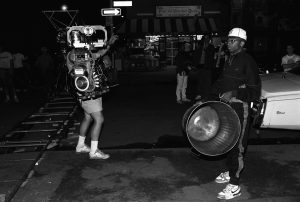 Spike Lee with a trash can and camera on the set of Do the Right Thing; Courtesy Feral House.
According to the film crews, things are sadly a lot more corporate today. “Some element is gone when you lose the hedonism of the business,” says scenic artist Bradley Rubenstein, who also observes of film and television culture, “I think it’s all just content now.” So Cinematic Immunity also depicts a lost era, a time when every last penny didn’t have to be accounted for, when producers wanted to turn a profit but also had an interest in the quality of the final product. Perhaps that’s why there’s only three chapters about 21st century productions and they are all television shows.
Seems that things just aren’t as much fun anymore. Gone are the days when prostitutes would dance on the tables at the weekly Saturday Night Live after-party (“That was just a part of the culture,” says scenic artist Cathy Nasch). Now, the clenching fists of the bean counters have eliminated camaraderie and instead fueled the kind of “toxic environment” that camera operator Leland Krane experienced while working on the series Blindspot, where “everyone was terrified, and the quality of the work was not as good because people were not collaborating. There’d be sloppy stuff, because nobody wanted to take care of it, because it involved contacting another department, talking to somebody else, and nobody wanted to talk to anybody.”
Thankfully, Nirenberg found plenty of people happy to talk to him.
PS: Thanks Feral House for including a packet of microwave popcorn with the review copy of this book! The gift in no way affected my review.