
HYROX is quickly becoming one of the most compelling crossover challenges for endurance athletes looking to build strength, diversify their training, and test themselves in a new competitive arena.
The format is simple: athletes run one kilometre, complete a functional workout station, and repeat that sequence eight times. The stations range from high-power efforts like the SkiErg and row, to strength-focused challenges including sled pushes and pulls, farmer’s carries, sandbag lunges, burpee broad jumps, and a final wall-ball grind.
What makes HYROX particularly appealing to triathletes and runners is that it still rewards aerobic fitness, but layers it with repeated strength demands under fatigue. Singles racing is a full-body endurance test that feels remarkably similar to a prolonged threshold effort. Doubles offers a more social or tactical option, with partners sharing station work while completing all the running together.
All events take place indoors in arena-style venues. For Canadian athletes looking to try it, an Ottawa event is scheduled for May 15-17, 2026.
With professional triathletes increasingly testing themselves on the HYROX circuit and age-group participation surging worldwide, the sport is carving out a distinct space between endurance racing and functional fitness. HYROX also recently became part of World Triathlon, a significant step toward its longer-term goal of Olympic inclusion, potentially as early as the 2032 Brisbane Games.
 Photo Credit: HYROX
Building HYROX Fitness: Inside the ENDUROX Training Hierarchy
If you’re coming to HYROX from triathlon or another endurance background, you may be wondering how to train for something that blends sustained running with repeated high-force strength demands.
This is where Dr. Dan Plews and Dr. Adam Storey come in.
Plews is well-known in the triathlon world as the age-group course record holder at the Ironman World Championship in Kona and the first age-group athlete to break eight hours at Ironman California in 2022. In recent years, he has shifted his competitive focus to HYROX, where he has broken the one-hour barrier individually. He also currently holds the world record for men’s doubles (45-49) with Australian triathlon legend Simon Thompson.
Storey brings complementary expertise as a coach and sport scientist specializing in strength and conditioning, with extensive experience working alongside Olympic athletes. He also recently joined the HYROX Sports Science Advisory Council.
Together, Plews and Storey have partnered with HYROX to share evidence-based training through their platform, ENDUROX. They outline the foundations of their framework here for those of us looking to dip our toes into this new challenge (or to improve our performance after an initial attempt!).
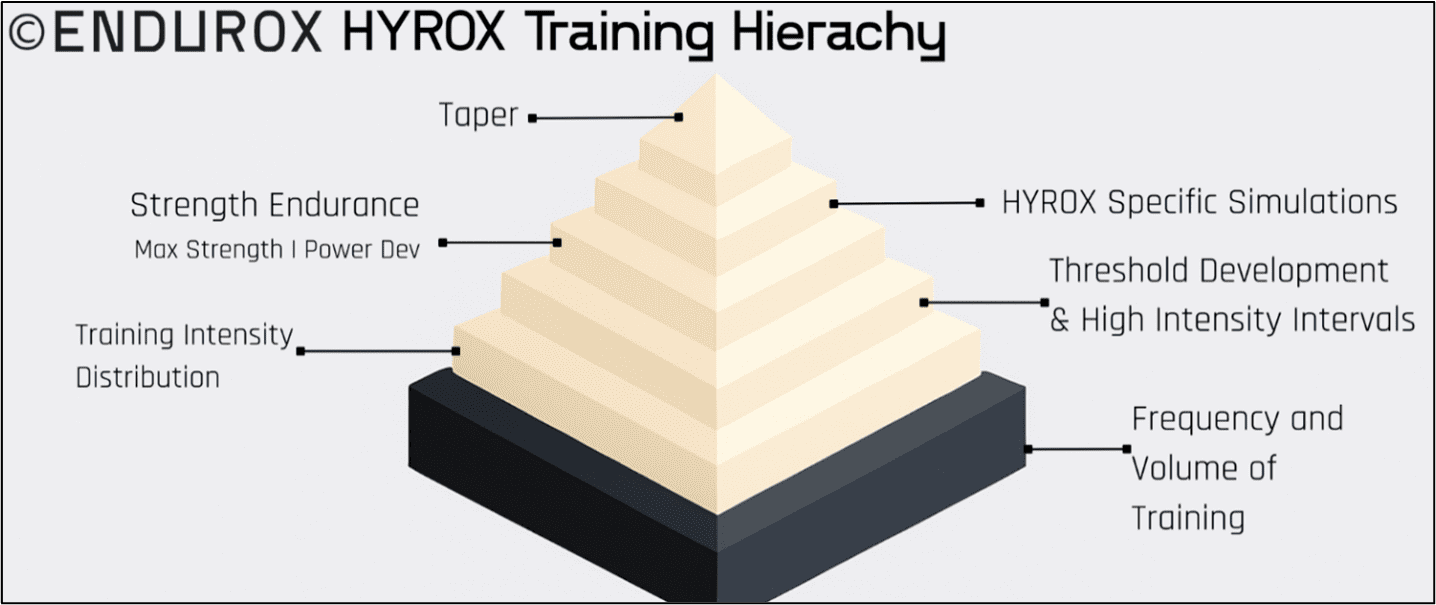 Photo Credit: ENDUROX
The Foundation Will Feel Familiar (Triathletes: You Can Lean on the Engine You’ve Built!)
If you’re coming from triathlon or distance running, it may be reassuring to hear that the aerobic engine you’ve spent years building still matters – a lot.
At the base of the ENDUROX hierarchy sit frequency and volume of training, followed by training intensity distribution.
This mirrors what we already understand in triathlon: training more, particularly at low intensities, builds the aerobic capacity that underpins performance. From there, intensity is layered in deliberately to reflect the demands of the race and the specific physiological qualities that need to be optimized.
So what does this practically mean for triathletes looking to step into HYROX?
Tip 1. Reallocate, Don’t Just Add
When it comes to frequency and volume – the base of the pyramid – total weekly training load may remain similar to what you’re accustomed to. What changes is the distribution.
For example, swim and bike sessions may shift into maintenance mode, preserving fitness without aggressively chasing gains. At the same time, Plews often recommends reducing the length of the long run, with little practical need to exceed 90 minutes, to free up capacity to train for (and adapt to) HYROX-specific strength demands.
As many endurance athletes learn the hard way, simply layering additional load onto an already full training schedule is a fast track to injury, excessive autonomic stress, and a reduced ability to absorb and adapt to new stimuli. Intentional reallocation is key.
Tip 2. Be Strategic With Intensity
Training intensity distribution, the next layer of the pyramid, also benefits from a targeted approach. During a HYROX build, higher-end efforts are best reserved primarily for run and strength sessions, where performance gains have direct race-day relevance.
Swim and bike can retain small doses of intensity to maintain neuromuscular connection, but progression of top-end development should shift toward the run and strength components.
Key Takeaway: For triathletes, HYROX training does not require rebuilding your engine, but it does require strategic reallocation of load. Maintain your aerobic base, reduce non-essential volume, and direct intensity primarily toward the run and strength demands that define the race.
Threshold and Strength Development: Where HYROX-Specific Fitness Takes Shape
The next layers of the pyramid focus on threshold and strength development (which includes maximal strength, power development, and strength endurance).
This is where training becomes distinctly HYROX-specific. It is also where many athletes experience rapid gains as they adapt to unfamiliar demands.
What should this look like in practice? Let’s break it down. (A note that we’ll focus primarily on station-specific work, as most triathletes are already comfortable building threshold fitness on the run.)
Tip 3. Learn the Technique
Plews’ first recommendation for athletes new to HYROX is simple: invest in at least a handful of sessions with a HYROX-informed strength coach – someone who understands the stations and the movement patterns that optimize efficiency.
Poor technique under load, particularly when learning unfamiliar movements, is one of the fastest routes to injury. And there is no quicker way to derail a training block than being sidelined.
A small upfront investment in sound mechanics pays dividends throughout the build, improving efficiency while reducing unnecessary strain.
Tip 4. Raise the Ceiling
The next performance principle is raising the ceiling.
Athletes from CrossFit backgrounds often describe the running as the hardest part of HYROX, while endurance athletes tend to report the opposite: the running feels manageable, and the stations are the key limiter.
Much like VO2 max sets a ceiling for aerobic capacity, with threshold pace existing as a percentage of that ceiling, maximal strength sets the upper limit for force production. In practical terms, the higher your maximal strength, the lower the relative cost of each sled push, carry, or lunge.
This does not mean chasing powerlifting numbers for their own sake. It means progressing deliberately and lifting heavy enough, consistently enough, that race loads feel controlled rather than overwhelming.
 Photo Credit: HYROX
Tip 5. Develop Power and Strength Endurance
Maximal strength raises the ceiling, but power and strength endurance are equally critical qualities.
You can think of developing sustainable power and strength endurance similarly to how you develop these qualities on the bike. Through structured interval-style training with intentional work-to-rest ratios, you progressively improve your ability to generate higher outputs at a lower relative physiological cost. Over time, you increase the percentage of your maximal capacity that you can sustain and repeat under fatigue.
Tip 6. Train the Stations With Intent
Of course, specificity remains essential. This means developing strength not just in the gym, but through deliberate, station-specific work.
Plews recommends two to three station-focused sessions per week during a HYROX build, integrated with ongoing run and endurance training.
Mixed-modality sessions that alternate short runs with station work can also be particularly valuable. Much like traditional brick sessions in triathlon, they prepare athletes to switch efficiently between modalities and adapt to race-specific demands.
Key Takeaway: Raise your ceiling, develop sustainable power and strength endurance, and practice the stations consistently. Also intentionally include mixed-modality sessions that alternate short runs with station work to prepare for race-day demands, much like traditional brick workouts in triathlon.
HYROX Simulations and Tapering: Sharpening for Race-Day Execution
At the top of the hierarchy sit race simulations and tapering. Like triathlon, this phase is not about building fitness; it is about refining execution and preparing to express the fitness you’ve already earned.
Tip 7. Rehearse the Race
HYROX simulations can help calibrate pacing, sharpen transitions between running and stations, and clarify what sustainable effort truly feels like when strength and aerobic demands are interwoven.
Because HYROX typically lasts about an hour, a full simulation is feasible (though demanding, and best used sparingly). Especially for athletes new to the sport, developing a genuine understanding of race-day demands in advance can be invaluable.
Simulations are best introduced in the final weeks before competition, once fitness is established and the focus shifts toward integration and execution.
Tip 8. Implement a Strategic Taper
Last but certainly not least is the taper, which should follow familiar endurance principles. Training volume should be meaningfully reduced (often in the range of 40-60%), while frequency can remain relatively stable. Brief, high-quality efforts should be retained to maintain neuromuscular sharpness and connection to race intensity.
Strength work should be reduced but not eliminated, ensuring athletes arrive rested without feeling flat or disconnected from load.
The objective is simple: remove fatigue, not fitness.
Key Takeaway: Use race simulations to refine pacing, transitions, and confidence. Then taper by reducing volume while preserving intensity and movement patterns so you arrive rested, sharp, and ready to execute.
The Joy of a New Challenge
Dan Plews has already climbed the highest peaks of age-group triathlon. What draws him to HYROX now is the chance to master a new challenge.
For many endurance athletes, that renewed spark can be powerful. If your 2026 race calendar feels in need of something different, HYROX may offer exactly that!
We’ll see you in the arena.

![DVIDS - Images - Allied forces strength showdown [Image 3 of 5]](https://www.vitaminrush.com/wp-content/uploads/2026/04/1776415460_1000w_q95-770x515.jpg "DVIDS – Images – Allied forces strength showdown [Image 3 of 5]")