



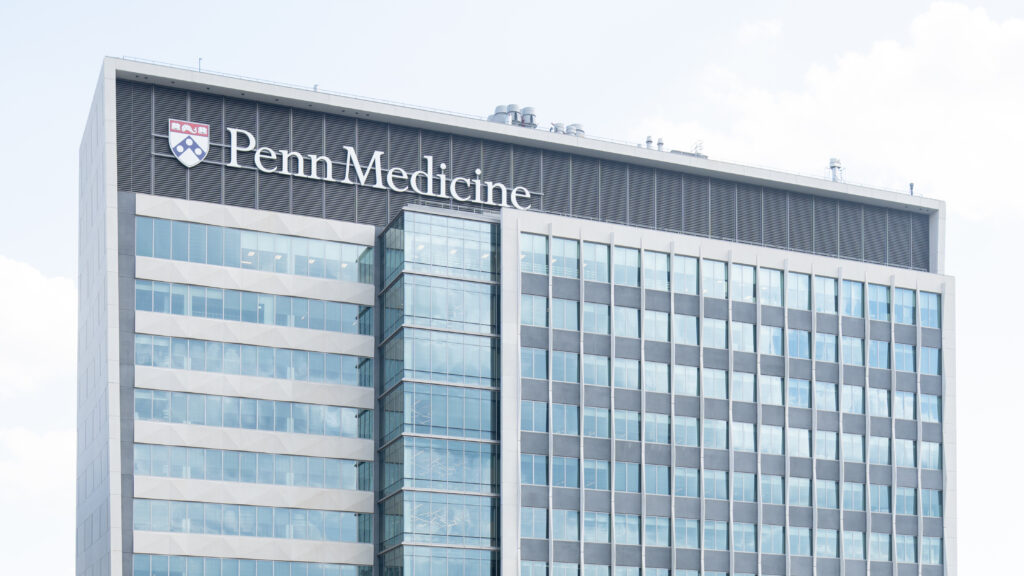
The construction consists of a 217,000-square-foot wet lab, office, and research facility, built on top of an active 250,000 square-foot office tower where the first seven floors have been newly refurbished. The new floors house teams from the Colton Center for Autoimmunity at Penn, a global hub for autoimmunity research and the leader of the Colton Consortium for Autoimmunity (spanning centers at Penn, NYU, Yale, and Tel Aviv University); and the High-Throughput Institute for Discovery, a specialized lab enabling testing on patient samples to help make diagnoses and guide treatments.
“While we can’t predict exactly what tomorrow will hold, our track record shows we have the creativity and courage to meet it head-on. The idea of building for a future we can’t fully see—a kind of faith in possibility—is a hallmark of Penn Medicine,” said University of Pennsylvania Health System CEO Kevin B. Mahoney. “This space embodies that adaptability and, through its connection to our research ecosystem, is designed to be a place where the next breakthroughs will be imagined and achieved.”
A $50 million gift from philanthropists Stewart and Judy Colton, made in 2022 to accelerate the existing Colton Center for Autoimmunity and matched by Penn, has been integral to the construction of the new Colton Center space.
“Autoimmunity affects so many people, and yet we still see gaps in knowledge and care options available to patients and families,” said philanthropists Judy and Stewart Colton, Wharton class of 1962. “Our goal is to improve that outlook. By investing in Penn and its scientific partners in the Colton Consortium, we hope to create an organized approach so we can work together to define the future of this important area of medicine.”
Cementing Penn’s place as an Immune Health leader
Scientists at Penn Medicine are conducting deep profiling of individual immune systems to capture each patient’s unique immune fingerprint, a living blueprint of personal health and disease, that offers new ways of thinking about health care.
The effort’s leader is E. John Wherry, PhD, director of the Institute for Immunology and Immune Health (I3H) and Chair of the Department of Systems Pharmacology & Translational Therapeutics.
The High-Throughput Institute for Discovery is overseen by Sara Cherry, PhD, John W. Eckman Professor of Medical Science in Pathology and Laboratory Medicine, whose research leverages high-throughput screening to accelerate drug discovery and predict drug efficacy in individuals, matching patients with the right treatments. The building will also house a new BSL-3 (Biosafety Level 3) lab, which is specially equipped to handle infectious disease specimens, and was made possible by the philanthropy of University Trustee Wendy Holman, W’97, and Wayne Holman, MD.
Taken together, the building presents new opportunities for using advanced treatments such as CAR T cells and AI-guided drug repurposing, as well as applying cutting-edge immune profiling to define disease mechanisms, and will lead the way to developing innovative new treatments for autoimmune disease. Wherry also emphasized that, often, the key to major advances is bringing together a wide variety of labs with different immunological expertise in one place to share ideas.
One famous example? A chance meeting at a copier between Drew Weissman and Katalin Kariko led to a now-famous scientific partnership that paved the way for mRNA technology and a Nobel Prize. Putting that spirit into action, the new space is dotted with areas meant to foster collaboration and draw researchers together, plus other, more private spaces intended for sensitive conversations and reflection.