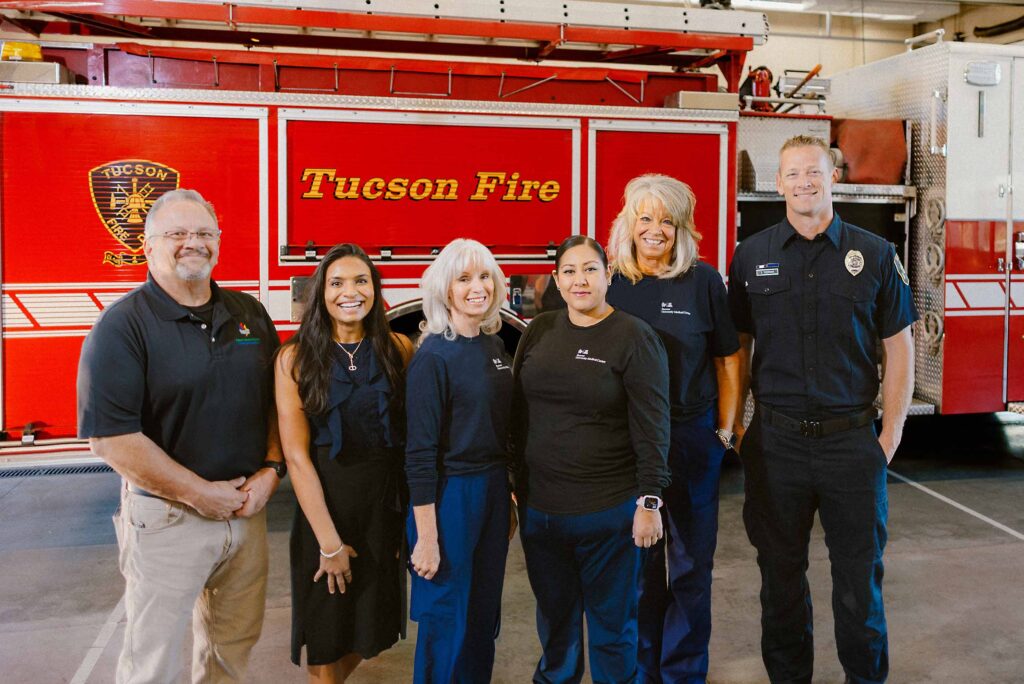
Researchers at the University of Arizona Comprehensive Cancer Center are conducting a clinical research trial with the Tucson Fire Department to evaluate whether an over-the-counter dietary supplement made from broccoli seed and sprout extracts can help the body detoxify and eliminate harmful chemical exposures that firefighters may encounter during their work.
Patricia Thompson, professor of physiology, U of A College of Medicine – Tucson
Photo by Joshua Elz, U of A Comprehensive Cancer Center
The clinical trial is funded by the National Cancer Institute and supports research within the University of Arizona Cancer Prevention Clinical Trials Network (UA CP-CTNet).
The Phase 2 clinical trial is testing whether taking a daily tablet containing broccoli seed and sprout extract for 12 weeks can help the body more effectively process and eliminate harmful chemicals commonly found in smoke.
“Firefighters are routinely exposed to a complex mixture of environmental chemicals during their work, including substances classified as carcinogens,” said Patricia Thompson, principal investigator of UA CP-CTNet, professor of physiology at the U of A College of Medicine – Tucson and a member of the Cancer Center.
“This study explores a cancer prevention strategy focused on supporting the body’s natural detoxification processes. By testing a plant-based intervention in a real-world setting, we hope to better understand whether nutritional approaches can help reduce the biological impact of chemical exposures over time.”
The study is led by Dr. Malvi Bipin Savani, assistant professor of medicine at the University of Arizona College of Medicine – Tucson and a physician at the Southern Arizona VA Health Care System. The research is being conducted with fire stations across the Tucson Fire Department and involves close collaboration with firefighters as research partners.
Dr. Malvi Bipin Savani, assistant professor of medicine at the University of Arizona College of Medicine – Tucson and a physician at the Southern Arizona VA Health Care System
Photo by Kris Hanning, U of A Office of Research and Partnerships
“The current study is among the first efforts to explore whether a nutraceutical — a food-based product studied for potential health effects — can be used as a cancer prevention research strategy in an occupational exposure setting such as firefighting,” Savani said.
As part of the trial, study coordinators and trained Tucson Fire Department liaisons meet crews at their stations to collect urine samples within hours after firefighters respond to fires, often between calls or late in the day. Researchers will analyze the samples to measure chemical exposures and biological markers that indicate how effectively the body processes those exposures and to determine whether the intervention increases the body’s ability to clear these chemicals. The study will follow 66 firefighters, each of whom will take either the supplement or a placebo daily for 12 weeks.
Broccoli and other cruciferous vegetables are natural food sources of sulforaphane, a compound studied for its ability to activate the body’s natural detoxification pathways, which help break down and remove certain toxic substances.
The broccoli extract used in the study is sold as the dietary supplement Avmacol®.
The study is based on earlier research led by Dr. Julie Bauman, former deputy director of the Cancer Center, which showed that Avmacol® increased urinary excretion of carcinogens found in tobacco smoke among smokers. This increase in urinary excretion is considered a marker of enhanced chemical clearance in individuals exposed to these compounds.
Savani and the UA CP-CTNet team are leveraging a longstanding collaboration, led by Dr. Jeff Burgess, between U of A public health researchers and the Tucson Fire Department. Burgess, a professor in the Department of Community, Environment and Policy at the Mel and Enid Zuckerman College of Public Health and director of the Center for Firefighter Health Collaborative Research, is also involved in the current study. He has collaborated with firefighters on health and safety research since 1992, with a focus on cancer risk and prevention since 2015.
Conducting a clinical trial in active fire stations presents logistical challenges, Thompson said.
“Our team has spent extensive time working with firefighters to develop a study design that reflects real-world conditions,” she said. “Collecting data across multiple firehouses requires flexibility and problem solving in real time.”
Researchers interview participants, obtain informed consent, collect blood samples and record vital signs and medical histories. Follow-up assessments occur after the 12-week study period. Unlike traditional clinic-based trials, much of this work takes place around firefighters’ duty schedules.
In addition to measuring environmental exposures, the research team will analyze metabolic and molecular markers, including changes in gene activity and protein expression as biological readouts of the intervention’s effects.
“This trial is asking whether this type of research approach is feasible and whether it provides enough biological information to justify a larger, longer-term study,” Thompson said.
“Large-scale urban fires have highlighted the need to better understand occupational exposures and potential preventive strategies,” Thompson said. “If future studies show that this approach meaningfully alters biological markers associated with carcinogen exposure, it could inform new directions for cancer prevention research.”