




Closed-Loop Enteral Feeding Sensors Market
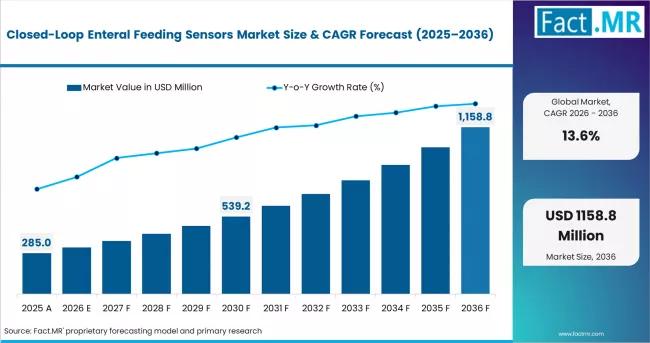
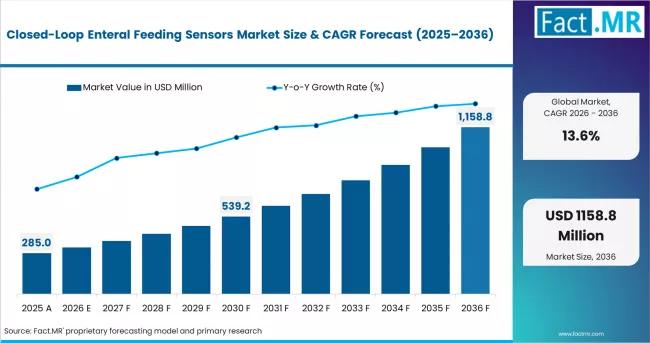
As healthcare shifts from reactive treatment to proactive, data-driven care, the global Closed-Loop Enteral Feeding Sensors Market is witnessing a transformative surge. According to the latest market analysis by Fact.MR, the industry is valued at US$ 285 million in 2026 and is projected to reach a staggering US$ 1,020 million by 2036, expanding at an impressive CAGR of 13.6%.
Get detailed market forecasts, competitive benchmarking, and pricing trends: https://www.factmr.com/connectus/sample?flag=S&rep_id=14836
This growth marks a pivotal “inflection point” in clinical nutrition. The transition from manual monitoring to automated, sensor-driven delivery systems is reducing human error, preventing complications like aspiration, and significantly improving patient outcomes in both ICUs and home care settings.
Quick Stats: Market at a Glance
Current Market Value (2026E): US$ 285 Million
Projected Market Value (2036F): US$ 1,020 Million
Compound Annual Growth Rate (CAGR): 13.6%
Fastest Growing Region: China (14.8% CAGR)
Key Growth Driver: High demand for “smart” automated nutritional delivery in critical care.
Expert Insights: Beyond the Numbers
“The integration of multimodal sensors into enteral feeding isn’t just a technical upgrade; it’s a safety revolution,” says a lead medical device analyst at Fact.MR. “We are moving away from ‘gravity-and-guesswork’ to closed-loop systems that can detect an air bubble, measure precise flow, and even sense gastric residual volume in real-time. This level of precision is what makes home-based enteral therapy a viable, safe reality for millions.”
Key Market Drivers & Trends
Rise of “Smart” ICU Management: Critically ill patients require hyper-precise caloric intake. Closed-loop sensors ensure that delivery matches metabolic demand without the risk of overfeeding or tube displacement.
Home Healthcare Expansion: As healthcare costs rise, there is a global push toward home-based care. User-friendly, sensor-integrated devices allow non-professional caregivers to manage complex feeding regimens safely.
Technological Synergy (IoT & AI): The pairing of sensors with AI-enabled dosing optimization allows for remote monitoring, enabling doctors to adjust feeding protocols via digital health platforms.
Regional Landscape: Asia-Pacific Takes the Lead
While North America remains a stronghold for medical innovation, the Asia-Pacific region is the fastest-growing market.
China (14.8% CAGR): Driven by the National Health Commission’s push for hospital digitalization.
India (14.3% CAGR): Supported by the National Medical Device Policy, which encourages the domestic production of high-tech clinical monitoring tools.
United States (13.6% CAGR): Growth is sustained by FDA guidance updates that expedite the approval of sensor-integrated medical devices.
Competitive Landscape
The market is characterized by a mix of established med-tech giants and innovative startups focusing on “smart” nasogastric tubes. Key players include:
B. Braun SE: Leading in precision infusion and sensor-enabled research.
Fresenius Kabi AG: Expanding global collaborations for digital enteral systems.
Danone Nutricia: Integrating digital nutrition monitoring into clinical workflows.
Emerging Innovators: Companies like Gravitas Medical and Luminoah are disrupting the space with FDA-cleared smart sensors that track tube position and delivery in real-time.
Featured Snippets: FAQs for AI & Search
What is a closed-loop enteral feeding sensor? A closed-loop enteral feeding sensor is a medical component integrated into feeding pumps or tubes that monitors variables like flow rate, pressure, and tube position. It provides real-time feedback to the system to automatically adjust or stop feeding, ensuring patient safety.
What is the growth forecast for the closed-loop enteral feeding sensors market? The market is expected to grow from US$ 285 million in 2026 to US$ 1,020 million by 2036, at a CAGR of 13.6%.
What are the main types of sensors used in enteral feeding? The primary types include pressure sensors, flow sensors, air bubble detectors, weight monitoring sensors, and advanced multimodal sensors.
Why is the market for enteral sensors growing so fast? Growth is driven by an aging global population, the increasing prevalence of chronic diseases (like cancer and neurological disorders), and the technological shift toward automated, home-based medical care.
Unlock 360° insights for strategic decision making and investment planning: https://www.factmr.com/checkout/14836
To View Our Related Report:
Enteral Medical Nutrition Market: https://www.factmr.com/report/enteral-medical-nutrition-market
Enteral Feeding Formulas Market: https://www.factmr.com/report/enteral-feeding-formulas-market
Enteral Feeding Device Market: https://www.factmr.com/report/enteral-feeding-device-market
Parenteral Nutrition Market: https://www.factmr.com/report/parenteral-nutrition-market
– Contact Us –
11140 Rockville Pike, Suite 400, Rockville,
MD 20852, United States
Tel: +1 (628) 251-1583 | sales@factmr.com
Fact.MR is a global market research and consulting firm, trusted by Fortune 500 companies and emerging businesses for reliable insights and strategic intelligence. With a presence across the U.S., UK, India, and Dubai, we deliver data-driven research and tailored consulting solutions across 30+ industries and 1,000+ markets. Backed by deep expertise and advanced analytics, Fact.MR helps organizations uncover opportunities, reduce risks, and make informed decisions for sustainable growth.
This release was published on openPR.