




Connected Fitness Market Size, Share, and Growth
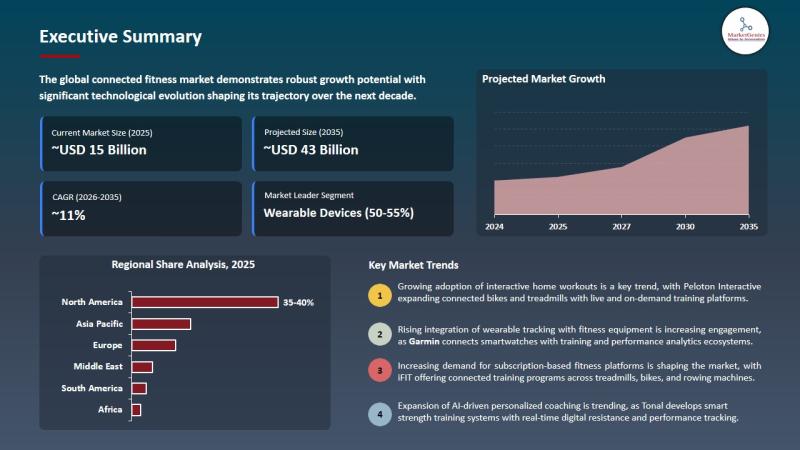
Wilmington, DE, USA, April 24, 2026 – According to MarketGenics Global Research, the global connected fitness market is valued at USD 14.7 billion in 2025 and is projected to reach USD 43.3 billion by 2035, expanding at a CAGR of 11.4% during the forecast period.
The market is transitioning from hardware-led growth to an integrated ecosystem model where devices, software, and subscription platforms operate as a unified digital fitness infrastructure.
Connected fitness is no longer defined by equipment-it is defined by data, personalization, and continuous engagement.
Get Sample Copy of the Report: https://marketgenics.co/download-report-sample/connected-fitness-market-58258
==============================
MARKET STRUCTURE & CONCENTRATION
The global connected fitness market is moderately consolidated, with the top five players accounting for over 55% of market share in 2025.
Market leadership is anchored in ecosystem control-companies that integrate hardware, software, and content are capturing disproportionate value.
Key players including Apple, Fitbit (Google), Garmin, Samsung, and Peloton dominate through vertically integrated platforms, proprietary fitness ecosystems, and continuous innovation in wearable and connected technologies.
==============================
SEGMENTAL DATA INSIGHTS
The wearable devices segment dominates the global connected fitness market, accounting for approximately 54% of total market share in 2025.
This dominance is driven by widespread adoption of smartwatches and fitness trackers enabling real-time health monitoring, activity tracking, and seamless integration with digital fitness applications.
Connected equipment and digital platforms are gaining traction, reflecting a shift toward hybrid fitness ecosystems combining physical hardware with subscription-based services.
==============================
PRODUCT PERFORMANCE BENCHMARKING
Competitive differentiation is increasingly defined by ecosystem depth and user engagement rather than standalone device performance:
• Wearable Devices – Core segment driven by continuous health monitoring
• Connected Equipment – Growth driven by interactive and immersive training
• Digital Platforms & Software – Recurring revenue backbone
• Hybrid Solutions – Integrated hardware + software ecosystems
• AI-Powered Coaching Systems – Emerging differentiator in user retention
The competitive battlefield is shifting from devices to data ecosystems.
==============================
DEMAND TRENDS
Rising demand for continuous health monitoring and fitness tracking is accelerating adoption of wearable technologies globally.
Consumers increasingly prefer connected devices integrated with smartphones and digital ecosystems, enabling seamless tracking, analytics, and personalized training experiences.
The shift toward home-based fitness and subscription-driven engagement models is redefining consumption patterns across the industry.
==============================
VALUE CHAIN & APPLICATION INTELLIGENCE
The connected fitness value chain integrates hardware manufacturing with digital service delivery:
• Component sourcing – sensors, processors, batteries, connectivity modules
• Device manufacturing – wearables and smart fitness equipment
• Software integration – mobile apps, cloud platforms, analytics engines
• Subscription services – virtual coaching, content, and performance tracking
• Post-sale engagement – updates, community platforms, and user analytics
This convergence of hardware and software creates recurring revenue streams and long-term user lock-in.
==============================
TECHNOLOGY TRANSFORMATION
AI-driven personalization, real-time biometric tracking, and cloud-based fitness platforms are reshaping the user experience.
Emerging technologies such as virtual reality and immersive training environments are transforming fitness into an interactive, gamified experience.
The integration of wearables with connected equipment is creating a unified health and performance ecosystem.
==============================
PRICING & COST PRESSURE ANALYSIS
High upfront costs of connected equipment and premium wearable devices remain a key barrier to adoption.
Subscription dependency adds ongoing cost pressure for consumers, limiting penetration in price-sensitive markets.
Manufacturers face the challenge of balancing advanced features with affordability to achieve mass-market scalability.
==============================
END-USE INTENSITY ANALYSIS
Demand is expanding across multiple application segments:
• Home Fitness & Personal Use – Primary growth driver
• Commercial Gyms & Fitness Centers – Hybrid adoption models
• Corporate Wellness Programs – Emerging enterprise opportunity
• Healthcare & Medical Integration – Data-driven health monitoring
• Professional & Elite Training – Performance analytics-driven adoption
This diversification strengthens the market’s long-term resilience and scalability.
==============================
REGIONAL INSIGHTS
North America dominates the global connected fitness market, accounting for approximately 35-40% of total market share in 2025.
Regional leadership is driven by high adoption of wearable devices, advanced digital infrastructure, and strong consumer spending on health and wellness technologies.
Asia Pacific is the fastest-growing region, supported by rising health awareness, expanding middle-class population, and increasing smartphone penetration.
==============================
INNOVATION & ECOSYSTEM SHIFT
The market is evolving toward fully integrated fitness ecosystems combining wearables, connected equipment, and digital platforms.
AI-powered coaching, cloud-based analytics, and immersive virtual training are emerging as core differentiators.
Ecosystem integration-not device innovation alone-is defining competitive advantage.
==============================
COMPETITIVE LANDSCAPE
• Apple
• Fitbit (Google)
• Garmin
• Samsung
• Peloton
• iFIT
• Technogym
• Strava
• Nike Training Club
• ClassPass
• Other Key Players
==============================
STRATEGIC DEVELOPMENTS
In December 2025, iFIT partnered with F45 Training to integrate at-home digital workouts with in-studio fitness, expanding immersive training experiences.
In October 2025, Peloton partnered with Johnson Fitness & Wellness to expand retail access for its connected fitness equipment across more than 100 stores.
==============================
FUTURE OUTLOOK & OPPORTUNITIES
The global connected fitness market is expected to create an incremental opportunity of approximately USD 29 billion by 2035.
Growth opportunities are expanding across AI-powered fitness applications, wearable health monitoring, smart home gyms, and corporate wellness integration.
==============================
THE GLOBAL CONNECTED FITNESS MARKET HAS BEEN SEGMENTED AS FOLLOWS:
By Product Type
• Wearable Devices
• Connected Equipment
• Digital Platforms & Software
• Hybrid Solutions
By Connectivity Type
• Bluetooth
• WiFi
• Cellular
• Hybrid
By Distribution Channel
• Direct-to-Consumer
• E-commerce
• Retail
• Fitness Centers
By End-Use
• Home Fitness
• Commercial Gyms
• Corporate Wellness
• Healthcare & Medical
==============================
KEY MARKET TRENDS
Key trends include AI-driven personalized training, integration of wearables with connected equipment, growth of subscription-based fitness platforms, and expansion of immersive and virtual fitness experiences.
==============================
RESEARCH METHODOLOGY:
The study integrates device-level analysis, user behavior modeling, and digital ecosystem mapping across global markets.
Analytical frameworks include competitive benchmarking, pricing analysis, adoption modeling, and technology impact assessment.
The research further incorporates innovation tracking, regulatory analysis, and strategic opportunity mapping across the connected fitness ecosystem.
Access the full report and strategic insights: https://marketgenics.co/reports/connected-fitness-market-58258
==============================
RECOMMENDED REPORTS:
E-Commerce Market: https://marketgenics.co/reports/e-commerce-market-45229
Wellness Products Market: https://marketgenics.co/reports/wellness-products-market-48969
Contact:
Mr. Nikhil Sawlani
MarketGenics Global Research
800 N King Street, Suite 304 #4208, Wilmington, DE 19801, United States
USA: +1 (302) 303-2617
Email: sales@marketgenics.co
Website: https://marketgenics.co
About MarketGenics
MarketGenics is a global market research and business advisory firm empowering decision-makers across startups, Fortune 500 companies, non-profit organizations, universities, and government institutions. The company delivers comprehensive market intelligence, industry analysis, and strategic insights across diverse sectors.
MarketGenics publishes detailed industry research reports combining granular quantitative analysis with expert insights on market trends, competitive landscapes, and emerging opportunities. These reports help organizations make informed strategic decisions, identify growth opportunities, and support sustainable business development.
In addition to research publications, MarketGenics supports organizations with strategic insights on product development, application modeling, market expansion strategies, and identifying niche growth opportunities.
This release was published on openPR.