




 WESH
WESH
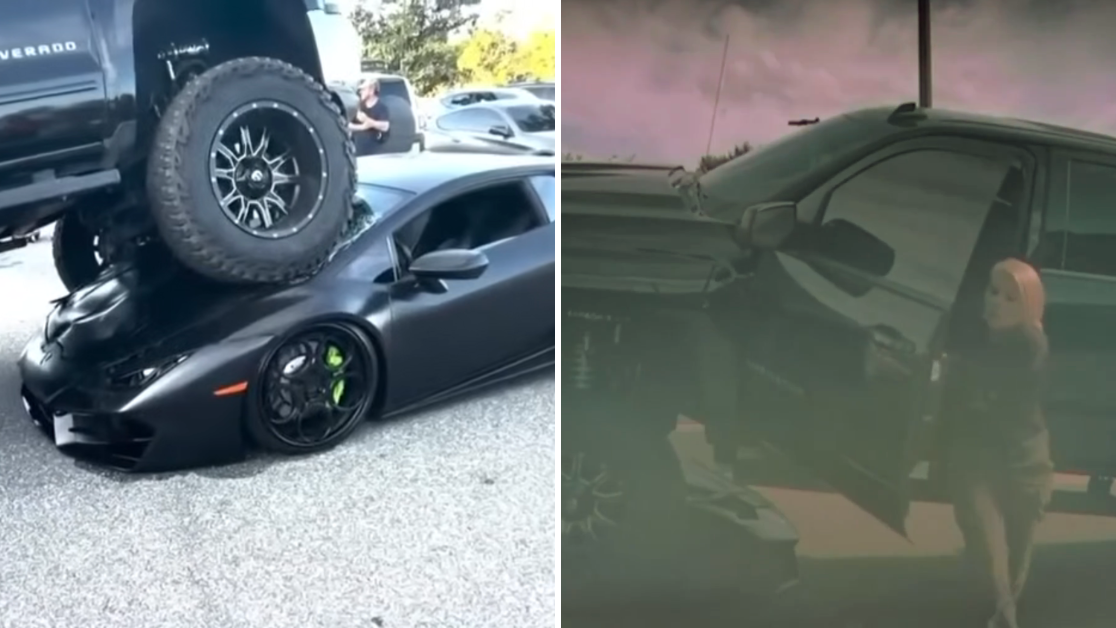
Ramón Ferrer was driving his black Lamborghini Huracán through the parking lot of a Lake Nona shopping center on April 22, 2026, headed to the gym, when a lifted Chevrolet Silverado came around the corner, didn’t slow, and drove up and over the front end of his supercar (1).
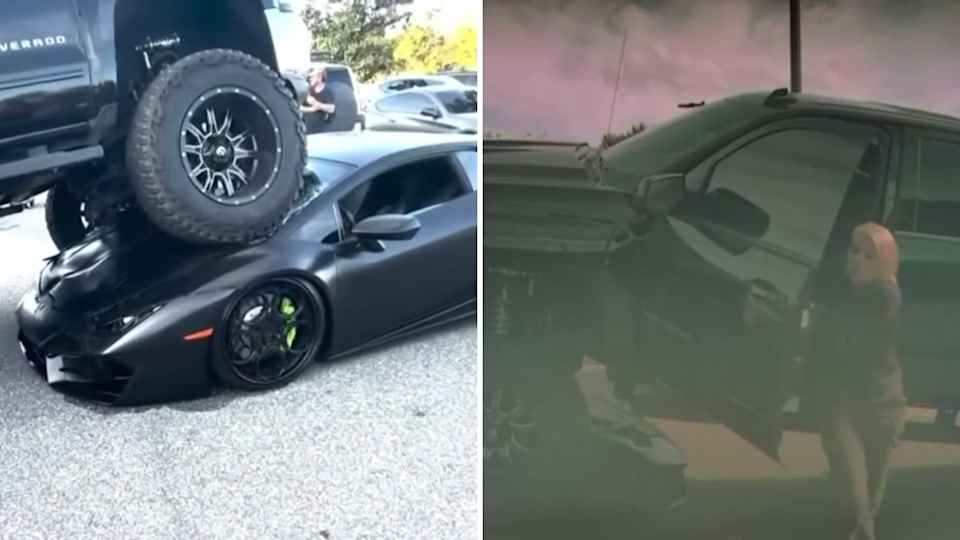
Ferrer was still inside, five months into owning the car (1). The truck climbed the Huracán’s nose, shattered the windshield, gouged the hood and came to rest on top of the car like a monster-truck show stunt that wasn’t supposed to happen at a strip mall. The Silverado’s driver got out, put her hands on her head and stared at what she’d just done (1).
No one was hurt, which is the only reason this clip is everywhere instead of a tragedy.
The footage, which began circulating on social media on April 23, has been viewed millions of times across X, Reddit and Instagram (2). The Huracán is moving slowly, the way you’d expect anyone hunting for a parking space in a low-slung exotic to move. The Silverado enters the frame with noticeably more speed than the setting calls for. There’s no obvious correction, no hard braking before contact. The truck just rides up and over (2).
A tow truck and a crane were eventually needed to separate the two vehicles (1). No criminal charges have been filed as of this writing (1).
The truck didn’t need a short driver to make a Huracán disappear. It just needed to be a lifted full-size pickup.
Lifted pickups have a forward blind zone that grows with every inch of ride height, and the trucks themselves keep getting taller from the factory before anyone touches the suspension.
A June 2025 study from the European Federation for Transport and Environment found the average hood height of new cars sold in the EU, UK and Norway has risen by half a centimeter every year since 2010, reaching roughly 33 inches (83.8 cm) in 2024, with 46% of new vehicles now exceeding 33.5 inches (3). The trend is sharper in the US. The Insurance Institute for Highway Safety reports that the average American passenger vehicle has grown roughly 4 inches wider, 10 inches longer, 8 inches taller and 1,000 pounds heavier over the past three decades (4).
Story continues
A lift kit on top of a full-size pickup that already left the factory tall pushes the geometry past the point of usable forward visibility.
The blind zone that swallowed a $250,000 supercar swallows other things, too.
A graphic from the T&E study shows that a driver in a Dodge Ram TRX cannot see a 4-foot-5-inch 9-year-old standing directly in front of the bumper (3). And the IIHS, in a 2023 analysis of nearly 18,000 pedestrian crashes, found that pickups, SUVs and vans with hoods more than 40 inches off the ground are about 45% more likely to kill pedestrians than vehicles with hoods 30 inches or lower (4).
US pedestrian deaths fell 11% in the first half of 2025, the largest drop since the Governors Highway Safety Association started tracking the number 15 years ago (5). But fatalities remain roughly 20% above 2016 levels and hit a 40-year high in 2022 (6). Drivers still struck and killed 7,148 people on foot in 2024 (6).
The Lake Nona crash went viral because the thing in the blind zone was a Lamborghini and the owner wasn’t hurt. The version of this crash that nobody films involves a kid on a scooter.
A new Huracán starts around $250,000, and that’s before customizations. The financial cleanup is going to be a story of its own.
Most personal auto policies in Florida cap property damage liability well below that figure. The state’s mandatory minimum is just $10,000 in PDL coverage, and even drivers who carry expanded limits typically top out at $50,000 to $100,000. Anything beyond the policy ceiling becomes the at-fault driver’s personal liability, and a judgment that size can follow someone for years.
Whether Ferrer’s car is repairable or written off depends on what’s underneath the cosmetic damage. Insurers typically declare a vehicle a total loss when repair costs hit 50% to 75% of its pre-accident value, with the exact threshold varying by state (7). For exotics, that math turns ugly fast: specialized parts can cost 10 to 20 times more than equivalent components on a regular car, and a single carbon-fiber hood replacement on a comparable supercar runs around $15,000 (8). With a three-ton Silverado parked across an aluminum-and-carbon monocoque, frame damage is on the table, and one outlet that interviewed Ferrer noted his Huracán may end up a write-off (9).
Ferrer’s collision coverage, assuming he carried it, will eat the rest, and his premiums are heading in one direction. Before any of that, the tow, crane and storage bill alone is likely a five-figure invoice.
“Today I was born again,” Ferrer wrote in a social media post after the crash. “Thank you God for another day and another chance. Material things don’t matter to me — my health is the main thing.”
T&E is pushing European regulators to cap new-vehicle hood heights at 33.5 inches starting in 2035. There is no comparable proposal moving through US federal regulation. The National Highway Traffic Safety Administration sets crashworthiness standards for occupants, not for the people standing in front of the bumper.
Until that changes, the Lake Nona parking lot is a preview of crashes or vehicle incidents that end with not everyone walking away.
Join 250,000+ readers and get Moneywise’s best stories and exclusive interviews first — clear insights curated and delivered weekly. Subscribe now.
We rely only on vetted sources and credible third-party reporting. For details, see our editorial ethics and guidelines.
WESH (1); Carscoops (2); Transport & Environment (3); Insurance Institute for Highway Safety (4); Governors Highway Safety Association (5, 6); SuperCarClaims.com (7); FirstMark Insurance Group (8); autoevolution (9)
This article originally appeared on Moneywise.com under the title: Florida woman’s Silverado rolled over a $250K Lambo at Crunch Fitness — a known safety risk could’ve ended it worse
This article provides information only and should not be construed as advice. It is provided without warranty of any kind.