




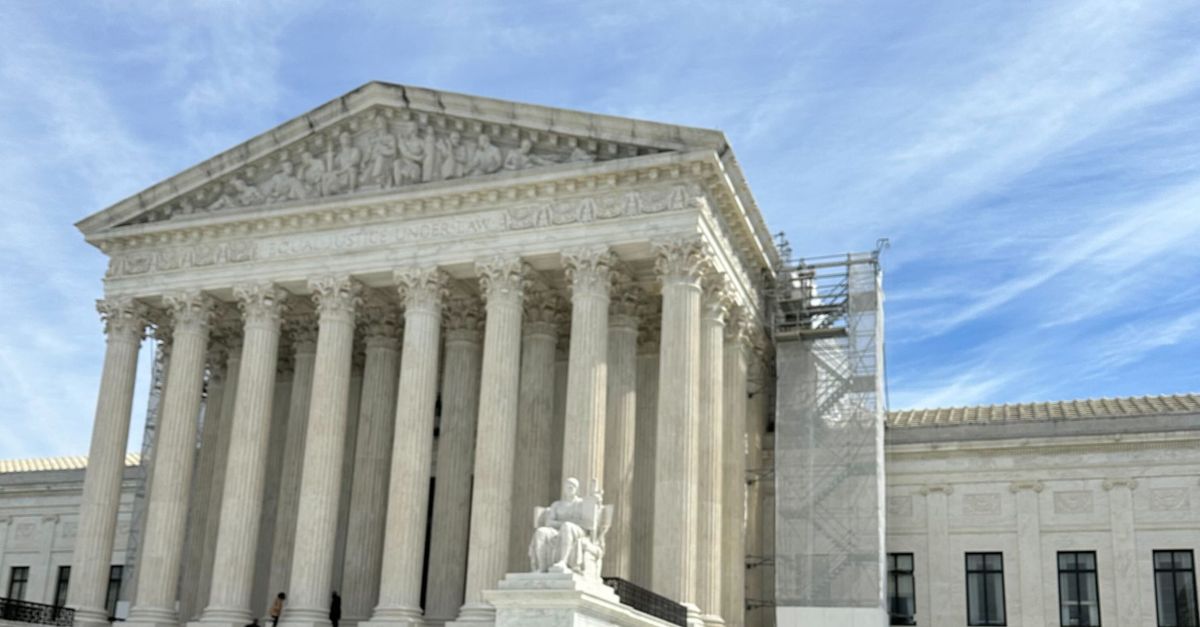
In yesterday’s decision in Hencely v Fluor Corporation, Justice Clarence Thomas’ opinion for the majority rejected the idea that military contractors have absolute immunity for negligent mistakes they make in an active war zone.
The case arises from a 2016 suicide bombing at Bagram Airfield, then a U.S. military base in Afghanistan. The bombing was perpetrated by a former Taliban member working as an on-base employee of the defendant Fluor, a military contractor, and the suit reflects the view of the survivors that Fluor’s failure to follow the military’s rules about keeping track of its native employees made it responsible for the attack. As my post about the argument explained, the oral argument suggested general skepticism about the idea that Fluor’s status as a military contractor protected it from liability. What we now know is that it does not.
Thomas starts from the premise that the statement in the supremacy clause of the Constitution that federal law is “the supreme Law of the Land” means that “the state law must yield” whenever federal law contradicts state law. Granting that, he emphasizes that state law is not preempted “in vacuo, without a constitutional text or a federal statute.” Under that reasoning, the lack of preemption here is self-evident to Thomas: “No constitutional provision says [Hencely’s state law tort suit] is preempted … Nor does any federal statute preempt this suit.”
Thomas first considers the lower court’s conclusion that the contractor’s immunity can be derived from a 1988 Supreme Court case called Boyle v. United Technologies Corp. Boyle involved a suit against a contractor seeking to hold the contractor liable under state law for defective design even if it built a military helicopter as its contract with the government required. Thomas states that Boyle recognized “a defense because ‘the government [] directed the contractor to do the very thing that is the subject of the claim.’” In contrast, the conduct here “was not authorized by, but was even contrary to, federal instructions,” as military officials found that it “failed in its contractual obligations.” In summary, “[e]ven granting that there is a ‘uniquely federal interest’ in the regulation of military bases overseas, there would be no ‘significant conflict’ between that interest and state-law negligence liability premised on a contractor’s departure from military instructions.”
Recommended Citation: Ronald Mann, Justices reject certain protections for contractors in war zones, SCOTUSblog (Apr. 23, 2026, 1:26 PM), https://www.scotusblog.com/2026/04/justices-reject-certain-protections-for-contractors-in-war-zones/