



Your support helps us to tell the story
From reproductive rights to climate change to Big Tech, The Independent is on the ground when the story is developing. Whether it’s investigating the financials of Elon Musk’s pro-Trump PAC or producing our latest documentary, ‘The A Word’, which shines a light on the American women fighting for reproductive rights, we know how important it is to parse out the facts from the messaging.
At such a critical moment in US history, we need reporters on the ground. Your donation allows us to keep sending journalists to speak to both sides of the story.
The Independent is trusted by Americans across the entire political spectrum. And unlike many other quality news outlets, we choose not to lock Americans out of our reporting and analysis with paywalls. We believe quality journalism should be available to everyone, paid for by those who can afford it.
Your support makes all the difference.Read more
Dressed in a tight white vest tucked into camouflage trousers, the sergeant who greets me at RAF High Wycombe cuts an imposing figure. Broad shoulders and a vice-like handshake cement this status. This is the man who will be overseeing my RAF fitness test.
The assessment is split into three parts, with the first being the multistage fitness test – better known as the bleep test. This gruelling challenge involves running 20-metre shuttles between two cones in time with a shrill beep. The further you go, the faster the beeps become – participants continue until they cannot keep up.
I’m told the score I need to pass for my age group, then I step into a sports hall and walk up to the start line. Despite a smattering of recruits watching on, the world seems to go quiet as three beeps signal the start of the test. I push off with my right foot, step forward with my left, and the test begins.
What happened when I took the RAF fitness test?
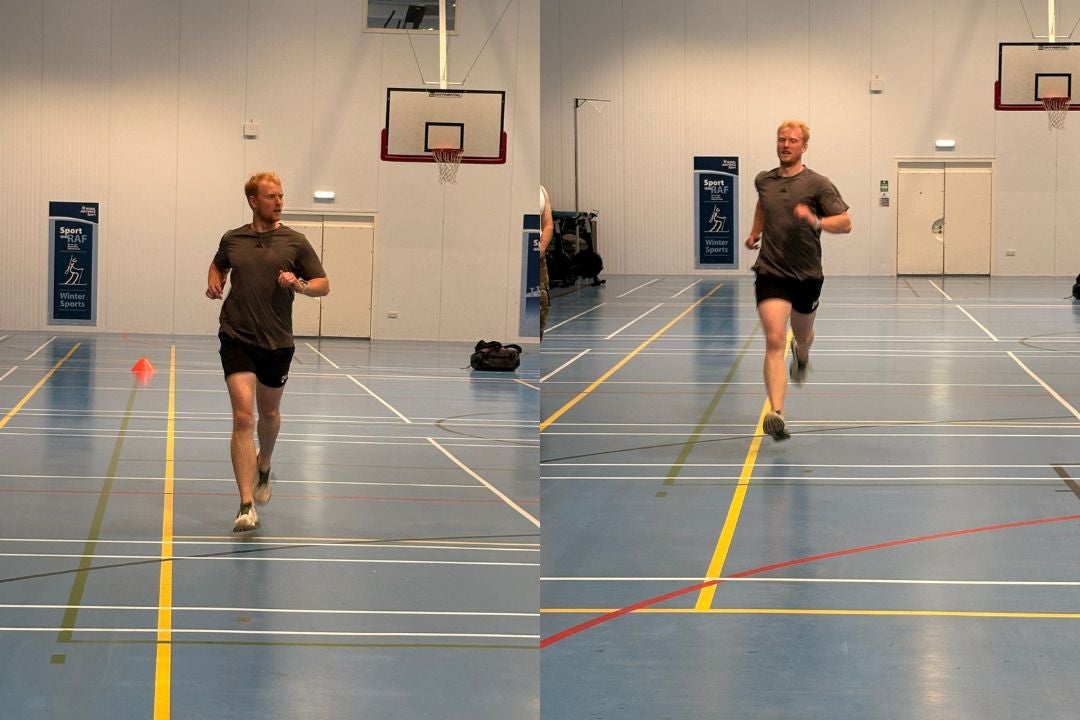 I found the bleep test started off incredibly slowly, but soon ramped up (Harry Bullmore/The Independent)
Part one: The multistage fitness test
How to do it
The bleep test is split into levels. After completing a set number of shuttles in one level, you progress to the next one, and each level requires you to run marginally faster than the last.
Your score is defined by the level you reach followed by the number of shuttles you successfully complete within that level. You stop when you fail to cover the 20-meter distance in time with the eponymous bleeps for three consecutive shuttles.
How I fared
The test starts incredibly slowly, lulling me into a false sense of security. On my first shuttle, a light jog takes me to the second cone with time to spare, then I stand there waiting for the next beep to sound.
This is the devilish nature of the test. It slowly forces you to crank up through the gears until you have nothing left to give.
For someone who trains in a CrossFit gym invariably filled with thumping music, the environment is somewhat unnerving. All I can hear is the slapping of my shoes against the sports hall flooring, interrupted occasionally by a loud beep.
In an attempt to fill the silence, I make a couple of nervous jokes to personnel present, but very soon I’m in no fit state to speak.
As we pass level 10, the speed ramps up considerably. My early plodding evolves into a purposeful stride, and my cheeks progress along the Dulux paint chart until they reach an aggressively deep red.
By level 11, I’m struggling to keep pace. My legs are leaden, my breathing is ragged and sweat soaks my forehead. I make 11.1, 11.2, 11.3, 11.4 – then the wheels fall off.
Roughly 10 minutes and 2km in, I’ve hit the point of no return. My body can no longer supply my muscles with the fuel this intense test demands, and I bow out. My fitness tracker later shows how my heart rate held at a cool, calm and collected 120-or-so until the nine-minute mark, then the increased pace of levels 10 and 11 sent it soaring into the 160s.
As I double over, plant my hands on my knees and attempt to regain some semblance of composure, my invigilator informs me I’ve done enough to earn a pass.
Read more: How to prevent muscle loss when using weight-loss drugs, according to science
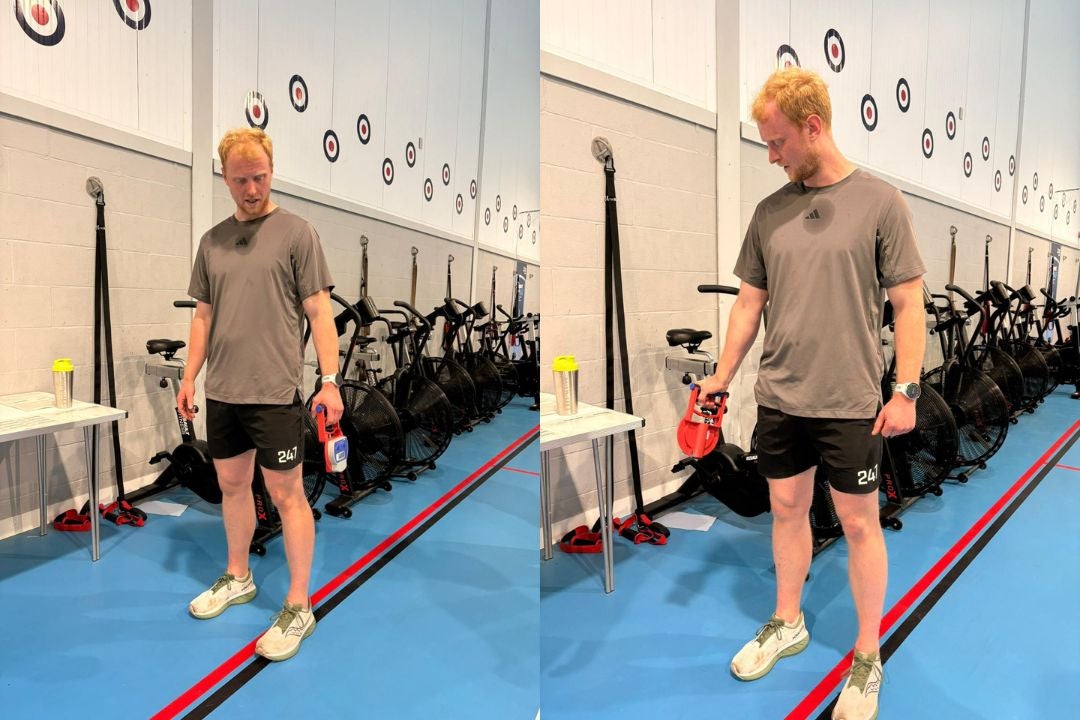 Still sweaty from the multistage fitness test minutes before, my next job was to tackle the grip dynamometer (Harry Bullmore/The Independent)
Part two: The grip dynamometer test
How to do it
Grip strength might seem like an odd measure of your overall fitness, but it has been identified as a reliable indicator of overall upper body strength, as well as being linked to greater health and longevity.
The way to test it is simple. You hold a grip dynamometer (a kitchen scale-esque item attached to a handle) at your side, slightly away from your body, with a straight arm. Then, without holding your breath, squeeze as hard as you can.
There are no levels to this one: it is simply a pass or a fail depending on your score.
How I fared
Grip strength has always been something of a weakness of mine, so I fear it could be the undoing of my bid to earn a pass. However, the test is over in a matter of seconds.
Following the instructions given, I grab the dynamometer with my left hand, squeeze as hard as I can and, thankfully, scrape a pass with a score of 41.4kg – the amount of force generated.
Interestingly, I then repeat the test on my favoured right hand and record a weaker score. The grip dynamometer can be a handy tool for identifying strength asymmetries, an on-hand exercise physiologist informs me.
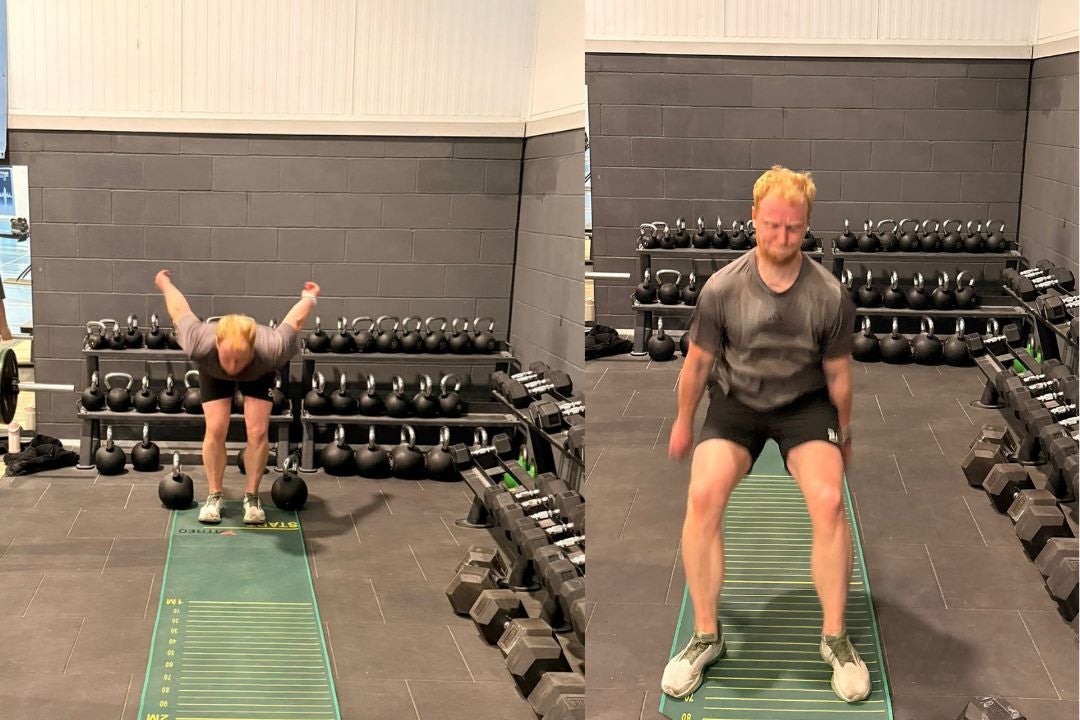 The final assessment was a maximum standing broad jump – my favourite portion of the RAF fitness test (Harry Bullmore/The Independent)
Part three: The standing broad jump test
How to do it
A rubber mat is laid out on the floor with markings along it to indicate distance. I am told to stand with both feet on the ground at the indicated start line, then jump as far as I can with a two-footed take off.
You must stick the landing – no falling forward to earn a few extra centimetres – and the measurement is taken from your heels rather than your toes. Long jump rules, if you will.
How I fared
If grip strength is my nemesis on this test, the standing broad jump is my best friend by comparison. With a background in football, and more recently dabbling in Olympic weightlifting, I back myself on the springiness front.
My assessor delivers an impressively blasé 1.9m by way of demonstration, then it is time for my two attempts.
I prime my body, creasing at the hips and softening my knees, then snap both joints open and throw my arms forward to fire myself along the mat: 2.4m.
“That’s a pass,” I’m informed. “You can have another go if you want?”
I’m still exhausted from the bleep test, but any tiredness is overruled by an intense, intrinsic sense of competitiveness.
I return to the start line and repeat the process, delivering a marginal improvement at 2.6m before calling it a day.
The sum of all three tests: I’ve passed.
Read more: The real reason you can’t stop snacking – and the simple ways to rewire your brain
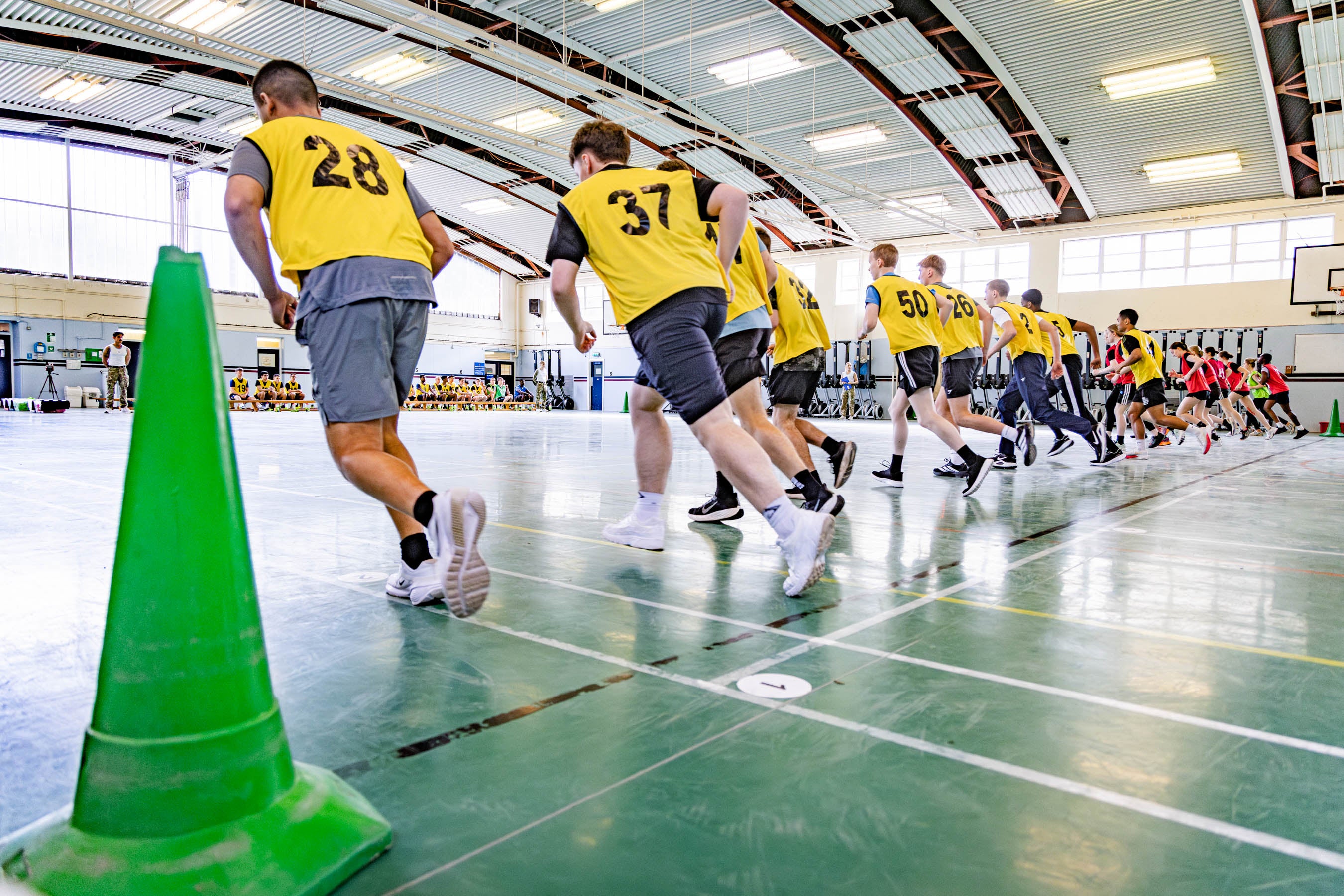 Recruits tackling the bleep test as part of RAF assessments at RAF Halton’s Finlay Gym (Royal Air Force)
What is the point of the RAF fitness test?
Each part of the RAF fitness test is intended to measure a different facet of fitness.
The multistage fitness test assesses your aerobic capacity – the maximum amount of oxygen you can take in and use during exercise, also known as VO2 max.
“Aerobic fitness is probably the most important aspect of fitness in terms of protecting against lifestyle diseases, cardiovascular disease, obesity and cancer,” an RAF spokesman tells me.
“The reason we set a high bar for aerobic fitness is because it demonstrates our Service personnel have the robustness and fitness to recover when they’re on deployment. That’s why we focus on aerobic fitness. But muscular strength and power are also important for functional fitness and military tasks.”
The grip dynamometer is a good indicator of upper body strength, while the standing broad jump signals lower body strength and power.
Personnel may not be asked to run back and forth, grip something as hard as they can or jump as far as possible during active service. But if their heart, lungs and muscles are in good nick, chances are they can handle the rigours of their role.
For safety, some people – such as those aged 40 and above and those with sickle cell trait – will have their aerobic capacity assessed using the Rockport Walk Test instead of the multistage fitness test. This involves walking one mile in the quickest time possible, recording your heart rate immediately afterwards, then inputting these figures into a set formula to estimate your VO2 max.
Read more: Stop falling for fitness industry myths – do this instead
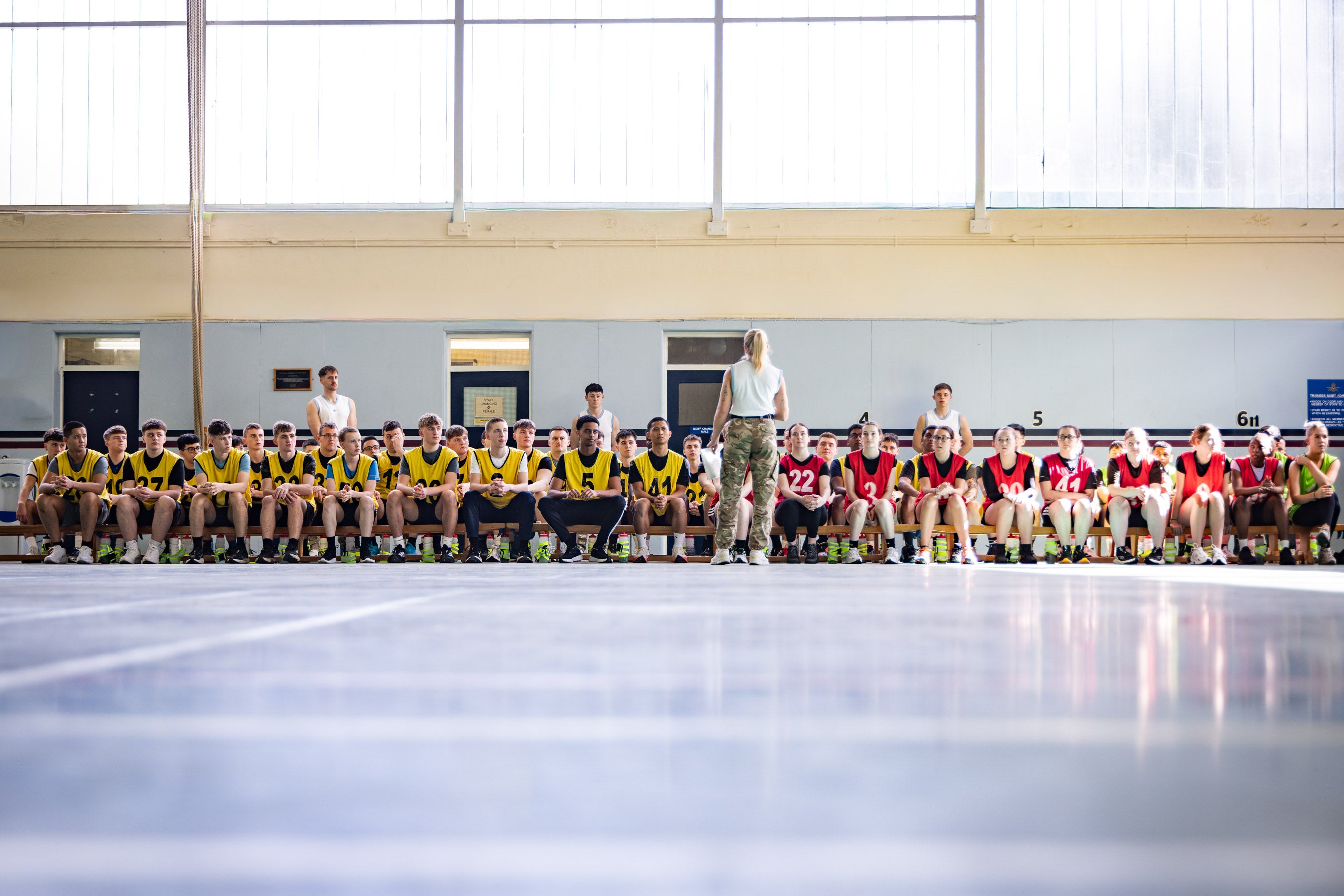 Recruits receive a briefing before taking a series of tests during the RAF’s Basic Recruit Training Course (The Royal Air Force)
The RAF fitness test is taken annually with set standards for men and women which differ by age category.
“The fitness standards we have are linked to the levels shown by science to be important for improving your fitness relative to your health,” an RAF spokesman explains.
Those who fail are given a personalised reconditioning fitness plan then retested in 12 weeks. Those who pass don’t have to take the test for another year.
There is an added incentive to stay fighting fit too. Those who clear the standards by some margin do not have to take the test for another three years (this is called a three-year currency), while those who record exemplary scores earn a five-year currency.
My results would have earned me a three-year currency, although I was some way short of the five. Perhaps, after a bit of dedicated training, I might return to RAF High Wycombe one day to see if I can pass with flying colours.
Read more: The exercise more important than walking – especially if you’re older