




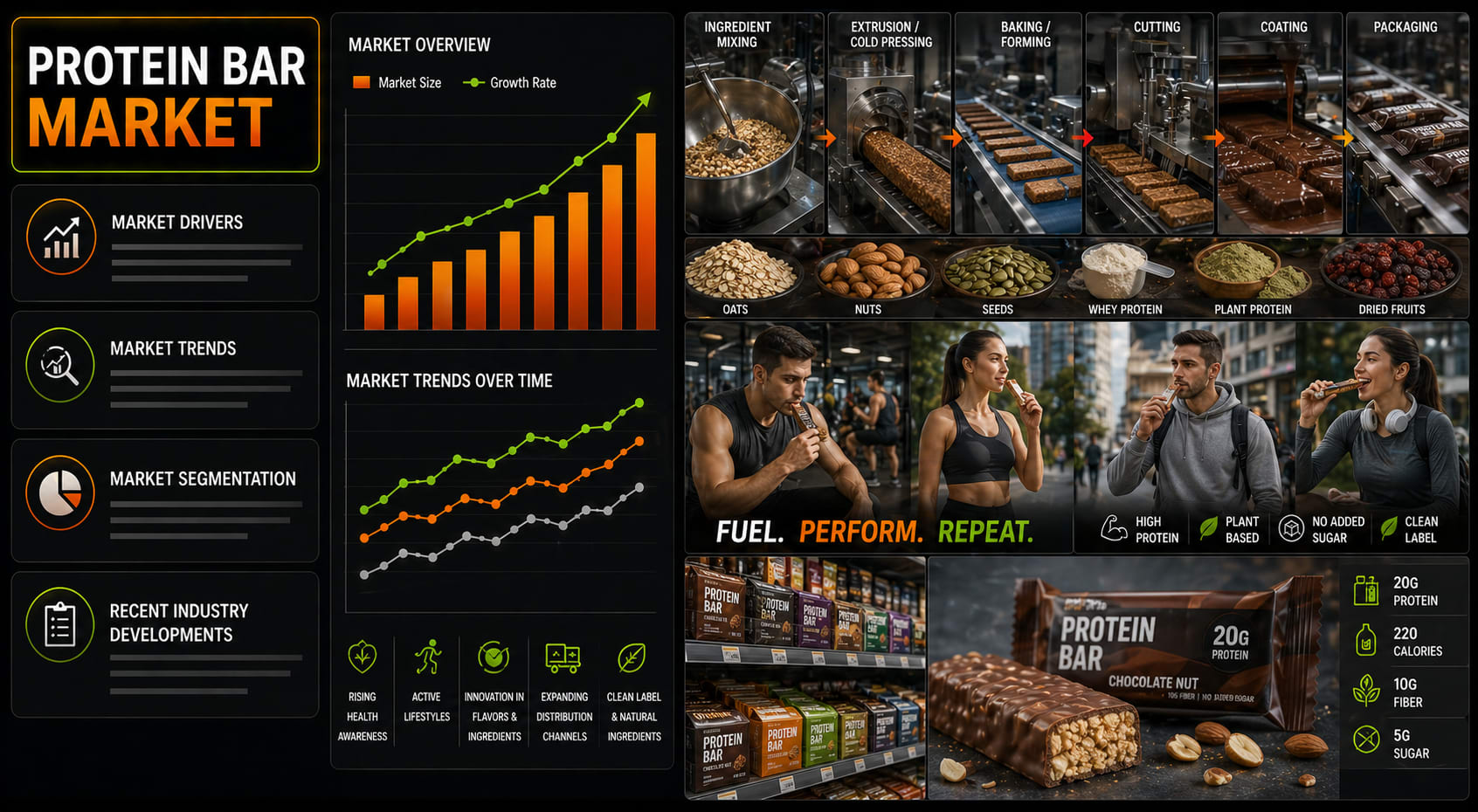
According to IMARC Group’s latest research publication, The global protein bar market size reached USD 3.9 Billion in 2025. Looking forward, IMARC Group expects the market to reach USD 5.9 Billion by 2034, exhibiting a growth rate (CAGR) of 4.60% during 2026-2034, exhibiting steady expansion driven by growing health consciousness among consumers, rising demand for convenient nutrition solutions, and increasing innovation in flavors and functional ingredients.
How Innovation is Reshaping the Future of the Protein Bar Market
Functional Ingredient Advancement and Nutritional Fortification: Brands are going beyond basic protein content to incorporate superfoods, added vitamins, adaptogens, and performance-enhancing compounds into their formulations. Health-conscious consumers are actively seeking bars that deliver multi-benefit nutrition in a single serving, prompting manufacturers to enrich products with organic ingredients, caffeine, probiotics, and minerals. This trend is elevating the perceived value of protein bars from simple snacks to targeted wellness tools, broadening their appeal across fitness, weight management, and general health demographics. Plant-Based Protein Innovation: The plant-based segment is experiencing strong growth momentum as consumer preferences shift toward sustainable and ethical dietary choices. In February 2024, Roquette launched four new NUTRALYS pea protein variants specifically designed for nutritional bar applications, offering improved taste, texture, and high protein content. These multi-functional ingredients give food manufacturers new formulation solutions for meeting the rapidly growing demand for plant-based, high-protein options without compromising on sensory quality. Flavor Diversification and Dessert-Inspired Product Development: Brands are aggressively expanding flavor portfolios to attract a wider consumer base, ranging from sweet dessert-inspired varieties to savory profiles. In May 2025, CLIF BUILDERS expanded its high-protein bar range with BUILDERS OREO-flavored protein bars containing 20 grams of plant protein, alongside BUILDERS Reduced Sugar Crispy bars in Almond Salted Caramel and Peanut Butter Chocolate flavors with 16 grams of protein and only 5 grams of sugar. These launches reflect the industry’s strategy of combining indulgent taste experiences with serious nutritional credentials. Direct-to-Consumer and E-Commerce Channel Expansion: Online platforms are becoming a primary growth engine for protein bar brands, enabling direct consumer relationships and real-time feedback loops that accelerate product iteration. In November 2024, SuperYou, co-founded by Ranveer Singh and Nikunj Biyani, launched India’s first protein wafer bar, offering 10 grams of protein and 3 grams of fiber per serving with no added sugar, using fermented yeast protein technology for improved digestion. The brand made its products available through its own website, major e-commerce platforms, and select modern retail stores, initially targeting India’s top 10 cities. Strategic Acquisitions and Portfolio Consolidation: Major food and confectionery companies are acquiring specialized protein bar brands to gain immediate footholds in the functional nutrition segment. In January 2025, Ferrero Group announced a signed agreement to acquire Power Crunch from Bio-Nutritional Research Group, Inc. Established in 1996, Power Crunch had seen significant recent growth through its range of protein wafer bars and high-protein crisps, making the acquisition a direct move by Ferrero to scale its presence in the premium protein snacking category.
Protein Bar Industry Overview
The global protein bar industry is undergoing rapid transformation and scale-up, underpinned by a broad convergence of health, lifestyle, and demographic forces. According to the World Health Organization, globally 1 in 8 individuals suffered from obesity as of recent data, with 2.5 billion adults classified as overweight and 890 million living with obesity. These figures are fundamentally reshaping consumer food choices, with high-protein, low-sugar snack formats emerging as a preferred alternative to traditional calorie-dense options across both developed and emerging markets.
North America currently dominates the global protein bar market, supported by high consumer spending power, a robust retail infrastructure, and a deeply embedded health and wellness culture. The region is also home to many of the industry’s leading brands, which consistently introduce product innovations to meet evolving consumer preferences for personalized nutrition. Asia Pacific is emerging as a high-growth region, driven by rising disposable incomes, growing fitness culture, and increasing urbanization in markets including India, China, and Southeast Asia.
The market is also benefiting from a significant increase in fitness participation globally, with gyms, home workout platforms, and wellness apps expanding the addressable audience for sports nutrition products. Protein bars, once exclusively associated with competitive athletes, are now firmly positioned as everyday convenience foods for working professionals, students, and health-conscious families.
Request a Sample Report with the Latest Data and Forecasts
Protein Bar Market Trends and Drivers
The rising incidence of obesity, diabetes, and lifestyle-related health conditions is the primary structural driver of protein bar demand. As consumers become more informed about macronutrient balance and the role of protein in weight management and muscle preservation, protein bars are increasingly replacing traditional high-carbohydrate snack options in daily routines. This behavioral shift is particularly strong among millennials and Generation Z consumers, who prioritize functional nutrition and ingredient transparency when making food purchases.
The convenience imperative is reshaping how and when consumers eat. Modern lifestyles characterized by long work hours, commuting, and busy schedules are reducing the time available for meal preparation, making portable, shelf-stable, nutritionally complete products like protein bars an essential category. The demand for on-the-go nutrition is no longer limited to gym environments but extends to offices, schools, travel, and casual social settings.
The intersection of sustainability and nutrition is creating a powerful new driver for plant-based protein bars. Growing consumer awareness about the environmental impact of animal agriculture is encouraging a shift toward plant-derived protein sources, with pea, soy, brown rice, and hemp proteins gaining mainstream acceptance. This trend is broadening the addressable market beyond vegan and vegetarian consumers to include a large segment of flexitarians actively reducing animal product consumption.
Retail and digital channel expansion is accelerating market accessibility. Supermarkets and hypermarkets remain the dominant distribution channel due to their product variety, competitive pricing, and consumer footfall, while specialty stores attract premium buyers seeking expert guidance on functional nutrition. Online stores are growing rapidly, driven by the convenience of home delivery, detailed product information, and the proliferation of direct-to-consumer brands that bypass traditional retail entirely.
Strategic partnerships between protein bar brands and fitness influencers, sports teams, and wellness platforms are creating new consumer touchpoints and reinforcing brand credibility in a market where authenticity and health credentials are closely scrutinized by buyers.
Leading Companies Operating in the Global Protein Bar Industry
Amway Corp. General Mills Inc. Kellanova Mars Incorporated Mondelez International Group Nestlé S.A. NuGo Nutrition Premier Nutrition Company LLC The Simply Good Foods Company ThinkThin
Protein Bar Market Report Segmentation
By Source:
Plant-based exhibits clear dominance in the market, driven by the growing consumer shift toward sustainable dietary choices, rising environmental awareness around animal farming, and the broadening appeal of plant-derived proteins beyond traditional vegan and vegetarian audiences.
By Type:
Sports Nutrition Bar Meal Replacement Bar Others
Sports nutrition bars represent the largest segment, driven by heightened fitness culture, growing participation in athletic and recreational exercise, and the demand for convenient pre-workout and post-workout nutrition that delivers protein, vitamins, and minerals in a portable format.
By Distribution Channel:
Supermarkets and Hypermarkets Convenience Stores Specialty Stores Online Stores Others
Supermarkets and hypermarkets represent the leading distribution channel, offering broad product variety, competitive pricing, and strategic accessibility that cater to the largest volume of everyday consumers purchasing protein bars alongside routine grocery shopping.
Regional Insights:
North America (United States, Canada) Asia Pacific (China, Japan, India, South Korea, Australia, Indonesia, Others) Europe (Germany, France, United Kingdom, Italy, Spain, Russia, Others) Latin America (Brazil, Mexico, Others) Middle East and Africa
North America leads the global protein bar market, accounting for the largest regional share, driven by high health awareness, strong purchasing power, an advanced retail ecosystem, and the presence of major food and beverage companies that continuously introduce innovative protein bar formulations.
Recent News and Developments in the Protein Bar Market
May 2025: CLIF BUILDERS expanded its high-protein bar portfolio with two new product innovations including BUILDERS OREO-flavored protein bars containing 20 grams of plant protein, and BUILDERS Reduced Sugar Crispy bars in Almond Salted Caramel and Peanut Butter Chocolate, each delivering 16 grams of protein with just 5 grams of sugar. The launches are designed to serve consumers seeking recovery-focused and on-the-go snacking options without compromising on taste or nutritional value. January 2025: Ferrero Group announced a signed agreement to acquire Power Crunch from Bio-Nutritional Research Group, Inc. The brand, established in 1996, had recorded significant recent growth through its popular protein wafer bars and high-protein crisps, making the acquisition a strategic move by Ferrero to strengthen its position in the premium functional snacking segment. November 2024: SuperYou, co-founded by Ranveer Singh and Nikunj Biyani, entered the Indian protein bar market with the country’s first protein wafer bar. Offering 10 grams of protein and 3 grams of fiber per serving with no added sugar, the product uses fermented yeast protein technology for improved digestibility. It was made available across the brand’s own website, major e-commerce platforms, and select modern retail stores targeting India’s top 10 cities. February 2024: Roquette launched four new NUTRALYS pea protein variants designed for nutritional bar manufacturing. These multi-functional plant-based ingredients were developed to improve taste and texture while delivering high protein content, offering food manufacturers advanced formulation tools to meet rising demand for plant-based protein bars in global markets.
Note: If you require specific details, data, or insights that are not currently included in the scope of this report, we are happy to accommodate your request. As part of our customization service, we will gather and provide the additional information you need, tailored to your specific requirements. Please let us know your exact needs, and we will ensure the report is updated accordingly to meet your expectations.