




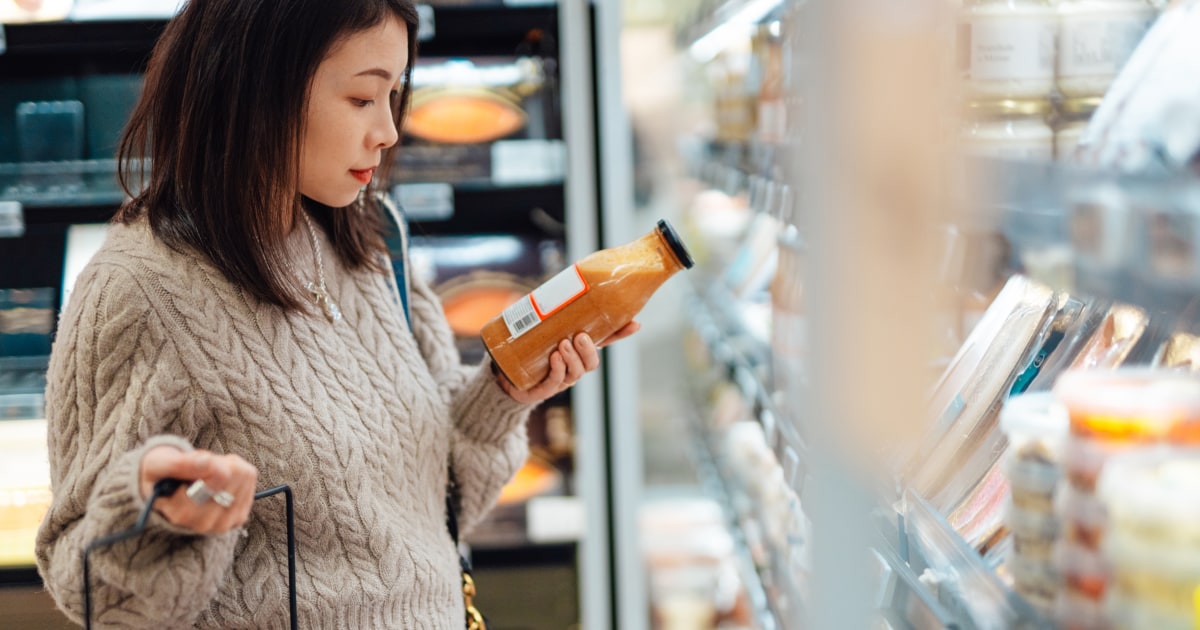
When shopping at the grocery story, you’ll see foods on shelves with a wide array of labels — from “healthy” to “natural” to “low-fat” or “low-carb.” But these items may still be loaded with added sugar, sodium or calories, even though their marketing teams would have you believe otherwise, explains Dr. Ian Smith, physician and bestselling author.
That’s where understanding nutrition labels comes in — they can help you choose foods that meet your health goals, whether you’re looking to manage your weight, reduce chronic disease risk, or improve your fiber and protein intake.
Smith joined TODAY on April 27 to share the basics of reading nutrition labels. It can be a lot to remember, so here’s a quick checklist to bring with you next time you go to the grocery store.
Start With Serving Size
Everything on the label is based on this amount, so if you eat double the serving size, you double the amounts on the label, Smith explains.
Check Calories
Calories provide a quick snapshot of how much “energy” you’re taking in from the item, Smith says. Knowing the calories per serving will help you stay within your range.
Scan the Big 3
When looking at nutrition labels, start with these rows:
Protein (a pro)Fiber (an even better pro)Added sugar (a con)Read the Ingredients List
Ingredients are listed from most to least, Smith says. The shorter and more recognizable the list of ingredients, the better. Here are a few rules he tries to follow when choosing foods.
The 5-20 Rule
If a food has 5% or less of the daily value of something, that is low. For added sugar and sodium, this is a good thing.
If a food has 20% of the daily value or more, that is high. For fiber, protein and vitamins, this is a good thing.
Fiber-to-Carb Ratio Rule
Fiber should be 10% of total carbs or more. For example, a food that has 30 grams of carbs should have at least 3 grams of fiber
Protein Check
You should try to get 20-30 grams protein per meal and at least 5 grams per snack, so choose foods that can help you get there.
Added Sugar Cap
Try to choose foods with fewer than 6-7 grams of added sugar per serving.