



PARIS — In 2025, Weleda posted record cosmetics sales that surpassed the 400-million-euro mark for the first time.
They reached 401.9 million euros, up 9.2 percent year-over-year in reported terms and 10.2 percent on a currency-adjusted basis. That outpaced the cosmetics market’s growth, and came in the wake of Weleda cosmetics’ 8 percent year-over-year sales gains in 2024.
Tina Müller, Weleda’s chief executive officer since October 2023, who ran Douglas perfumery for five years, has been shape-shifting Weleda’s strategy. That includes catapulting it into the prestige facial care category, while making it more alluring to younger consumers with forays into new product segments.
Prior to her arrival, cosmetics sales at Weleda, which also counts an anthroposophic medicine branch, had been in decline for years. In 2022, Weleda was loss-making.
About 40 percent of Weleda AG’s capital and about 80 percent of its voting rights are held by the General Anthroposophical Society and the Arlesheim Clinic, both in Switzerland. This makes Weleda one of the rare midsize beauty brands not to be owned by a strategic today.
Müller’s focus has been on strengthening and modernizing Weleda’s cosmetics business.
“The strategy behind this, we call it ‘growth with responsibility,’” she said, underlining nature has always been the foundation of the brand’s activity.
Weleda is certified natural cosmetics by Natrue. The brand grows and harvests its healing plants in six owned gardens worldwide. Weleda is an agricultural company, which works in partnerships on organic and biodynamic cultivation, too.
“Then science comes into play and takes the extracts of the healing plants” that are used in high-quality formulas, Müller said.
For cosmetics, which generated about 80 percent of Weleda’s overall sales in 2025, she has been leveraging four pillars, with innovation being the most important.
“Driving the cosmetics business works with innovation — new products which are different and relevant to your target,” Müller said. In 2025, Weleda introduced more products in a year than ever before, with each contributing to total growth.
The second lever is digitization. “Here was the focus on e-commerce and digital marketing-slash-social media marketing,” Müller said.
There is internationalization. “Weleda is in 50 countries,” she said, adding the brand is close to entering India with Nykaa. “We grow over-proportionally internationally.”
Last year, Weleda expanded in core markets as well as in emerging ones. It posted strong growth in Eastern Europe, where it had 27 percent like-for-like gains; in the U.K., mainly thanks to Skin Food, with 12.3 percent growth, and in Weleda’s home region of Germany, Switzerland and Austria, or DACH, where it increased sales 12.4 percent.

Weleda Skin Food
Courtesy of Weleda
“The fourth pillar is premiumization,” Müller said. Weleda got a new logo, which she described as more modern, elegant and sophisticated, and a new claim of Swiss Natural Science, which was added to some packaging, to emphasize the brand’s Swiss heritage.
“We know that people connect to Switzerland very high quality and naturalness,” Müller said. “Once we communicated on our new antiaging line Blue Gentian and Edelweiss, claimed it Swiss Natural Science and put the communication into the Swiss world, the market share jumped to a completely different level.”
Her innovation offensive last year began with that line in the antiaging segment, the largest in skin care.
“For Weleda, a brand which came originally more from body care instead of face care, it was a strategic step to focus also the investments on face care,” Müller said, adding the margins are the highest in that segment. “If you are good at face care, you are credible for all the other categories.”
Weleda launched Serum Booster Drops that have been tremendously successful among young people.
Müller pointed out beauty routines have changed over the last few years, with many people adding serums to their day and night cream usage.
“The concept that you can drop the serum into your face cream was a new concept,” Müller said. “Only with that, we reached 8 million [euro] turnover last year just on top.”
Serum Booster Drops went viral in Germany, where they were the most successful skin care launch of the year in the country’s facial care market.
“It was social first,” Müller said. “But not only. I’m a big believer in combining social even with television in our core market Germany…for fast awareness-creation.”
Demand was so large that Serum Booster Drops flew off the shelves, causing an out-of-stock issue.
Weleda Serum Booster Drops
Courtesy of Weleda
“This is a natural certified product, so our supply chain is much more demanding than any other supply chain in the normal cosmetic world,” Müller said. “It’s not so easy to produce immediately.”
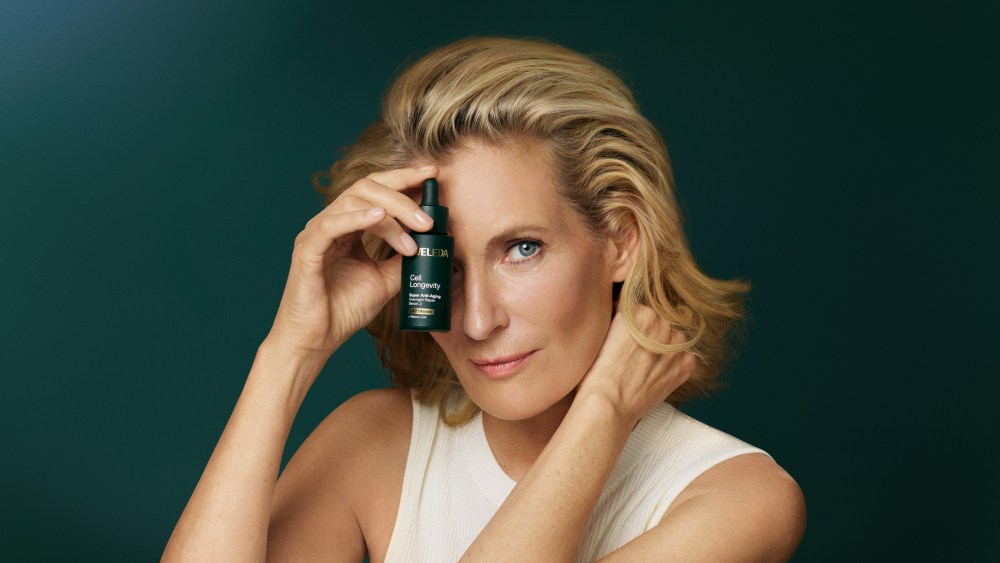
Cell Longevity, Weleda’s first premium face care line, was another major product innovation for the brand last year. It launched in October 2025 in the DACH region and is now carried in perfumeries and other selective retail there.
For Cell Longevity, Weleda came up with new plant-based science centered on the NAD-plus booster. (NAD is a core enzyme in a person’s body and skin, which decreases over time.)
“We have invented in our research-and-development a formula which can boost the NAD-plus in skin and is rejuvenating skin,” Müller said.
At 35 euros to 80 euros, Cell Longevity’s price points are significantly higher than Weleda’s other products. Serum Booster Drops cost about 9.90 euros, for example.
“It’s a big strategic entrance for Weleda into the premium face care market, into the selective distribution omnichannel,” Müller said.
In brick-and-mortar, the brand is carried in Douglas but in the likes of Müller and Breuninger department stores as well.
Meanwhile, Weleda keeps modernizing in its classical retail presence, including drugstores, food distribution and pharmacies.
Innovation doesn’t stop there. In the first quarter of 2026, Weleda launched into two more product categories. One is UV protection, with UV Glow Fluid.
“We do it with mineral filters,” Müller said, describing that as quite challenging. “It took us years to come to a formula, where you have glow and UV protection in a fluid with a very nice texture.”
Tina Müller
Courtesy of Weleda
Weleda also launched hair and body fragrance mists in the Vanilla Cloud, Tropical Crush and Mystic Aura scents. Müller said Weleda has always been close to natural perfumes.
“On the other hand, it’s a stretch for the brand, because it’s an entirely new category,” she said. “So we enter into a new field.”
Müller described the first weeks since launch very promising.
“We have this, what we call a Gen Z block, in the shelves now,” she explained, highlighting the drops, UV fluid and mists.
“We modernized the brand in a way that’s relevant now to the younger target groups,” Müller said. “This was really needed, because Weleda in 2022 was getting too old. The core consumers had been more like 60-, 70-plus.
“It was very important to recruit new users, younger users at the beginning of the funnel,” she continued.
The executive noted the same high growth in first-quarter of 2026 as was seen last year. “All in all, the strategy paid off in a very good way,” Müller said.
She believes Weleda’s big asset — and it’s why she joined as CEO — is its high-quality products for which there is no compromise.
The recipe for Skin Food, which turns 100 years old this year, has never changed. To help fete its centenary, for both of Stella McCartney’s shows during Paris Fashion Week, models are being given a Skin Food treatment as a primer. Skin Food will be present at London and Milan Fashion Weeks, too.
The social media buzz for the product has been bolstered thanks to celebrity fans such as Drew Barrymore, Hailey Bieber, Victoria Beckham and Bella Hadid, too.
To boost innovation and communication, Weleda increased its marketing budget for cosmetics in 2025 by 21 million euros, more than 20 percent higher versus 2024.
“The launch in the perfumery channel demands a separate team, a separate sales force,” Müller said.
When she arrived at Weleda, the brand had no owned e-commerce shop in Germany or Switzerland.
“We opened it very quickly in 2023,” Müller said. “It’s growing constantly by 40 percent. In total, we make now 18 percent of our business in e-commerce worldwide.
“We invest also into our own shop because of CRM — you get the data, you can work with the data — and email marketing is still one of the most powerful tools for conversion,” she said.
The executive hired a chief digital officer to drive that effort.
“It’s kind of a revolution within the company, because Weleda was very traditional,” Müller said. “We injected a lot of new expertise and know-how by bringing external people to the team.”