




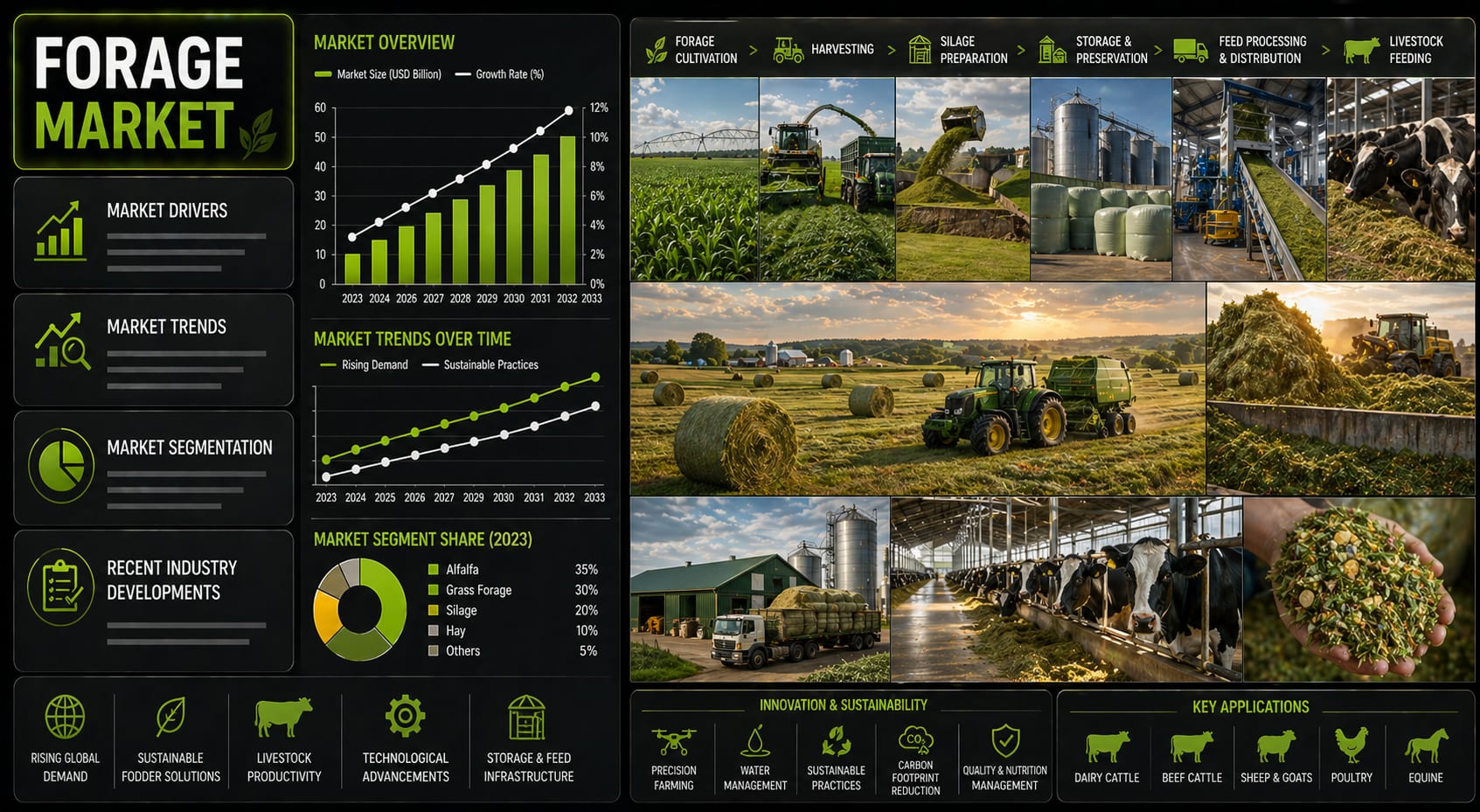
According to IMARC Group’s latest research publication, The global forage market size reached USD 97.6 Billion in 2025. Looking forward, IMARC Group expects the market to reach USD 136.1 Billion by 2034, exhibiting a growth rate (CAGR) of 3.77% during 2026-2034.
How AI and Technology Are Reshaping the Future of the Forage Market
Precision Agriculture and Crop Health Monitoring: AI-powered satellite and drone systems are transforming forage crop management by enabling real-time monitoring of soil moisture, crop health, and nutrient deficiencies across large-scale production areas. Machine learning algorithms process multispectral imaging data to identify stress zones within forage fields before visible deterioration occurs, allowing farmers to deploy targeted interventions that protect yield quality. The University of Agricultural Sciences reported that optimized drone deployment in crop monitoring can reduce pesticide volume requirements by at least 15% while simultaneously improving overall field management efficiency, directly reducing input costs for forage producers operating at commercial scale. Genetic Modification and Climate-Resilient Crop Development: Biotechnology platforms are enabling the development of forage crop varieties with enhanced drought tolerance, disease resistance, and improved digestibility profiles specifically engineered for the nutritional requirements of high-productivity livestock systems. Genetically modified alfalfa, corn silage, and sorghum varieties developed through precision breeding programs are delivering measurable yield advantages over conventional cultivars under adverse climatic conditions, including reduced rainfall seasons and elevated temperature stress events. These developments are critically important for forage producers in regions facing increasing climate variability, where yield consistency directly determines the economic viability of both forage farming operations and the livestock systems they supply. IoT-Enabled Field Operations and Equipment Automation: Internet of Things sensor networks embedded in soil, irrigation infrastructure, and harvesting equipment are enabling continuous operational monitoring across forage production systems, reducing commercial expenses while improving agronomic decision quality. Automated irrigation systems triggered by real-time soil moisture sensor data deliver precise water volumes to forage crops at optimal growth stages, eliminating both under-irrigation stress and over-irrigation waste that collectively reduce yield potential and increase water costs. Smart harvesting equipment equipped with GPS guidance, yield mapping sensors, and automated bale density control systems is reducing labor requirements and improving harvested forage quality consistency across large-scale cereal, legume, and grass production operations. Silage Fermentation Optimization and Storage Technology: Advanced fermentation monitoring systems using biosensor technology and AI-driven anaerobic condition management are improving silage nutritional preservation outcomes across commercial dairy and beef cattle operations. Optimized silage additives, inoculant formulations, and oxygen barrier film technologies are extending effective storage durations while maintaining digestible energy and protein content at levels that support peak ruminant productivity throughout the feeding year. These storage technology improvements are particularly valuable for large dairy operations requiring consistent, high-quality stored forage year-round, where nutritional variability in silage batches directly impacts milk yield, reproductive performance, and feed conversion efficiency across the herd.
Forage Market Industry Overview
According to IMARC Group’s latest research publication, the global forage market size reached USD 97.6 Billion in 2025. Looking forward, IMARC Group expects the market to reach USD 136.1 Billion by 2034, exhibiting a growth rate (CAGR) of 3.77% during 2026-2034. The market is experiencing steady growth driven by the escalating demand for meat and dairy products necessitated by a growing global population, the rising awareness of sustainability issues encouraging the adoption of environmentally friendly farming techniques, and the increasing shift towards organic and sustainable forage production.
Request a Sample Report with the Latest Data & Forecasts
The forage market’s commercial foundation rests on its indispensable role in global livestock nutrition. Forage, encompassing cereals, legumes, and grasses in both fresh and stored forms, constitutes the primary dietary input for ruminant livestock including cattle, sheep, and goats, whose collective output of dairy products, beef, and lamb serves the nutritional requirements of billions of consumers worldwide. Cereals represent the largest crop type segment, driven by the versatility and high energy conversion efficiency of corn, oats, barley, and sorghum, which are integral elements of both silage and grain-based livestock feed systems. Stored forage, including silage and hay, holds the largest product type share owing to its critical role in ensuring year-round feed availability during cold seasons, dry conditions, and periods when fresh pasture cannot sustain herd nutritional requirements.
Ruminants represent the dominant animal type segment, reflecting the biological dependence of cattle, sheep, and goats on fibrous forage as the primary substrate for their rumen-based digestive systems. The nutritional quality of forage fed to dairy cattle directly determines milk solids yield and composition, creating strong commercial incentives for dairy operators to source high-quality stored and fresh forage varieties with verifiable nutritional profiles. Foodservice channels and retail dairy product buyers are increasingly transmitting quality requirements upstream through the supply chain, creating demand pressure that is driving forage producers toward premium variety cultivation, precision growing practices, and certified organic production systems.
The global organic food market context is an important demand signal for the forage industry, with the organic food sector having reached USD 207.4 Billion globally and demonstrating robust expansion momentum that is pulling certified organic forage supply into structural undersupply conditions across North America and Europe. Organic livestock operations require certified organic feed inputs as a non-negotiable compliance requirement, and the growth of certified organic dairy, beef, and poultry production is creating sustained demand for organically produced forage that conventional supply chains are not currently equipped to fully satisfy.
Forage Market Trends and Drivers
The escalating global demand for meat and dairy products is the primary structural driver sustaining forage market fundamentals across all producing and consuming geographies. Rising population levels, expanding middle-class income bases in emerging economies, and increasing per capita consumption of animal-based proteins across Asia Pacific, Latin America, and the Middle East are collectively driving livestock herd expansion that directly translates into greater forage procurement demand from commercial farm operators. Governments across major livestock-producing nations including the United States, Brazil, Australia, and India are actively supporting domestic forage production through agricultural subsidy frameworks, research funding for high-yield forage variety development, and infrastructure investment in storage and logistics capabilities that enable forage supply chains to serve geographically dispersed livestock operations efficiently.
Technological advancement across precision agriculture platforms is functioning as a simultaneous productivity and sustainability multiplier for the forage sector, enabling producers to achieve higher yields per hectare while reducing water consumption, pesticide application volumes, and carbon intensity per unit of forage produced. Satellite-based crop monitoring systems, IoT soil sensor networks, and AI-driven farm management platforms are transitioning forage production from experience-based management to data-driven decision frameworks that consistently outperform conventional agronomic approaches on both yield and input efficiency metrics. The integration of genetically modified forage crop varieties exhibiting drought tolerance and improved digestibility profiles is particularly significant for producers in climate-stressed regions where yield variability under conventional varieties creates unacceptable commercial risk for livestock operators dependent on reliable annual forage supply contracts.
Sustainability and organic farming trends are reshaping both the supply side and the pricing architecture of the global forage market in ways that are creating structural opportunities for producers capable of meeting certified organic and environmental compliance standards. Consumer awareness of the environmental footprint of conventional livestock production, combined with institutional pressure from food retailers and processors operating under corporate sustainability commitments, is driving livestock operators to seek out organic and sustainably produced forage inputs that can substantiate environmental claims to end consumers. The harmful effects of traditional farming including pesticide pollution, soil erosion, and biodiversity loss are accelerating adoption of forage production methods that prioritize soil health, rotational grazing integration, and reduced synthetic chemical dependency. These production system transitions are creating premium market segments within the forage industry where certified organic and sustainably produced varieties command price premiums that justify the higher production costs and certification compliance investments required from forage farming operations.
Climate change is simultaneously functioning as the forage market’s most significant operational risk and its most compelling technology adoption catalyst. Increasing frequency of drought events, unpredictable rainfall patterns, and temperature extreme episodes are creating yield volatility that threatens the feed cost stability of livestock operations globally. This climate exposure is accelerating investment in drought-resistant forage crop varieties, precision irrigation technology deployment, and stored forage inventory buffer strategies that allow livestock operators to manage seasonal supply disruptions without catastrophic herd nutrition impacts. Water management efficiency improvement is a particularly high-priority investment area for forage producers in water-stressed regions across the western United States, Australia, the Middle East, and Southern Europe, where regulatory pressure on agricultural water consumption is intensifying alongside the physical scarcity constraints that are already limiting conventional irrigation approaches.
Leading Companies Operating in the Global Forage Market
Barenbrug Group Dow AgroSciences LLC (Corteva Agriscience) DLF Seeds A/S Forage Genetics International LLC (Land O’Lakes Inc.) Hi-Qual Manufacturing Innospec Inc. Pacific Seeds (Advanta Seeds) Standlee Hay Company S&W Seed Company Teff Grass Valley Proteins Inc. Wilbur-Ellis Holdings Inc.
Forage Market Report Segmentation
By Crop Type:
Cereals account for the majority of the market share owing to their high energy conversion efficiency, versatility across diverse soil and climatic conditions, and critical role as both silage and grain-based feed inputs essential for the nutritional requirements of high-productivity livestock systems globally.
By Product Type:
Stored Forage Silage Hay Fresh Forage
Stored forage holds the largest share of the industry, driven by its indispensable function in ensuring year-round livestock feed availability during cold seasons and dry conditions when fresh pasture cannot sustain herd nutritional requirements, supported by continuous advances in fermentation technology, storage additives, and oxygen barrier preservation systems.
By Animal Type:
Ruminants Swine Poultry Others
Ruminants represent the leading market segment owing to the biological dependence of cattle, sheep, and goats on fibrous forage as the primary substrate for rumen-based digestion, and the direct link between forage nutritional quality and the dairy milk yields and meat production performance that commercial livestock operators are commercially incentivized to maximize.
Regional Insights:
North America (United States, Canada) Asia Pacific (China, Japan, India, South Korea, Australia, Indonesia, Others) Europe (Germany, France, United Kingdom, Italy, Spain, Russia, Others) Latin America (Brazil, Mexico, Others) Middle East and Africa
North America and Europe lead global forage production in terms of quality standards, technology adoption, and high-value export volumes, underpinned by advanced precision agriculture infrastructure, strong certified organic production ecosystems, and institutional research investment in high-yield forage crop variety development. Asia Pacific is the fastest-growing consuming region, driven by accelerating demand for higher quality animal feed inputs to satisfy the nutritional standards required by export-oriented meat and dairy production systems serving Western market buyers.
Recent News and Developments in the Forage Market
March 2025: Barenbrug Group announced the commercial release of a new drought-tolerant perennial ryegrass variety developed through its proprietary precision breeding program, targeting dairy and beef cattle operators in water-stressed production regions across Australia, New Zealand, and the western United States. The variety demonstrated consistent dry matter yield advantages of 12 to 18% over standard cultivars under reduced rainfall trial conditions, representing a significant agronomic advancement for forage producers facing intensifying water availability constraints. January 2025: S&W Seed Company completed the expansion of its alfalfa seed production and processing capacity in the San Joaquin Valley of California, adding significant throughput capability to serve growing domestic and export demand for high-quality alfalfa seed varieties. The facility expansion supports the company’s strategic positioning within the premium hay and alfalfa forage segment, where Middle Eastern and Asian dairy operators are driving sustained import demand for certified high-digestibility alfalfa hay and seed products. October 2024: Forage Genetics International, a subsidiary of Land O’Lakes Inc., received regulatory approval for a new herbicide-tolerant alfalfa variety incorporating enhanced root architecture traits that improve drought resilience and nitrogen fixation efficiency compared to conventional alfalfa cultivars. The variety addresses two critical production challenges simultaneously, reducing irrigation water requirements and lowering synthetic nitrogen fertilizer dependency in alfalfa production systems across North American growing regions. August 2024: DLF Seeds A/S concluded a strategic acquisition of a European forage legume breeding program, strengthening its research pipeline in clover and vetch varieties specifically developed for organic and low-input farming systems. The acquisition reflects the growing commercial importance of certified organic forage seed supply as European organic livestock certification requirements drive sustained demand for organically compliant forage inputs that conventional seed supply chains cannot adequately serve. April 2024: The United States Department of Agriculture announced an expansion of its Conservation Reserve Program funding allocations specifically supporting the establishment of perennial forage grass and legume cover on previously cropped land, providing participating farmers with annual rental payments and cost-share support for establishment costs. The program expansion was targeted at improving soil health, reducing agricultural runoff, and building a domestic buffer supply of perennial forage biomass available for grazing and hay production during periods of commodity forage supply tightness.
Note: If you require specific details, data, or insights that are not currently included in the scope of this report, we are happy to accommodate your request. As part of our customization service, we will gather and provide the additional information you need, tailored to your specific requirements. Please let us know your exact needs, and we will ensure the report is updated accordingly to meet your expectations.