




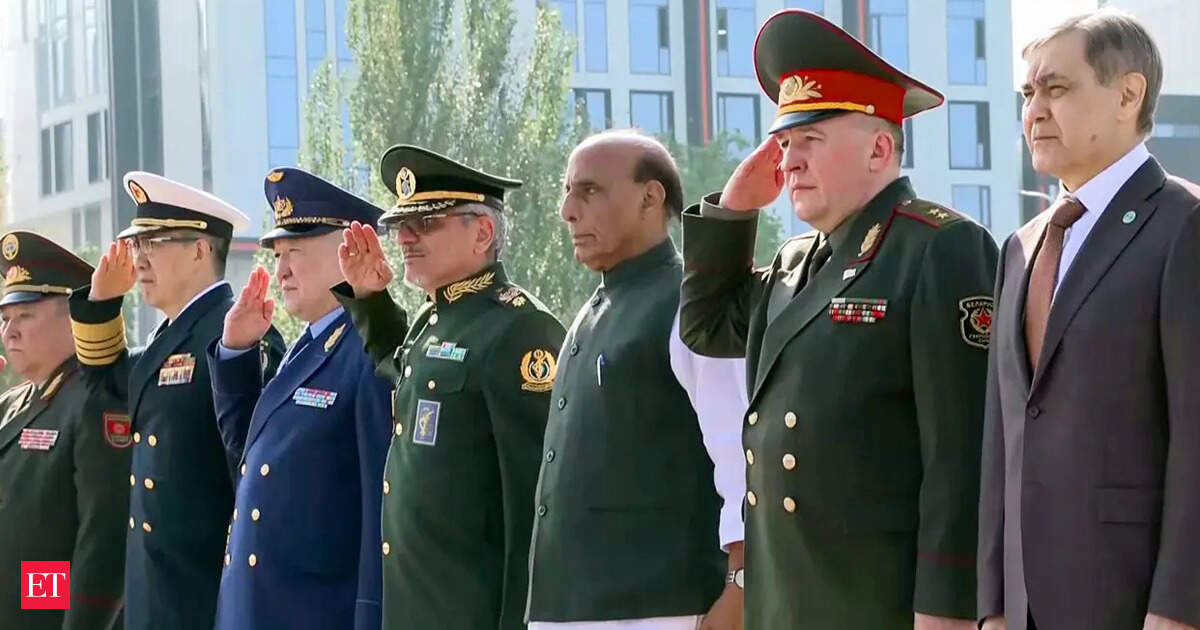
New Delhi: Terrorism epicentres are no longer immune to “justifiable punishment”, defence minister Rajnath Singh said at a Shanghai Cooperation Organisation (SCO) defence ministers’ summit, stressing that there can be no double standards in dealing with terrorism.
Referring to India’s actions during Operation Sindoor last year, Singh said the country had demonstrated its resolve to respond firmly to terror threats.
“The carnage in Pahalgam had shaken the entire humanity. During Op Sindoor, we demonstrated our firm resolve that terrorism epicentres are no longer immune to justifiable punishment,” he said.
 Live EventsAt the summit in Bishkek (Kyrgyzstan) on Tuesday, Singh also met his counterparts from several countries, including Russia and China.
He called for a unified approach to tackle terrorism, separatism and extremism by eliminating safe havens and acting against state-sponsored cross-border terrorism, in an apparent reference to Pakistan.
Singh also spoke on ongoing regional conflicts, saying there is need for global consensus in which co-existence and compassion take precedence over chaos and conflict.
“The real crisis today is not of a non-existent order but a tendency to question the established rule-based world order. We must focus on a global consensus where co-existence, cohabitation and compassion take precedence over chaos, competition and conflict,” he said.
He urged SCO members to work together to curb terrorism, stressing the need for consistency in action.
“The real test of collective credibility remains in consistency. We must not forget that terrorism has no nationality and no theology. Nations must take a firm and collective stance against terrorism,” he said.
Noting that the world today is facing a reality check in the form of increasing unilateralism and conflicts, he called upon members to take measures to tackle the ongoing situation that has resulted in loss of lives and property with disturbing frequency in the last few years.
He also held discussions on regional security, terrorism and radicalisation, and their wider implications for global peace and stability.