


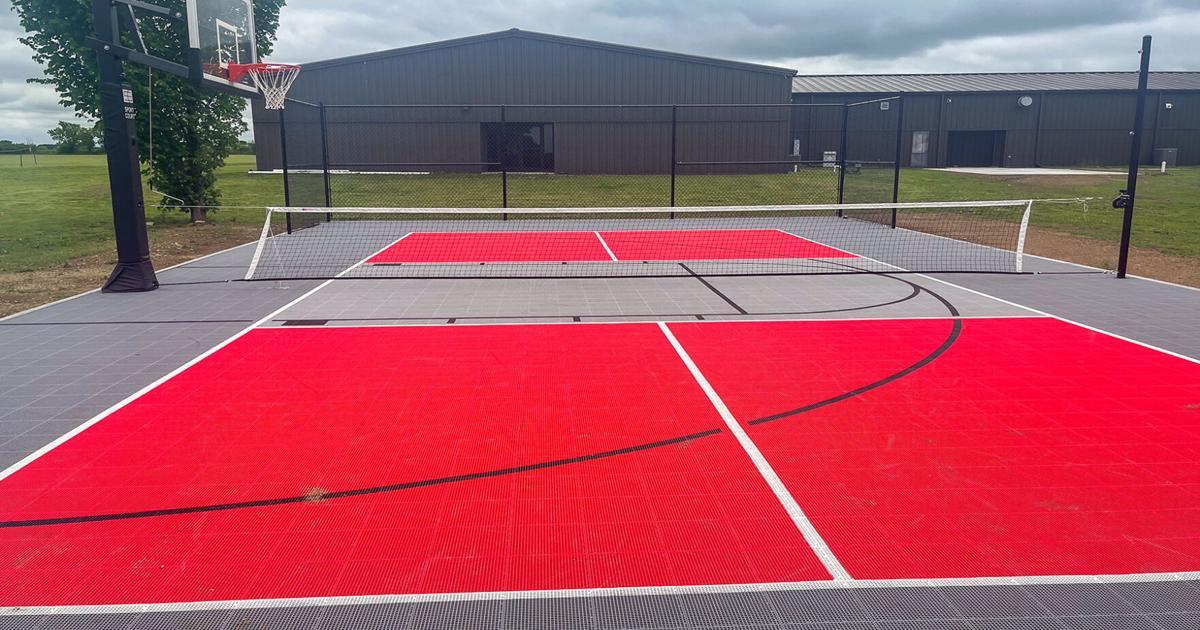
SOUTH COFFEYVILLE, Okla. – In rural northern Nowata County, a new pickleball court at Oklahoma Union Public Schools is serving as the latest example of Cherokee Nation’s investment in community health and wellness.
The school located between South Coffeyville and Lenapah was established in 1990 and includes grades kindergarten through 12thgrade. The school’s new court along with sidewalk paths, shaded areas and picnic tables were built using a $104,800 Cherokee Nation Public Health and Wellness Partners Grant.

The court along with sidewalk paths, shaded areas and picnic tables were built with a $104,800 grant provided by the Public Health and Wellness act.
COURTESY
Oklahoma Union Public School Superintendent Brenda Taylor said she found out the school received the grant in August 2025 during a school event.
“I received my email, and I ran out into the presentation,” she said. “I was like, ‘Guys, we got (the grant),’ and everyone burst into applause. It was wonderful.”
Construction began on the pickleball court began shortly after and could be seen by students from the cafeteria.
Pickleball is a paddle sport blending tennis, badminton and table tennis that is played indoors or outdoors on a badminton-sized court with a slightly lower net. Players use a solid paddle and a perforated plastic ball in singles or doubles, with underhand serves.
Taylor said in less than a year after applying for the grant, construction is mostly finished and already the community has benefited.
“I had a family reach out and ask to have a family gathering there. Just today we had a community member bring in paddle ball sets. It’s just been amazing to see,” Taylor said. “I just want to express my sincere appreciation for Cherokee Nation and their support of students and community, not just at Oklahoma Union but Cherokee Nation in general. It is much appreciated, and it doesn’t go unnoticed.”
The Cherokee Nation doesn’t shy away from investing in rural areas, according to Deputy Secretary of State Canaan Duncan. When asked why Cherokee Nation invests so much in rural areas, he noted that he understood why people may be concerned.
“It’s a fair ask of any government,” Duncan said. “I think it’s easily justified, but not in a Westernized way – ‘what’s the bottom line, dollar figures.’ In our eyes, it’s justified through the dividend that it’s going to pay through community health.”
“I like to quote First Lady January Hoskin,” he continued. “‘Investing into the wellness of a community and creating more access to public health and wellness spaces is going to pay dividends that can’t be measured by numbers but they can be measured by longevity of life.’”
District 11 Tribal Counselor Kendra McGeady echoed support for the Public Health and Wellness Act.
“Health and wellness comes in many forms,” McGeady explained. “It might be an outdoor playground or a new fire truck. Whatever form it comes in, it’s going to fund a lot of projects that make a big difference across the Cherokee Nation.”
The grant program was established in 2025 through the amended Cherokee Nation Public Health and Wellness Fund Act. In the grant program’s inaugural year, the tribe awarded 34 entities, including Oklahoma Union Public Schools, $1.8 million to support access to opportunities.
The 2026 grant application window closed March 30. According to the tribe, the PHW Partners grant will issue grants from a pool of $1.5 million this year. Eligible entities may be awarded up to $150,000 for eligible capital projects or up to $25,000 for one-time funding of new or pilot program operations. Funds are meant to assist schools, local governments and non-profits with projects that can improve their local community’s public health, such as pilot wellness programs or capital projects to create or enhance access to physical activities.