




 9 min read
So you’re a cyclist who wants to lose weight? Join the club. Many people who regularly ride have the primary or secondary goal of shedding pounds.
But while cycling can absolutely be a helpful part of someone’s weight loss strategy, it’s not as straightforward as you might think. Read on for 10 common mistakes people make when cycling for weight loss and how you can correct these pitfalls yourself… or avoid them altogether.
1. Underfueling Your Rides
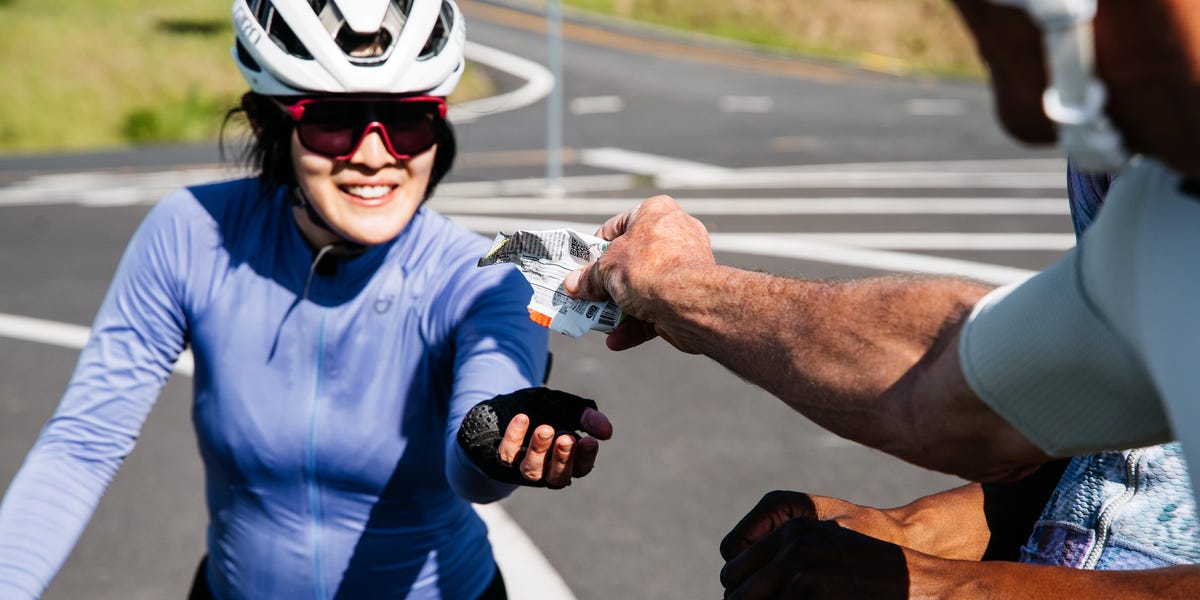
Maintaining a slight daily caloric deficit is necessary to lose weight. But a lot of riders make the mistake of restricting their calories too much, especially leading up to a workout. This backfires for two reasons. The first: “Their workout most likely sucks because they’re low energy,” says exercise physiologist Renee Eastman, CSCS, a coach with Carmichael Training Systems. The second: After the workout, their caloric deficit is so great they can’t control their hunger and they end up overcompensating, she explains.
Avoid this by focusing on preloading rather than reloading, Eastman says, borrowing a phrase from physiologist Stacy Sims. In other words, eat enough during the day to power your workouts and daily tasks, then cut back at dinner. Think of it this way: Being a little underfueled overnight when you’re sleeping will have much less impact on your functioning than being underfueled during the day.
Unsure if you’re underfueling your workouts? If you finish a ride and feel famished (or bonk during your ride), that’s typically a sign you could stand to eat more before and/or during it, Eastman says.
Related Story2. Pedaling More Miles Just to Burn Extra Calories
Unless you’re a professional athlete who rides for, say, six to seven hours a day, the majority of the calories you burn in a day are likely coming from Non-Exercise Activity Thermogenesis (NEAT), i.e., your activities of daily living, Eastman says. You also burn the most fat through these really low-intensity activities, she adds.
So when you add extra exercise minutes to your schedule in a sole attempt to burn more calories—maybe you tack an additional 45 minutes onto what was scheduled as a 60-minute ride—you’ll likely end up resting more throughout the remainder of the day, which diminishes the impact of NEAT. For example, you may choose to drive versus walk to the grocery store, or opt for Netflix after dinner instead of playing with your dog. This approach doesn’t really get you ahead calorically, and instead just makes you more tired for your next workout, Eastman says.
A better approach, she says, is to stick to your given training plan and ensure that you have enough energy after your workouts to stay active in daily life. Better yet, try to incorporate more low-intensity movement into your day to up the impact of NEAT. Think: Do a few dynamic stretches in between each Zoom call, take the stairs instead of the elevator, or tackle housework yourself instead of outsourcing it. Basically, do what you can to regularly move your body during the day.
3. Repeating the Same Workouts Over and Over
When your goal is overall health and weight loss, “variety is really underrated,” says Kyle Pfaffenbach, PhD, an associate professor at Eastern Oregon University and director of the university’s laboratory of exercise assessment and performance. That’s because you may not be a genetic responder to cycling—meaning, based on your genes, you may not see many gains in your fitness from that particular form of movement. On the flip side, if you are a high responder to cycling, you’re going to see a bunch of initial benefits, but if you do the same training each day, you’ll eventually become really efficient at it. “And once you’re efficient at it, you’re not stimulating [your body] in new ways to achieve adaptation,” Pfaffenbach explains.
Of course, when you’re training for a race, efficiency is a good thing, Naimish Baxi, MD, spine and sports medicine physiatrist at Hospital for Special Surgery, tells Bicycling. It’s what allows you to work harder without expending as much energy. But when weight loss is the goal, you want inefficiency because that helps drive caloric burn, he says.
To that end, Pfaffenbach recommends regularly injecting variety into your workout program on all fronts, including workout intensity, length, duration, speed, and mode of exercise. This way, you’ll give yourself a higher probability of discovering what it is that you’re a responder to in regard to weight loss, and you’ll create those inefficiencies. Another positive of variety is that you’ll give your body time to recover from individual efforts, he says, instead of hammering it the same way day after day. Chronically stimulating the same system in the same way can lead to upped risk of injury and burnout.
Related Story4. Having a Goal Weight or a Specific Timeline
Let’s walk through a classic scenario: Your goal is to lose, say, 20 pounds in 10 weeks. So you crunch the numbers to develop a plan that’ll get you there: You’ll increase your bike riding to burn an extra 500 calories a day, while also restricting your diet by 500 calories a day (assuming you know your normal calorie consumption). That’ll create a caloric deficit of 1,000 calories a day. Because there are an estimated 3,500 calories in a pound, if you stick with this plan, you’ll shed exactly two pounds every week, for a total of 20 pounds lost in 10 weeks. Simple, right?
Not exactly. Weight loss, Pfaffenbach says, “almost never happens the way that you cook it up in your head.” That’s because it’s a super complex process, and factors like hormonal changes and compensatory mechanisms (processes the body uses to maintain its steady state) greatly influence the timing and rate of an individual’s weight loss, as well as the specific weight a body is happiest at.
All of this is why Pfaffenbach advises against having a goal weight or a timeline in mind around your weight loss. A better approach is to set a directional goal, he says. From there, introduce new exercises and workouts to create inefficiency while also fine-tuning your nutrition. (More on specific nutrition guidance in a minute.) Basically, put yourself in a healthier situation that is sustainable, and then let your body get to the weight it wants to be. Once you get to a point where you stop losing weight and you feel good, that’s likely where your body is happiest.
5. Blindly Cutting Calories Across the Board
Yes, restricting calories is an important part of weight loss, but often people get so aggressive with their calorie restriction that they end up not consuming enough protein and fat, Pfaffenbach says. This can lead to a slew of health-harming outcomes, including decreased muscle mass, increased hunger and fatigue, and compromised hormone health—all of which can sabotage weight loss.
Instead, it’s important to be strategic about which calories you cut to ensure you’re not shortchanging protein or fat. To that end, Pfaffenbach recommends the following guidelines. Calculate the following using a bodyweight that’s 10 pounds less than what you currently weigh. For example, if you’re 180 pounds, do these calculations with 170 pounds. This will help create a little bit of a caloric deficit to move you in the right direction, but not so much that you’ll encounter those health-harming outcomes.
Convert weight to kilograms: 170 pounds / 2.2 pounds per kgProtein: Aim for 1.4 to 1.6 grams per kilogram of bodyweight a day.Fat: Aim for 1.2 grams per kilogram of bodyweight a day.Carbs: No matter your weight, aim for 40 grams of carbs per meal as a general goal, and ensure you’re well-fueled for your workouts. Over time, manipulate carb intake in a way that gives you a caloric deficit.
Once you lose five pounds, adjust the calculations so that they are now 10 pounds less than your new weight. (So, if you drop down to 175 pounds, do the calculations based on 165 pounds.) Continue adjusting the calculations in this manner as you lose weight. Again, once you get to a point where you stop losing weight and you feel good, you can assume that’s where you’re meant to be.
6. Neglecting Strength Training
Cycling can absolutely torch your quads, hamstrings, and calves, but for most people, it doesn’t overload your muscles enough to qualify as strength training. And when the goal is weight loss, it’s important to also incorporate regular strength training into the mix, Eastman says. In fact, if you don’t combine cycling with resistance training, “it’s just hard to lose weight,” Baxi says.
That’s because aerobic exercise—which is what cycling typically qualifies as—doesn’t inherently increase muscle mass, Eastman says. But strength training does. And that’s a big plus, because “muscle is more metabolically active than fat,” Eastman explains. In other words, gaining muscle helps increase your basal metabolic rate (the amount of calories your body burns at rest), which is obviously helpful for weight loss. Strength training is also beneficial for bone health and for combating sarcopenia (age-related muscle loss), Baxi adds. So by regularly lifting weights, you can tick multiple health boxes at once.
To reap these benefits, aim for at least two, ideally three, full-body strength training sessions a week, Eastman says. New to lifting weights? Get started with our comprehensive guide to strength training for cyclists.
Related Story7. Introducing Unsustainable Changes
When you’re gung-ho about weight loss, it’s tempting to start with drastic steps, like committing to riding two hours a day, six days a week, or swearing off all forms of added sugar. But any changes you implement should be ones you can realistically sustain for the long haul. “It has to literally be: I can do this for the rest of my life,” Pfaffenbach says. Otherwise, you won’t achieve lasting change.
So instead of fixating on short-term dieting hacks or a grueling cycling routine, let consistency be your goal, Pfaffenbach says. With this mindset, you’ll have a much better chance of seeing permanent results.
8. Not Factoring in the Bigger Picture
Weight loss isn’t just about exercise and nutrition. Other factors, such as sleep and stress, also matter, Baxi says. So if you just focus your efforts on working out a ton and eating well, but you let those other facets of healthy living fall by the wayside—for example, you get by on just six hours of sleep a night, or you live in a near-constant state of anxiety—you’re potentially sabotaging your weight loss goals (while also harming your health in other ways).
That’s why Baxi recommends taking what he calls a “multi-pronged approach.” Basically, strive for healthy habits in all domains. (In fact, there are actually eight—yup, eight!—dimensions of wellness worth paying attention to. Learn more about them here.)
9. Trying to Figure it All Out Yourself
Weight loss can be a really complex, highly individualized endeavor. That’s why the plan that worked for your cycling buddy, or the one you randomly pulled off the internet, may not be effective for you.
So if you have the resources, Baxi suggests enlisting professional help, at least in the beginning of your weight loss journey. Working with a fitness expert, such as an exercise physiologist or certified personal trainer, can help you set realistic expectations, boost motivation, optimize the time you spend exercising, and curate an approach that’ll generate results.
10. Viewing Cycling as Solely a Weight Loss Tool
From better heart health to boosted mood to reduced risk of chronic diseases, there are so many benefits of exercise that have nothing to do with weight loss. For these reasons (and more), “it’s so important for people to do some sort of exercise, and it’s only sustainable when they genuinely love it,” Baxi says. Cycling, he adds, is one of those activities that his older patients, in particular, seem to really enjoy. If you’re similarly impassioned by riding, then by all means keep pedaling… regardless of how cycling does (or doesn’t) impact your weight loss goals.
“Cycling doesn’t necessarily have to be tied to weight loss,” Baxi explains. “You can focus on weight loss differently and just accept and understand that the cycling piece of it might not be the way to lose weight, but it’s still important to continue to do if that’s what you enjoy doing.” We couldn’t agree more.
Related Story
Jenny is a health and fitness journalist. She’s also an NASM-certified personal trainer. Her work has been published by Vogue, Glamour, SELF, Outside, and Health, among others. She lives in Colorado, where she teaches water aerobics at her local rec center.