




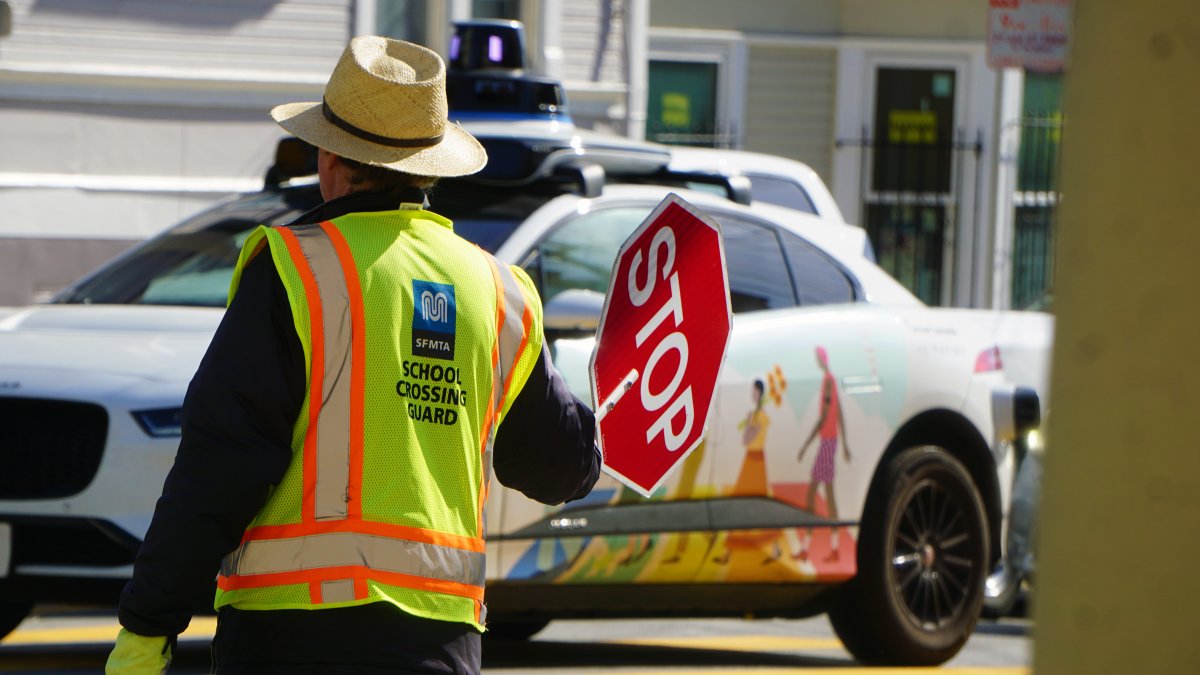
Driverless cars, which have long enjoyed immunity from traffic tickets in California, will soon be subject to a new type of enforcement. Late Tuesday, state regulators at the DMV officially approved their plan to hold autonomous vehicle companies accountable when their cars violate the rules of the road.
Beginning July 1, according to those newly adopted regulations, law enforcement officials across the state will be able to issue what the DMV describes as “notices of noncompliance” to driverless car companies when their vehicles violate traffic laws, such as running a red light or failing to stop for pedestrians in a crosswalk.
“California continues to lead the nation in the development and adoption of AV technology, and these updated regulations further demonstrate the state’s commitment to public safety,” DMV Director Steve Gordon said in a statement. “These updates support the growth of the AV industry by enhancing public safety and transparency while adding additional accountability for AV manufacturers.”
The DMV, which described its new rules as “the most comprehensive AV regulations in the nation,” said repeated or serious instances of noncompliance can result in the state suspending or even revoking a company’s driverless car permit.
More than two years ago, the NBC Bay Area Investigative Unit first exposed an apparent loophole preventing law enforcement from issuing traffic tickets to autonomous vehicle companies. California’s transportation laws have long noted that “drivers” are subject to citations when violating the rules of the road, so law enforcement has interpreted that to mean self-driving vehicles are not subject to traffic tickets when there are no human drivers in the front seat. Following NBC Bay Area’s reporting, Gov. Newsom signed Assembly Bill 1777 into law, which aimed to close the loophole by instructing officials at the DMV to craft a new type of enforcement process via these “notices of noncompliance.”
At the time, the Teamsters Union opposed the legislation, arguing it would take California “backwards.”
“Instead of giving law enforcement officers the ability to fine or ticket [autonomous vehicle] companies for traffic violations, officers may only issue a ‘notice of noncompliance’ for traffic violations committed,” the Teamsters noted in a statement.
According to the new regulations, once a driverless car company receives a noncompliance notice from law enforcement, it must provide details of the incident to the DMV within 72 hours — or within 24 hours for particularly serious cases.
Waymo, with its fleet of roughly 1,000 self-driving vehicles in the San Francisco Bay Area, is among one of the largest companies set to be impacted by the new regulations. In response to an earlier draft of the DMV’s proposed changes, Waymo noted concerns about having to publicly disclose information to the DMV relating to any noncompliance notice it might receive from law enforcement.
“Waymo emphasizes the importance of protecting confidential business information,” the company wrote in a statement to the DMV. “That disclosure could cause significant harm, including misuse by foreign entities.”
In response, the DMV noted that its reporting requirements balance transparency with “the need to protect sensitive business information from misuse,” and went on to say it “will continue to apply these confidentiality protections consistently.”
The DMV’s newly adopted rules also include a pathway for companies to begin testing autonomous big rigs weighing more than 10,000 pounds, which have long been barred from operating in California.
Watch our entire investigative series
Part 1: Driverless cars seek San Francisco expansion despite worries tech is unsafe
Part 2: CPUC votes to expand driverless car operations in San Francisco
Part 3: San Francisco city attorney files motion to pump the brakes on driverless cars
Part 4: Google’s Waymo says insurance data shows its driverless cars are safer than humans
Part 5: Hit-and-run driver strikes pedestrian, tossing her into path of Cruise car in San Francisco
Part 6: Driverless trucks and robot deliveries promise fewer traffic jams than robotaxis
Part 7: Cruise says its robotaxis can now better detect emergency vehicles
Part 8: California DMV orders Cruise’s driverless cars off the road
Part 9: Driverless cars immune from traffic tickets in California under current laws
Part 10: GM’s Cruise lays off nearly 25% of its workforce
Part 11: Waymo’s driverless cars surpass 7 million miles, but are they safer than human drivers?
Part 12: Cruise probe blames poor internet, “flawed” decisions for company’s woes
Part 13: Driverless Cruise car accused of nearly hitting child following similar near miss
Part 14: Cruise offers to pay $112,500 in fines to settle claims it misled regulators
Part 15: Uber Eats now uses Waymo Self-Driving cars to offer driverless deliveries
Part 16: Bills aimed at closing traffic ticket loophole for driverless cars get initial green light
Part 17: School crossing guards say they’ve had to dodge driverless cars to avoid being hit
Part 18: Cruise ordered to pay $112,500 in penalties for withholding info from regulators
Part 19: Waymo waitlist over in SF, all can hail driverless cars
Part 20: SF Mayor vows to hold driverless cars accountable after NBC Bay Area report
Part 21: San Francisco officials meet with Waymo to discuss safety concerns near schools
Part 22: California DMV gears up to allow driverless trucking despite calls to restrict big rigs
Part 23: Driverless cars can’t get traffic tickets in CA, but new law offers compromise
Part 24: Cruise to abandon robotaxi business after tumultuous year
Part 25: Waymo’s robotaxis surpass 25 million miles, but are they safer than humans?
Part 26: Waymo robotaxi rear-ended in fatal multi-car collision in San Francisco
Part 27: Multi-car wreck slams Waymo, marks first time driverless car involved in fatal crash
Part 28: Waymo’s driverless cars reach Silicon Valley, but when can you hail ride to SFO?
Part 29: Waymo says its driverless cars are better than humans at avoiding crashes
Part 30: Farmers fuming over California’s ban on driverless tractors, other autonomous robots
Part 31: Congressman wants to know how often driverless cars impede police, public transit
Part 32: What happened when we took a driverless Waymo on the highway
Part 33: Driverless cars have been immune to traffic tickets—but that’s changing
Contact The Investigative Unit
submit tips | 1-888-996-TIPS | e-mail Bigad