




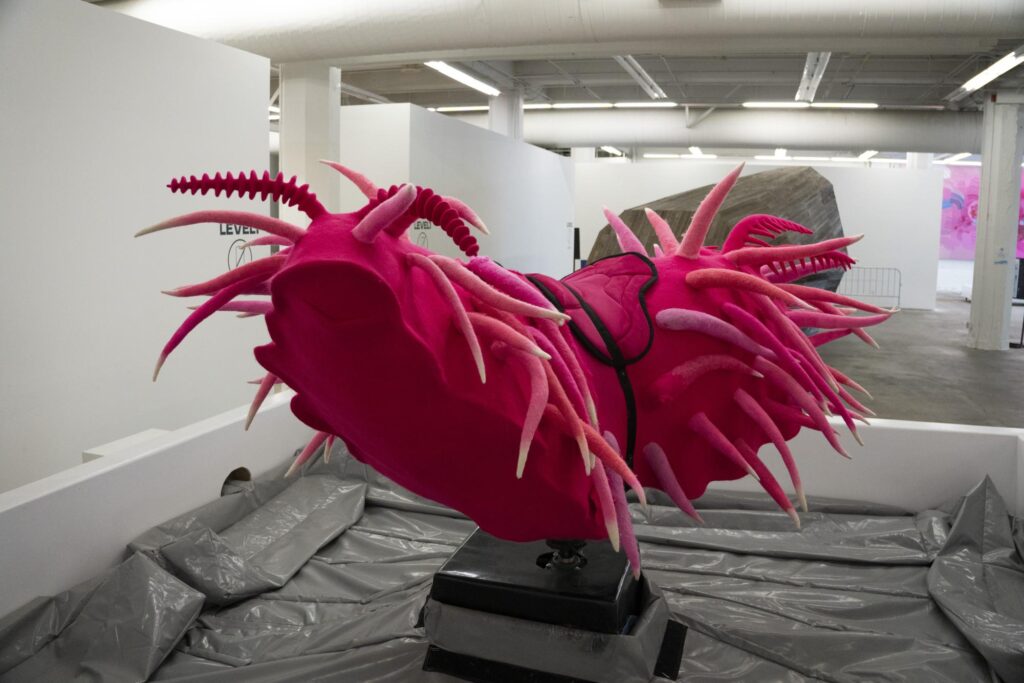
It is impossible to look at it neutrally. A ten-foot sea slug—hot pink, undulating, vaguely obscene—sits in a gallery congested with art so heavy and alive, you wonder whether to recoil or keep looking.
Inside a former Bed Bath and Beyond, the open, sterile space now holds work that refuses the conventional: a virtual reality ride, The MONSTER, pulls visitors through a synthetic landscape; paintings by Elizabeth Malaska that drip in bodily heat; and Tip Toland’s ceramic sculpture of a woman suspended mid-swing, feigning an authenticity of flesh and bone that holds the uneasy sense it might suddenly wake up. This is Cannonball Arts.
Downstairs, the sculpture titled Toxic Beauty squirms. The sculpture is a sea slug, scaled beyond recognition—its plush body stretched over the frame of a mechanical bull, and fully rideable by museum goers.
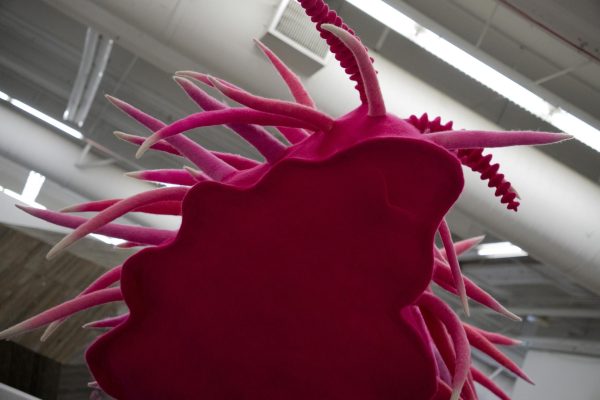 The underside of “Toxic Beauty” reveals what appears to be a friendly smile from the hot pink sea slug. (Nicole Baltimore)
The scale interrupts instinct. The color overrides danger. The gallery turns what should be rejected into something that can be approached, touched, even ridden. And behind it is artist Stephanie Metz.
She works in felted wool—compressing loose fiber into dense, sculptural forms. For years, she worked almost entirely in the natural off-whites of wool, drawn to the way light settles on undyed material. But in recent years, she’s turned toward hot pink.
“This bright pink is not a sign of beauty,” Metz said. “It’s a sign of danger and death and warning—and I really love that.”
In nature, that kind of color is a deterrent, an indication of toxins and the capacity for poisoning, but here, the logic breaks down. The pink is too saturated, too playful, too artificial to fear. It becomes desirable.
Part of that transformation is scale. Sea slugs are typically small creatures you have to search for, crouched over tide pools, your eyes adjusting to detail. Metz removes that proximity and magnifies it.
“Making things bigger always makes you have to experience them differently,” she explained. “It makes you more aware of your own physicality.”
The slug is now horse-sized, with tentacles that reach outwards and a softness that almost feels too exposed for something so large. The grotesque, when amplified, becomes something else entirely: immersive, almost theatrical. Its danger dissolves into spectacle. The shift is not just visual, it is tactile.
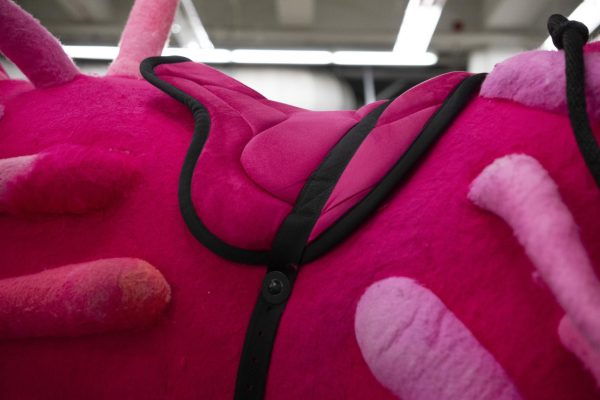 The saddle on the large, brightly colored nudibranch invites riders to participate in a mechanical bull-like experience. (Nicole Baltimore)
“We have a predilection to want to understand things through touch,” Metz said.
Unlike most gallery work, this piece invites physical interaction. The felted wool—built through a painstaking process of compressing and tangling fibers with barbed needles—is soft and dense.
Maria Gotay, the creative operations lead at Cannonball Arts, describes the piece as occupying an ambiguous, in-between space when asked whether visitors treat the installation as art, a toy, or something other.
“Probably somewhere in-between, like art, but also an Instagrammable experience,” Gotay said.
That ambiguity is part of its appeal. It resists classification. It doesn’t ask to be understood so much as encountered.
What begins as hesitation quickly mutates into intrigue, then participation. The object is too absurd to remain distant from. There is something slightly embarrassing about that impulse. Adults, especially, are trained to resist play, to maintain a certain composure in spaces that feel formal or intellectual. But Toxic Beauty undermines that instinct—deliberately accessible, deliberately disarming.
“[It’s] a little bit pop, a little bit campy,” Metz said.
But not everyone accepts that invitation without question.
“Does that harmful thing in nature really need to be made theatrical?” said Ellie LaRiviere Koempel, a Seattle U alumna who visited the exhibit. “Do we have permission to play with that?”
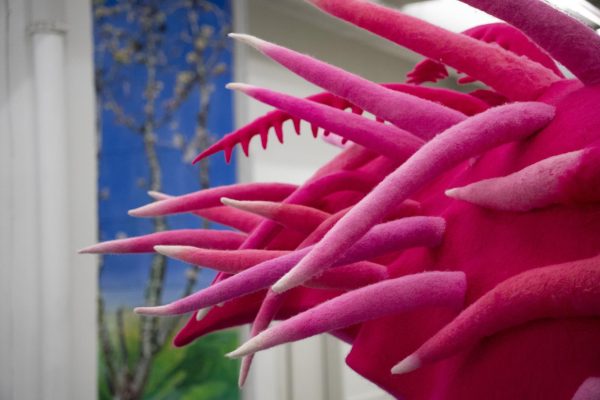 The long, hot pink appendages on “Toxic Beauty” wave through the air. (Nicole Baltimore)
The question cuts against the instinct to simply enjoy it. If the work transforms something biologically designed to repel into something we approach, what is lost in that translation?
Metz described her broader practice as an interest in the tension between invitation and warning, attraction and repulsion. What’s unsettling is how quickly the balance tips. Something that should repel becomes something we seek out, photograph, touch, or even ride. The warning signal is aestheticized. The alien becomes familiar.
But Metz resists reducing that transformation to a single meaning. For her, it returns to a simpler idea: wonder.
“Alien things are just things that aren’t familiar,” she says. “And that’s a chance to see something new.”
Maybe that’s the real seduction—not the grotesque itself, but the opportunity it offers. To look longer than we normally would. To pay attention to what we’d usually dismiss. To feel, briefly, that the world is stranger—and more alive—than we assumed.
You come expecting to laugh at it. Maybe even to recoil.
Instead, you climb on.