




Hyper-Personalized Fitness Market
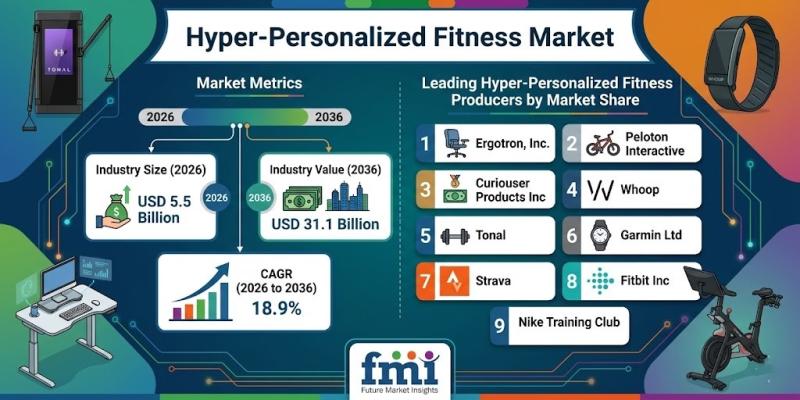
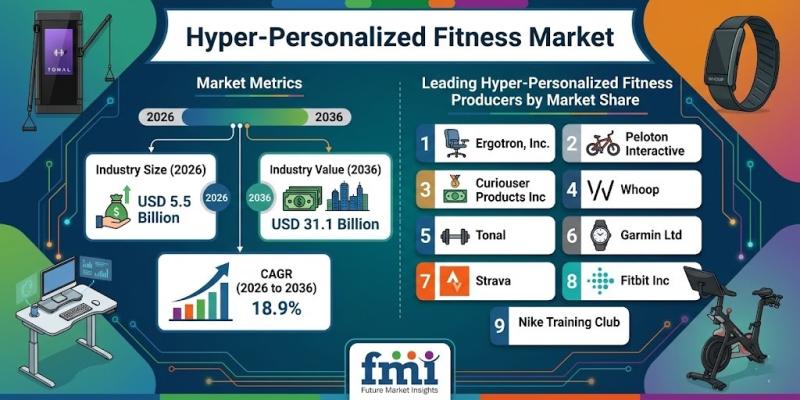
The Hyper-Personalized Fitness Market Forecast and Outlook 2026 to 2036 signals a structural shift in how fitness is delivered, monetized, and regulated. The market is projected to surge from USD 5.5 billion in 2026 to USD 31.1 billion by 2036, expanding at a CAGR of 18.9%, driven by the fusion of wearable biometrics, AI coaching engines, and clinical health data integration. What was once a fragmented ecosystem of apps and devices is rapidly consolidating into full-stack wellness platforms-where data ownership, interoperability, and clinical relevance define competitive advantage.
Quick Stats Snapshot
• Market size (2026): USD 5.5 billion
• Projected value (2036): USD 31.1 billion
• CAGR (2026-2036): 18.9%
• Wearables share (2035): ~47.3%
• Direct-to-consumer channel share: ~58.1%
• India CAGR: ~19.8% (fastest-growing major market)
Get detailed market forecasts, competitive benchmarking, and pricing trends: https://www.futuremarketinsights.com/reports/sample/rep-gb-19939
Market Size and Forecast: From Devices to Data Ecosystems
Growth in hyper-personalized fitness is no longer tied solely to hardware adoption. Instead, it is anchored in subscription-based AI services layered on biometric data streams, where marginal costs approach zero while recurring revenues scale.
The inflection point is visible in capital deployment. The 2026 merger between EGYM and Playlist-backed by USD 785 million in fresh equity-illustrates how investors are betting on integrated ecosystems rather than standalone products.
At the same time, platform expansion strategies are accelerating globally. Fitness providers are increasingly embedding content, coaching, and health analytics into everyday digital environments, reinforcing the shift toward continuous engagement models rather than episodic workouts.
Growth Drivers: Why Personalization Is Becoming Non-Negotiable
1. Convergence of Wearables and Clinical Data
The integration of wearable metrics with lab results and electronic health records (EHRs) is redefining fitness as preventive healthcare infrastructure. Platforms are evolving from tracking steps to predicting health outcomes.
2. AI as the Core Operating System
AI-driven coaching is transitioning from a feature to a foundational layer. Real-time adaptive coaching, behavioral nudging, and continuous feedback loops are becoming standard expectations across leading platforms.
3. Consumer Demand for Precision Wellness
Demand for tailored fitness has surged, with a growing share of users expecting programs aligned to physiology, genetics, and lifestyle variables. This demand is pushing companies to integrate genomic insights and advanced analytics.
4. Hybrid and Digital Fitness Models
Post-pandemic behavior persists, with a majority of users engaging in hybrid or virtual fitness formats. This reinforces the need for scalable, personalized digital platforms that can operate across home, gym, and mobile environments.
Market Challenges: Data, Regulation, and Supply Chain Risks
Despite strong growth, the market faces structural friction:
• Data Privacy & Compliance: As fitness data enters clinical territory, companies face stricter scrutiny around medical device classification and liability.
• Platform Dependency: Reliance on a limited number of AI model providers introduces systemic risk.
• Hardware Margin Compression: Wearables are increasingly commoditized, shifting profitability to software layers.
• Supply Chain Fragility: Semiconductor disruptions can directly impact sensor availability, affecting the entire personalization stack.
Opportunities: Where the Next Value Will Be Created
Clinical-Grade Personalization
The next wave of growth lies in bridging consumer wellness with healthcare systems, enabling insurers, employers, and providers to integrate fitness into care pathways.
Genomic and Biomarker Integration
Genetic and biomarker-driven fitness recommendations are opening new monetization avenues, with a growing segment of consumers willing to pay a premium for precision insights.
Immersive and AI-First Fitness Experiences
AI-powered training environments, computer-vision coaching, and immersive digital experiences are pointing toward fully adaptive, autonomous fitness ecosystems.
Corporate Wellness Expansion
Enterprises are increasingly adopting hyper-personalized fitness as part of employee health and productivity strategies, creating a parallel growth channel beyond individual consumers.
Speak to Analyst: Customize insights for your business strategy: https://www.futuremarketinsights.com/customization-available/rep-gb-19939
Segmentation Insights: Where Demand Is Concentrated
• By Product: Wearables dominate, contributing nearly half of market value due to continuous biometric tracking.
• By Channel: Direct-to-consumer models lead, reflecting the importance of data ownership and user relationships.
• By End Use: Residential fitness leads with over 60% share, underscoring the sustained shift toward home-based solutions.
Regional Analysis: Diverging Growth Narratives
North America: Platform Leadership
The United States remains the epicenter, driven by capital concentration, strong digital infrastructure, and early adoption of wearable-clinical integration.
Europe: Equipment-to-Platform Transition
Europe’s growth is shaped by the integration of smart gym equipment with digital platforms, accelerating the shift toward connected fitness ecosystems.
Asia-Pacific: Scale Through Mobile Ecosystems
Markets such as India and China are witnessing the fastest growth, fueled by smartphone penetration, rising middle-class spending, and app-first fitness adoption models.
Middle East: Corporate Wellness Hub
The region is emerging as a high-value market for enterprise-driven wellness programs and premium fitness services.
Competitive Landscape: From Fragmentation to Platform Dominance
The competitive hierarchy is increasingly defined by control over the data pipeline:
• Tier 1: Global platform leaders integrating hardware, software, and AI
• Tier 2: Specialized players targeting niche segments and use cases
• Tier 3: Emerging innovators focused on localized or highly specialized offerings
The defining shift is from standalone devices and apps to integrated ecosystems combining hardware, software, services, and community access.
Strategic Implications for Decision-Makers
• Data Ownership Is the New Moat: Companies controlling end-to-end data flows will dominate pricing and retention.
• Subscriptions Outperform Hardware Margins: Recurring AI-driven services offer scalable profitability.
• Interoperability Will Define Winners: Standardized frameworks bridging fitness and healthcare systems will become essential.
• M&A Will Accelerate: Consolidation is likely as firms seek scale across multiple layers of the value chain.
Future Outlook: Fitness Becomes Preventive Healthcare Infrastructure
The next decade will see hyper-personalized fitness evolve into a core layer of global health systems, not just a consumer category. The shift toward predictive, AI-driven, clinically integrated wellness suggests that fitness platforms will increasingly resemble digital health providers rather than lifestyle brands.
The competitive battleground is no longer about who builds the best device or app-but who owns the ecosystem that connects data, intelligence, and outcomes.
Executive Takeaways
• The market is scaling rapidly, but value is concentrating among integrated platform operators.
• AI + biometric data + clinical integration is the defining triad shaping competition.
• Emerging markets offer high-growth expansion opportunities, while mature markets lead in innovation.
• Regulatory, data privacy, and supply chain risks will shape long-term strategies.
• The real opportunity lies in transforming fitness into continuous, data-driven health management.
Why FMI: https://www.futuremarketinsights.com/why-fmi
Explore More Research Reports by FMI
Paint Ingredient Market : https://www.futuremarketinsights.com/reports/paint-mixer-market
Meal Voucher Market: https://www.futuremarketinsights.com/reports/meal-voucher-market
Mattress Topper Market: https://www.futuremarketinsights.com/reports/mattress-topper-market
Contact Us:
Future Market Insights Inc.
Christiana Corporate, 200 Continental Drive,
Suite 401, Newark, Delaware – 19713, USA
T: +1-347-918-3531
For Sales Enquiries: sales@futuremarketinsights.com
About Future Market Insights (FMI)
Future Market Insights, Inc. (FMI) is an ESOMAR-certified, ISO 9001:2015 market research and consulting organization, trusted by Fortune 500 clients and global enterprises. With operations in the U.S., UK, India, and Dubai, FMI provides data-backed insights and strategic intelligence across 30+ industries and 1200 markets worldwide.
This release was published on openPR.