




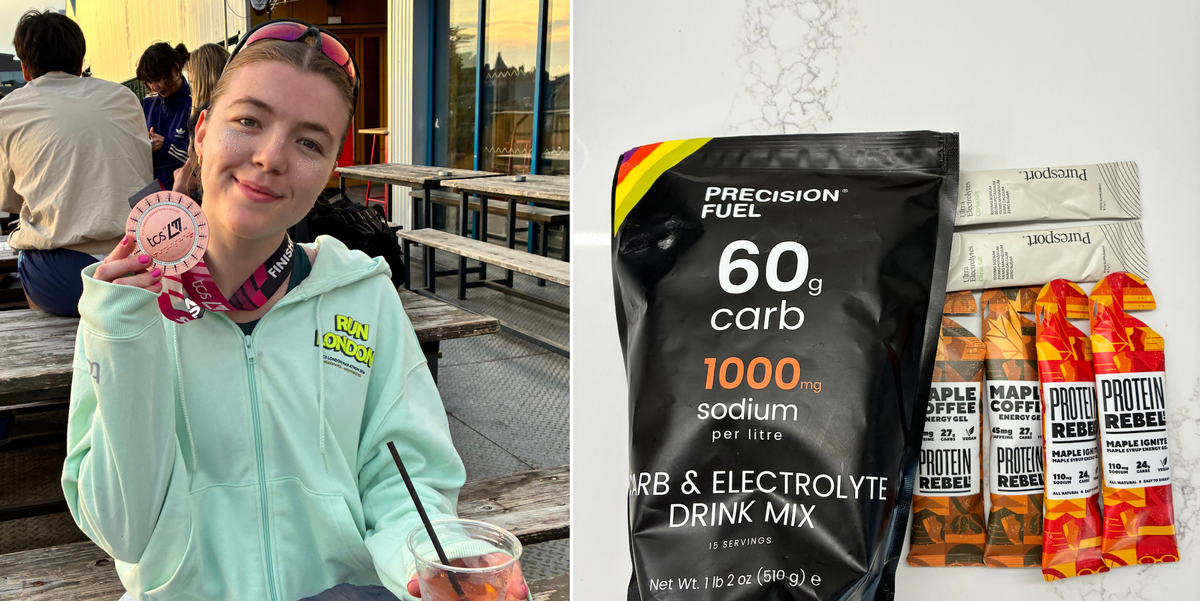
Running a marathon is an incredible achievement – no matter the time it’s completed in. Still, my overly competitive self clung onto the arbitrary sub-four goal so many first-time marathoners strive for. ‘She’s going to be fuming,’ my boyfriend told my family when the tracker predicted a 4:01 finish time following my first mile. Ah, but it was all part of my London Marathon plan – a plan that I somewhat smugly managed to execute to a T, and in which nutrition played a significant part.
My training plan and pacing
My pacing strategy on the day? Not to overcomplicate things. I knew I wanted that sub-four, but I’d also given myself a good talking to that I should be proud of myself whatever happened; of all the hard work that had gone into me getting to that start line. I knew the average pace I’d need for a 3:59 marathon (5:41 min/km) and that if I started on the slower side of it, I should be able to build up and finish faster, especially with the iconic London crowds behind me.
Indeed, starting slowly paid off. It was a really warm day, and building gradually allowed both my brain and body space to breathe, take it all in and really tune into how I was feeling and what I needed mile by mile. And we got the sub-four with a little to spare (3:58:36).
As for my training plan? Also pretty simple. Seeing people post super high weekly mileages on social media, it can be easy to constantly think you’re not doing enough. However, I know I’m busy and also that I want a life outside running (however much I love it), so I always viewed my life as influencing my plan rather than vice versa. Most of the time, that meant only doing two runs a week – prioritising the speed session and long run on my Runna plan, and only doing the extra easy run if time allowed. But generally, that was replaced with a strength session, team sport or a social event I’d simply get too much FOMO about.
How I fuelled my sub-4 marathon
I did track and field when I was younger – never long-distance (even 800m was far too long for my liking). So, when I rediscovered running as an adult, I started with 5ks and 10ks, for which in-run fuel wasn’t really necessary. Then came half marathons, which required a bit more nutritional consideration. But marathons? Well, those are a different beast – and need a lot more food for thought… as I’ve learnt.
I was lucky enough to be supported by the Lingo by Abbott team, who set me up with a Lingo CGM (continuous glucose monitor) so I could use personalised data to inform my race fuelling strategy. With the guidance of Pamela Nisevich Bede, Global Nutritionist at Lingo by Abbott, I was able to decode that blood glucose data, experimenting with different fuelling methods throughout my training and exploring what did – and didn’t – work.
Related Story
While nutrition is highly personal, below are some of the things that worked for me and that I used on race day to fuel my sub-four marathon:
1. One gel every 5k, taken slowly over one kilometre
Nisevich Bede suggested I try this when we reviewed my data from training runs, which had shown sharp glucose spikes and crashes when I’d gobbled gels up in one go. Taking the gels gradually helped avoid this. Plus, on the day, I think it also helped me swerve any GI issues that may have been worsened by the heat. For me, this specific method of taking gels has been game-changing.
I chose to run with a hydration vest so I could carry my pre-made electrolytes (Puresport’s Citrus Salt Powder) with me, and I’m so glad I did. It meant I was always taking on fluid with my gels and that I had a constant source to slowly and calmly sip from. Because it was so warm, I still took on plain water at every station, which, along with my electrolytes, kept me adequately hydrated.
 Hannah Bradfield
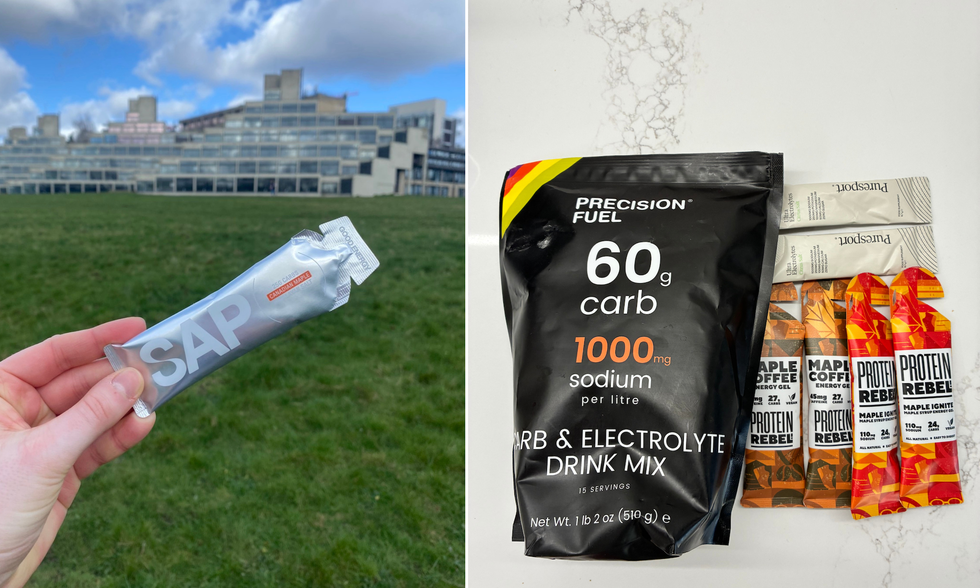
The fuel I found worked best for me
3. Alternating non-caffeine and caffeine gels
Caffeine can be a great performance enhancer when used correctly. After practising this gel pattern recommended by Nisevich Bede in training (several times) with no GI distress, I repeated it with success on race day. I used a mix of Protein Rebel’s Maple Energy Gels and Maple Coffee Caffeine Gels and SAP’s Organic Maple + Himalayan Salt Gels.
4. I carb-maxxed
Having experienced hunger at the end of a few long runs, I tried upping my carbs in the time spent procrastinating between breakfast (bagel with butter, peanut butter and honey, raspberries and coffee with milk) and heading out. On race day, that looked like 500ml of Precision Fuel’s Carb & Electrolytes Powder Drink Mix while travelling to the start line and then a CLIF Bar about 45 minutes before the race.
Again, nutrition is often very personal, but get it right and it could make your marathon – as it did for me.
Related Stories
Hannah Bradfield is a Senior Health and Fitness Writer for Women’s Health UK. An NCTJ-accredited journalist, Hannah graduated from Loughborough University with a BA in English and Sport Science and an MA in Media and Cultural Analysis. She has been covering sports, health and fitness for the last five years and has created content for outlets including BBC Sport, BBC Sounds, Runner’s World and Stylist. She especially enjoys interviewing those working within the community to improve access to sport, exercise and wellness. Hannah is a 2024 John Schofield Trust Fellow and was also named a 2022 Rising Star in Journalism by The Printing Charity. A keen runner, Hannah was firmly a sprinter growing up (also dabbling in long jump) but has since transitioned to longer-distance running. While 10K is her favoured race distance, she loves running or volunteering at parkrun every Saturday, followed, of course, by pastries. She’s always looking for fun new runs and races to do and brunch spots to try.