




We outline a decision analysis approach that supports decisions aimed at improving food environments and addressing malnutrition. We employed an iterative process that involved workshops, expert knowledge elicitation and calibration, and a literature review. We base our model on three workshops, held in 2023–2024 with a diverse group of 50 stakeholders (hereinafter referred to as “experts”) from a range of backgrounds, ensuring diverse perspectives and gender balance. Experts were predominantly Vietnamese, drawn from partner institutions, teachers and school administrators in Hanoi, and included practitioners from agriculture, nutrition, economics, education, and food preparation, as well as parents and their children. A detailed, date-annotated log of all stakeholder engagement activities, workshops, and meetings is available in the GitHub repository associated with this publication (Whitney & Kopton, 2025).
Decision Framing
We convened a workshop with experts to establish a common understanding of the problem. Our process began by co-defining “food environments” using the established framework of Downs et al. (2020), which encompasses the physical, economic, and socio-cultural contexts that shape consumer choices. With a shared definition as a foundation, we facilitated structured discussions on the specific challenges of food access, availability, and sustainability in Hanoi’s urban context. This process enabled experts to identify key issues and collaboratively propose and evaluate potential intervention points. Through this consensus-building exercise, school gardens emerged as the most feasible intervention, and school boards were identified as the primary decision-makers in this context.
Model formulation
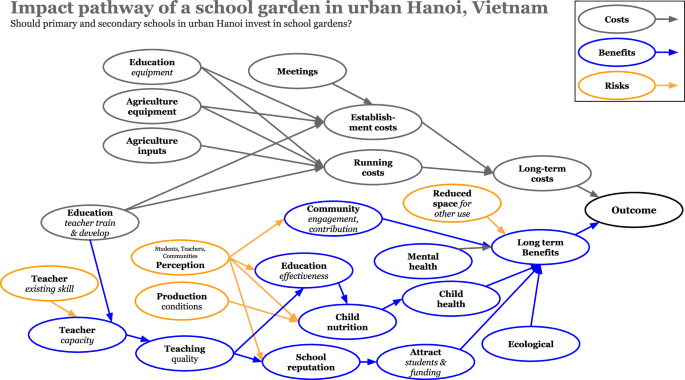
During the August 2023 workshops, we worked with experts to co-develop a comprehensive impact pathway model encompassing tangible and intangible components, costs, benefits, and risks associated with all decision options, following Whitney et al. (2018) (Fig. 1). The resulting conceptual model served as the direct blueprint for programming the simulation and underwent further validation and refinement in follow-up workshops and meetings.
Fig. 1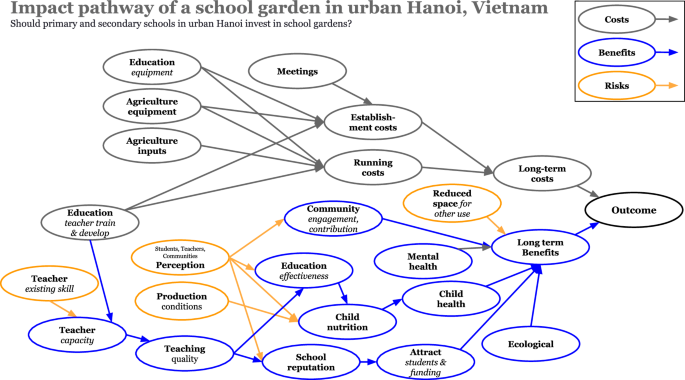 The alternative text for this image may have been generated using AI.
Co-developed causal model (Impact Pathway) illustrating the decision problem: Should urban Hanoi school boards invest time and money in creating school gardens? The model (represented by nodes and arrows) captures the relationships between key variables, showing how investments lead to costs and benefits. Key outcomes influenced by the improved food environment, education, and community engagement include Mental Health and Child Nutrition. This model was used as the foundation for Monte Carlo simulations.
Quick scoping review
We also conducted a Quick Scoping Review and incorporated the results into the model, ensuring the inclusion of relevant insights and data. The review was conducted independently to provide evidence-based parameter ranges that complemented expert knowledge. We focused our review on one central question: ‘What are possible effective nutrition interventions for enhanced child health outcomes in Vietnam?’ We searched Google Scholar for scientific papers, abstracts, theses, reports, and other published documents on the efficacy of food environment nutrition interventions for enhanced child health outcomes in Vietnam. We used the query “Child nutrition” + “intervention” + “Vietnam” + “food environment” and constrained the search to documents published since 2019. We pre-registered the query and published the search results (Whitney, 2023).
Our Quick Scoping Review yielded 245 papers, of which 166 were retained after duplicates and irrelevant work (e.g., bibliography-only or journal homepage-only) were removed (Whitney, 2025). The literature encompassed a range of topics related to public health, nutrition, and agricultural production and marketing. It included research findings, literature reviews, and conference proceedings addressing public health policy, community food security, the role of meat and fish in regional food systems, social determinants of healthy eating, school food environments, and the relationship between farm diversity and diet diversity, among other relevant subjects. The literature also covered other general topics related to food environments and child nutrition. The work addressed the impact of urbanization on food security, the role of indigenous vegetables in sustainable food systems, and the importance of innovation in transforming food systems. It included studies on inequities and nutrition-related policies and guidelines in various countries. Public policy and planning can support local stakeholders in maintaining equitable and nutritious local food systems, which in turn can positively impact child health outcomes. Many of the reviewed papers focused on public health policy in developed countries. The literature emphasized the need to assess policy impacts and the lack of such approaches in development research.
Data and variables
Our model formulation followed an iterative process that included peer-review of the model structure and expert elicitation to define input parameters. The model input parameters were derived from two primary sources: expert knowledge elicitation and a systematic review of available literature.
We engaged experts in a structured elicitation process. A critical first step was calibrating the experts themselves. Following established protocols (Whitney et al., 2018), we trained them to accurately express their knowledge as probability distributions, quantifying their uncertainty. Once calibrated, the experts provided estimates for the model’s core variables. All parameter estimates were elicited as 90% confidence intervals specific to urban Hanoi primary and secondary school contexts (ages 6–15). Estimates included expert knowledge and Hanoi-specific nutrition and food environment data where available. These intervals were translated into probability distributions and forward-propagated through 10,000 Monte Carlo runs, such that all results presented as ranges reflect this propagated parameter uncertainty. Our approach directly captured the integrated judgment of experts on complex outcomes, synthesizing pathways that would be difficult to model individually. Elicitation is a standard practice in fields where empirical data are limited, such as risk assessment and environmental modeling (O’Hagan, 2019; Soares et al., 2024).
Elicited variables included costs (e.g., establishment, training, maintenance), benefits (e.g., healthcare savings, mental health value, reputation gains), and critical risk factors (e.g., probability of community support, chance of bureaucratic barriers inhibiting the project). Experts were provided with a clear definition of each variable and asked to estimate a value range, e.g., for the probability of occurrence and level of damage for a given risk.
The health and biodiversity outcomes were expressed in monetary terms to create a unified decision criterion. Health benefits were converted into monetary terms using calibrated estimates of the expected healthcare savings through healthier diets and the mental health impacts of garden green space. Likewise, biodiversity benefits were converted into monetary terms using calibrated estimates regarding the value of living near and around urban biodiversity in Hanoi.
We also used the Quick Scoping Review to inform and cross-validate expert estimates with empirical data and benchmarks for parameters such as the prevalence of micronutrient deficiencies in Vietnamese children and the estimated economic value of urban biodiversity.
The model consists of 104 input variables, each translated into a probability distribution (e.g., uniform, positive, or truncated normal). A full table listing all variables, their defined distributions, and their data sources is provided in the supplementary materials (Whitney and Kopton, 2025).
Model programming
We used the R programming language (R core team, 2023) to develop a model script based on our conceptual framework. To compute the Net Present Value (NPV) as a measure of overall utility, we used probability functions from the decisionSupport package (Luedeling et al., 2015). We used conditional logic in the form of “if-else” logic to represent the interrelationships among variables in the model. We programmed the model as a Monte Carlo simulation with 10,000 runs, estimating a wide range of possible outcomes through repeated sampling from defined probability distributions. All scripts and data are accessible in the supplementary materials (Whitney and Kopton, 2025).
The core model simulates the economic, environmental and health outcomes of introducing school gardens in Hanoi schools as a standalone intervention or as an integrated part of STEM education. We designed the model to provide insights into school garden interventions across different school types (public and private). We used school type as a proxy for socioeconomic status to explore the influence of internal domain factors (e.g., ability to pay, community support) on garden intervention outcomes. The differences in outcomes between school types provide evidence for this influence.
To precisely define the scope of our analysis, we focus on specific domains of the school food environment that are influenced by garden interventions. Based on the framework of Downs et al. (2020), our model primarily evaluates changes in three internal food environment dimensions:
Availability: The presence of fresh fruits and vegetables produced in the garden.
Accessibility: Students’ physical access to and ability to obtain these garden-produced foods.
Desirability: The shift in students’ preferences, knowledge, and willingness to consume healthy foods through hands-on learning and exposure.
While broader external food environment factors (e.g., market price, advertising) are acknowledged, they are held constant in our model, as the intervention primarily targets these internal, school-based domains.
We built the model to distinguish between the initial costs of establishing the garden and the ongoing maintenance costs associated with it. Establishment costs include construction, equipment, garden design, and expenses for setting up a composting facility. Maintenance costs include expenditures for labor, seeds, fertilizers, and equipment replacement, with additional costs for teacher training and equipment if the garden is part of a STEM curriculum. In the STEM integration scenario, extra costs include specialized teaching equipment (e.g., microscopes, lab reagents) and training teachers on interdisciplinary topics. This equipment is essential for transforming the garden into a full-scale outdoor laboratory for inquiry-based science education. For example, microscopes allow students to investigate soil microbiology, plant cell structures, and pests, thereby integrating biological concepts with hands-on gardening activities. This setup requires ongoing teacher involvement and training.
The model incorporates several “ex-ante” risk factors, such as community support, management effectiveness, and ecological sustainability, which we expect to influence garden success. These factors reduce the expected benefits if risks materialize, effectively simulating real-world challenges like a lack of community interest or ineffective management. Public schools may face additional constraints, such as limited land availability, unsuitable land for gardening, and bureaucratic barriers, which could inhibit the establishment or long-term maintenance of gardens. The model accounts for these scenarios, reducing or eliminating benefits and costs if these risks prevent garden establishment.
We modeled the primary benefit of the garden through improving children’s food environments. Exposure to the garden can increase students’ desire for and access to fresh vegetables (e.g., Lohr et al., 2020; Ratcliffe et al., 2011), potentially reducing healthcare costs associated with diet-related issues (e.g., Rochira et al., 2020) and improving school performance (e.g., Berezowitz et al., 2015; Davis et al., 2023) and community engagement (e.g., Takkouch and DeCoito, 2024). For the STEM scenario, we also modeled the benefits of practical biology, ecology, and sustainability lessons, which are expected to lead to cost savings by reducing the need for after-school programs and tutoring by incorporating hands-on learning within school hours (e.g., Ozer, 2007).
We modeled the gardens’ expected enhancement of school reputation and community support, which can lead to increased enrollment and potential outside investment. These benefits are more pronounced in private schools, where we expect reputation-building to impact enrollment. Gardens also provide ecological benefits, such as green space and pollution reduction, which have intrinsic value in urban areas.
We calculated opportunity costs by comparing the potential earnings from garden use with alternative uses, such as playgrounds or parking areas. Accounting for other land uses enabled us to evaluate whether the garden provides a net benefit relative to a no-garden scenario.
We adjusted variables for inflation as necessary and calculated the Net Present Value (NPV) for each intervention, comparing the discounted future benefits and costs of the garden intervention (with and without STEM) against the no-garden alternative. We adjusted the NPV with discount rates to provide a realistic projection of long-term financial viability. The choice of discount rate can significantly influence outcomes, particularly for long-term ecological and health benefits. To account for this uncertainty and reflect a range of potential social time preference rates, we used a range of 3–8% for our analysis, consistent with guidelines for public investment appraisal in developing economies and similar agricultural projects (e.g., Cherbonnier and Gollier, 2023). This range enables us to assess the robustness of our conclusions across various valuation scenarios.
We calculated the NPV over a 5-year horizon. We present all model results in Million Vietnamese Dong (VND), roughly equivalent to 40 USD.
Post-hoc analyses
Following the Monte Carlo simulations, we conducted several post-hoc analyses to gain insights into the model outcomes and to inform potential decision-making strategies. First, we employed Partial Least Squares (PLS) regression to identify the most significant factors influencing key outcomes in the model. PLS regression is particularly useful in models with multicollinearity and a high number of predictors relative to the number of observations, allowing us to pinpoint variables with the greatest impact on school garden outcomes (Abdi, 2010; Wold et al., 2001). It was selected for this analysis specifically for its strength in deriving robust variable importance estimates from complex, correlated model structures.
In addition to PLS regression, we employed the Expected Value of Perfect Information (EVPI) to quantify the value of eliminating uncertainty in each model parameter. EVPI helps prioritize data collection efforts by identifying the parameters where reducing uncertainty would most improve decision clarity (Raiffa and Schlaifer, 2000). Parameters with high EVPI scores indicate areas where more precise data could improve decision-making. They point to places for refining the model and increasing its reliability. We followed up on high-EVPI parameters in a second round of calibration training and data collection with experts.
This layered approach, combining PLS regression, EVPI analysis, and calibration training, allowed us to refine key factors and identify priority data gaps in the model. These methods have proven effective for enhancing decision-making in complex systems with multiple objectives and uncertain outcomes (Howard, 1968; Keeney and Raiffa, 1993).
Pareto-optimal solutions
We explicitly modeled five controllable variables, decision parameters that school administrators can directly adjust, within defined bounds: garden size (m²), inclusion of animals, presence of a school canteen, number of annual school events, and whether parking is retained on the plot. These included Boolean, integer, and continuous variables. Uncontrollable variables comprised 71 stochastic inputs derived from probability distributions, capturing external factors such as environmental conditions, community support, and economic trends (full list in Whitney and Kopton, 2025).
We employed Pareto optimization techniques to map the relationships, whether synergistic or competitive, between the three objectives: economic return, biodiversity, and health outcomes across different intervention scenarios. This approach identifies Pareto-optimal solutions, which are configurations where one objective cannot be improved without worsening another (Miettinen, 1998; Pareto, 1971), thereby revealing the fundamental structure of the decision space. Given the complexity of the Monte Carlo simulations underlying our model, gradient-based or algebraic methods were unsuitable. In such cases, population-based metaheuristics are particularly well-suited due to their ability to explore large and complex search spaces (Maniezzo et al., 2021). We applied the evolutionary optimization Non-dominated Sorting Genetic Algorithm II (NSGA-II; Deb et al., 2002). NSGA-II has been successfully applied to balancing economic and environmental objectives for mixed integer problems (Kopton et al., 2023). We used NSGA-II with a population size of 80 and 80 generations to approximate the Pareto front of expected outcomes for each decision option. For the 3-dimensional objective function, we used the mean outcomes of a smaller set of Monte Carlo simulations with 2500 samples. This strategic use of probabilistic multi-objective optimization enabled systematic exploration of trade-offs and synergies across economic, biodiversity, and health objectives.