




We examined a cohort of over 250,000 youth from grades 5 to 8 over two years to assess changes in various aspects of physical fitness in response to COVID-19 restrictions, controlling for student age, sex and school characteristics. Our findings indicate a decline in body composition, cardiorespiratory fitness, and flexibility. Interestingly, musculoskeletal fitness showed mixed results; while performance in the push-up and curl-up tests deteriorated, measures such as handgrip strength, standing long jump, and trunk-lift test demonstrated improvement. Notably, the decline in body composition, cardiorespiratory fitness, and muscle endurance (push-up and curl-up tests) was significantly greater than the gains observed in case of handgrip, standing long jump and trunk-lift tests. This suggests non-uniform changes in students’ fitness profiles during the COVID-19 restrictions, which varied by the domain being investigated.
The body composition and cardiorespiratory fitness changes demonstrated in this study are consistent with previous research that has shown that prolonged periods of inactivity can have negative effects on different fitness profiles10,12,13,15,18,36,37,38. Furthermore, many investigations have demonstrated a decline in cardiovascular endurance10,13,15,16,37,38, highlighting the broader impact of restricted physical activity during this period.
There is no clear consensus regarding how lockdown correlated adolescents’ musculoskeletal systems. Similar to our study, studies from Estonia, the USA, and Poland16,39 reported decreases in push-up and curl-up test results after the COVID-19 pandemic. However, handgrip strength, standing long jump, and trunk-lift scores improved in Hungary and elsewhere10,16,40. We explain these results obtained by handgrip strength, standing long jump, and trunk-lift tests are primarily used to assess maximal strength and explosive power, whereas push-ups and curl-ups require muscular endurance, which is more susceptible to decline when physical activity levels decrease. The flexibility results were also mixed. Chinese36,38 studies reported gains, whereas Greek40 and French14 studies reported decreases. As our methods align more with European studies, our findings support their results. Overall, unlike body composition and cardiovascular fitness, to the effects of the lockdown on musculoskeletal test results were selective. Strength and power were maintained or improved, whereas endurance decreased due to less activity and structure.
In addition to the clear sex and age differences identified by statistical models which may be related tophysiological, hormonal, and behavioral factors, sensitivity analysis revealed that sex and age modified the effects of COVID-19 closures. Lockdown impacts were stronger in girls for BF%, cardiovascular endurance, flexibility, and handgrip strength, whereas boys showed greater changes in BMI, standing long jump, push-up, curl-up, and trunk-lift. Age also exerted an effect modification. Younger students had greater increases in BMI and declines in push-up performance, whereas older students showed greater declines in BF%, cardiovascular endurance, flexibility, and curl-ups. Older students also improved more in handgrip strength and long jump, whereas trunk-lift gains were greater among younger students. Our study, like others, revealed worsened body composition and improved cardiovascular endurance in boys11,12,38. Boys’ greater weight gain and girls’ sharper performance decline are likely due to reduced activity, more sedentary time, and mismatched energy intake, especially in boys. Boys’ greater muscle mass and strength may have supported their performance levels.
Similar to other studies12,41, considering age as an effect modification factor was linked to variations in the fitness profile of the students, especially among older adolescents. Several facilitating factors may contribute to these results. Compared with their older peers, young students are more likely to participate in free play and unstructured physical activity during leisure time (such as biking)8, in addition, studies have shown that older students tend to move less42,43. The results of the body composition profile are most negatively affected by age. This underlines the importance of fostering joy for movement as early as possible so that regular physical activity may become a part of children’s daily routine.
To the best of our knowledge, this is the first study to analyze not only the impact of COVID-19 on students’ physical fitness profiles, but also the structural characteristics of educational institutions. The analysis revealed substantial variation at the school level. For BF%, the standing long jump test, and the curl-up test, a significant number of schools deviated from the average, shifting towards positive log-odds, which suggests a greater likelihood of unfavorable test outcomes in many schools. The 20 m PACER, flexibility, curl-up, and trunk-lift tests exhibited the greatest variability across schools, with both favorable and unfavorable results.
The settlement size also mattered. Compared with those in the capital, students in smaller towns were less likely to reach the HFZ for body composition, cardiorespiratory fitness, and musculoskeletal fitness. This likely may be related to Hungary-specific factors, including limited sports infrastructure and programs in smaller or rural areas. Additionally, local attitudes and weak leisure policies often reduce engagement in physical activity. In contrast, in rural communities, there is often a negative perception of local opportunities and the leisure time policy actions of local governments44, which may contribute to less popular community leisure activities.
School maintainer type also related the investigated outcomes in this study. Students in foundation, church, or central schools were more likely to meet HFZ standards. These schools may promote healthier lifestyles by integrating physical, mental, and spiritual development. They also tend to have better resources and more structured activities and may attract students from higher socioeconomic backgrounds. However, it is possible that these differences partly reflect underlying socioeconomic or demographic characteristics rather than being solely attributable to school type. Additionally, we hypothesized that students attending school centers benefit from better-trained physical education teachers, a wider variety of extracurricular sports programs, more structured physical activity opportunities, and greater access to high-quality facilities.
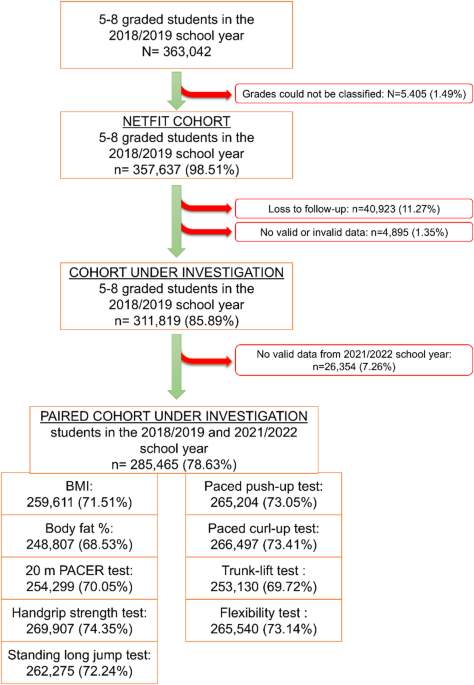
A key strength of the present investigation is the ability to test changes in students’ physical fitness profiles over time using prospective, cohort data with a relatively small dropout rate (11%) from the Hungarian adolescent population, which allowed for a thorough assessment of observed changes in students’ physical fitness during the COVID-19 period. All of the studied outcomes were validated and objectively measured each year, which increased the reliability and validity of the data. The data collection system on which the analysis is based has been in place for a long time; therefore, the teachers have considerable experience collecting the data, which improves the data quality of the investigation. Factors such as the socioeconomic status and health behaviors of the students may provide further insights into the observed differences, and the paired study design effectively minimizes the variability caused by individual differences, thereby enhancing the study’s reliability.
However, several limitations should be acknowledged. First, we cannot determine and analyze the causes of the observed changes in physical fitness due to factors (diet, sleep, and sedentary behavior or psychological effects, including stress, anxiety, and depression) that developed among the students during the COVID-19 pandemic and the closures. Evidence from the literature45 suggests that key health behaviors—sleep, and diet—worsened following COVID-19. Poor diet quality and insufficient sleep can reduce energy, hinder recovery, and impair overall physical performance. Second, the study did not examine the mediating relationships between demographic factors and the impact of lockdown, which could provide valuable insights into the research. A further limitation of our study is that physical fitness data were collected at different time points across the two analysed periods. In the pre-pandemic, measurements were limited to a 19-week window (January to June), whereas in the post-pandemic data could be registered throughout the school year (September to June). Because the exact timing of individual measurements could not be analysed or controlled, we cannot rule out the possibility that seasonal variations in physical activity contributed to the observed differences in fitness outcomes. Measurements during colder or less active periods might underestimate these outcomes. Because long-term trends were not analysed, pandemic-related effects cannot be fully separated from ongoing secular changes; nevertheless, national reports indicate that pre-COVID year-to-year variation was minimal. Although minor differences were observed between students retained in the cohort and those lost to follow-up, the magnitude of these differences was small and unlikely to meaningfully bias the results. Given the high follow-up rate (89%), the possibility of residual attrition bias cannot be entirely excluded and should be considered when interpreting the findings. Nonlinear effects of age were not explicitly modeled, and age was included primarily to control for confounding; future studies could explore potential nonlinear age trends.