



In March, the American College of Sports Medicine (ACSM) updated its stance on strength training for the first time in 17 years – and it makes for refreshing reading. The organisation examined data from 136 systematic reviews featuring more than 30,000 people, and concluded that consistency, not complexity, delivers the best results.
It matters less where you are, what equipment you use and the exact exercises you choose. What matters more is that you do something that challenges your muscles on a fairly regular basis – at least twice per week.
“The best resistance training program is the one you’ll actually stick with,” says Professor Stuart Phillips, an author on the position stand and professor in the department of kinesiology at McMaster University.
“Training all major muscle groups at least twice a week matters far more than chasing the idea of a ‘perfect’ or complex training plan. Whether it’s barbells, bands or body weight, consistency and effort drive results.”
For the last five years, I have been interviewing experts in sport science, exercise physiology and coaching. Here is their advice on how to start strength training and harness the many benefits it offers.
How to start strength training
Like any form of exercise, strength training is a skill, and you have to learn how to perform the movements correctly to progress.
If you are going to start strength training on your own, find quality online resources to teach you how to perform each exercise correctly. Or, if you can afford to, leading human performance scientist Dr Andy Galpin recommends hiring a qualified coach for your first month or two of lifting.
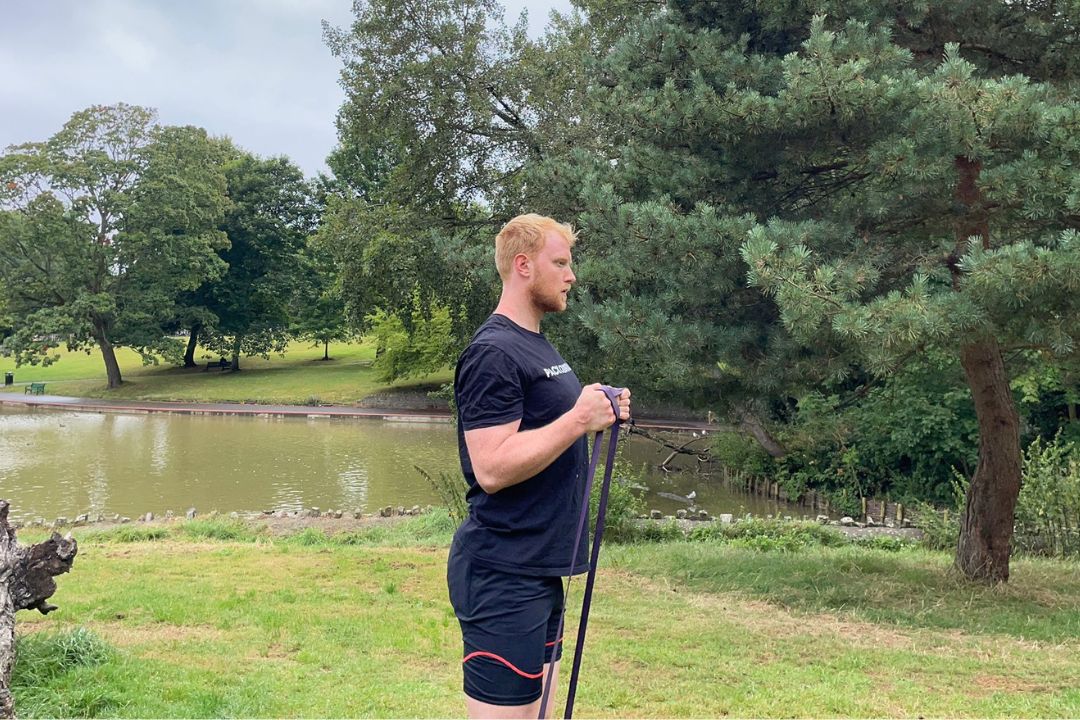 The Independent’s senior fitness writer Harry Bullmore training with a resistance band (The Independent/Harry Bullmore)
“Ignore creating an exercise plan or pursuing certain fitness goals at first, just ask them to teach you the proper technique for as many foundational exercises as possible,” he advises. This can be helpful as every exerciser is different and every body moves differently. A good trainer can help you find the best way to perform an exercise for your fitness level and body type.
Key moves to cover are variations of the squat, lunge, deadlift, row and press. These exercises provide everything you need to build a fit, functional body.
Read more: The easiest way to strengthen your entire body, according to this expert coach
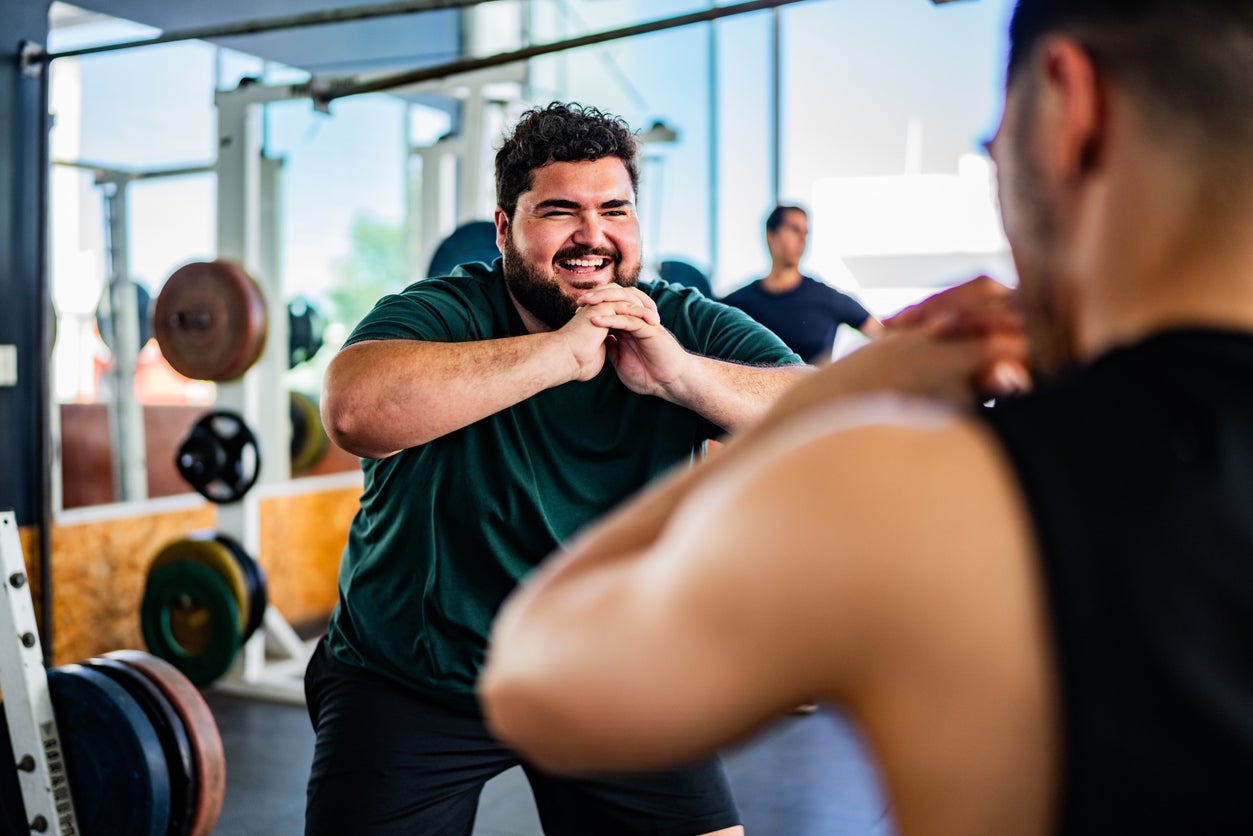 The squat is a fundamental human movement pattern (Getty/iStock)
Choose your exercise
“Select exercises that take you through the largest range of motion that is safe for you,” says Dr Galpin. “[The aim is] to find exercises or variations that allow you to train all muscles without it being painful,” adds Marchon Victoria head coach, Patrick James.
If you can perform a barbell squat comfortably with good form, this is an excellent way to strengthen your legs. If you cannot, you might start with an easier variation like the goblet squat.
If the bottom position of the squat still feels uncomfortable, you can squat to a box, and if you struggle with the stability element you can perform a leg press or leg extension using exercise machines in the gym.
Each of these exercises works the same primary muscles and joints, they just have differing degrees of accessibility. It’s all about finding the one that fits your fitness level and individual needs.
Exercise can be progressed in this way, as well as regressed. If you can currently perform a box squat to a platform that is 60cm high (or 24in – most boxes in gyms tend to be measured in inches) try to gradually lower this over time to build strength and mobility through a wider range of motion. Eventually, you will be able to comfortably perform a full squat.
Read more: I couldn’t hold a plank at 59 – now I can do pull-ups at 76
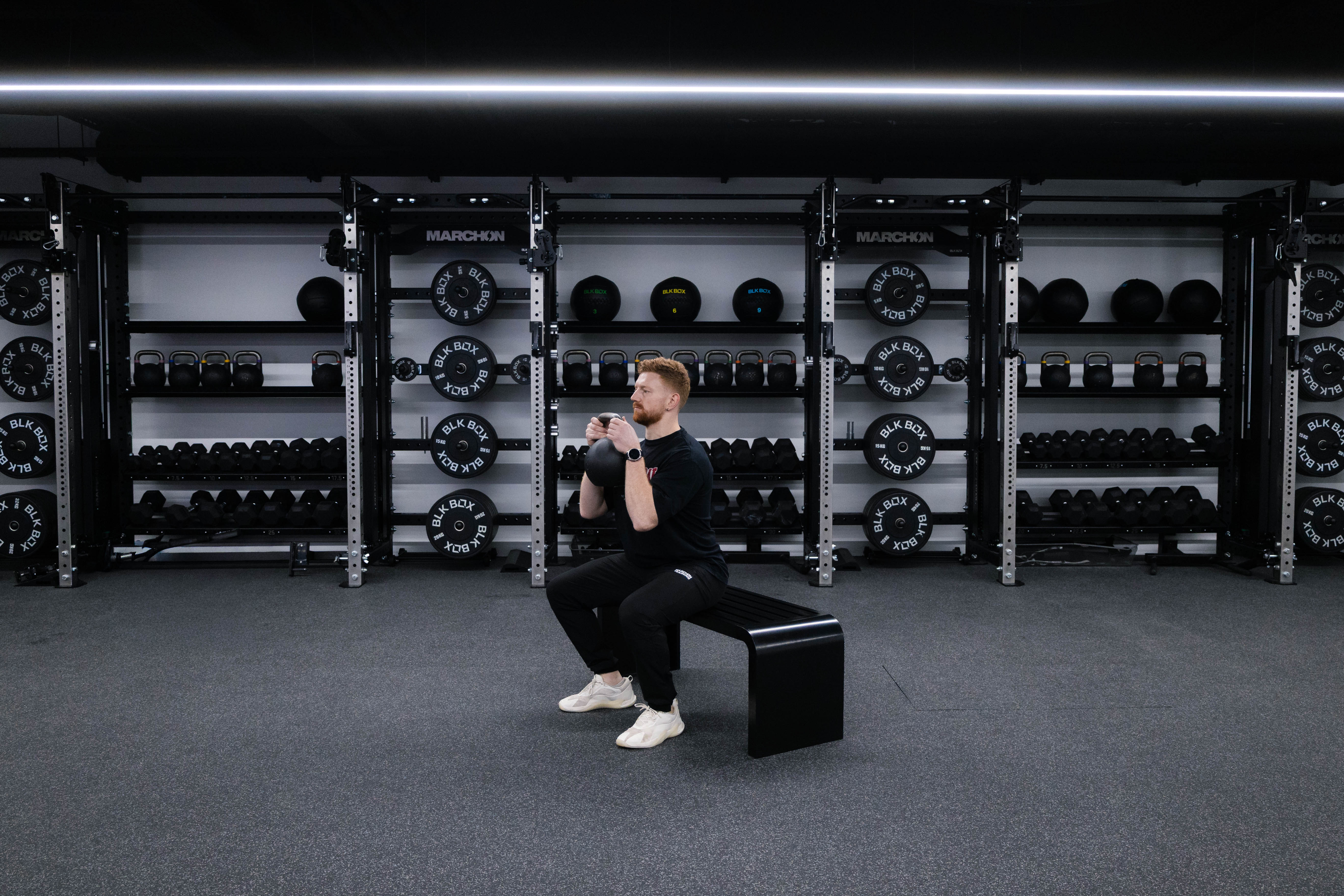 Marchon coach Patrick James demonstrates how to perform a squat to box (Patrick James/Marchon)
Five key principles of strength training
If you can commit these five things to memory and apply them to your workouts, you will have more knowledge at your disposal than most gym-goers.
Frequency: Consistency is key for successful strength training. Seasoned strength coach Ed Haynes says two full-body workouts per week will be enough for the vast majority of people to see impressive improvements in strength, muscle and mobility. Experienced exercisers, or those who enjoy strength training, may progress to three or four after a while.
Volume: Legendary strength coach Dan John says there are five basic human movement patterns; push, pull, hinge (at the hips, ie. a glute bridge or deadlift), squat and loaded carry. If you can touch on each of these in both of your weekly workouts, you’re on to a winner. The ACSM position stand recommends two or three challenging sets of each exercise per workout.
Intensity: The body adapts to overcome challenges it consistently faces. As a result, for strength training to be effective, each set needs to feel at least moderately challenging. “An easy test for this is, as you’re pushing through your set, there must be an involuntary slowing down of the speed of the lift, even with full effort,” says Haynes.
Progression: If the body adapts to overcome challenges, the challenge you’re giving it needs to become incrementally greater over time if you want to see continued results. You can do this by tweaking the variables in your workouts; the weight you are lifting, how many sets and reps you are completing, the difficulty of the exercise or the range of motion you are using in the movement. The simplest way to do this is, when an exercise feels like it requires a six out of 10 effort or below, increase one of these variables.
Fuel and recovery: Muscle is not built during workouts. What you do in your workouts persuades your body it needs to become stronger, then these changes are put into action in the days that follow. For this reason, fuel and recovery are key. Aim for at least seven hours of good quality sleep per night. Professor Javier Gonzalez, a professor of nutrition and metabolism at the University of Bath, also says that eating 1.2g of protein per kilogramme of bodyweight “may have additional benefits for muscle health and weight control,” while the protein requirements for athletes can extend up to 1.8g/kg.
Read more: Sitting all day wreaks havoc on your hips and spine – here’s how to stop that from happening
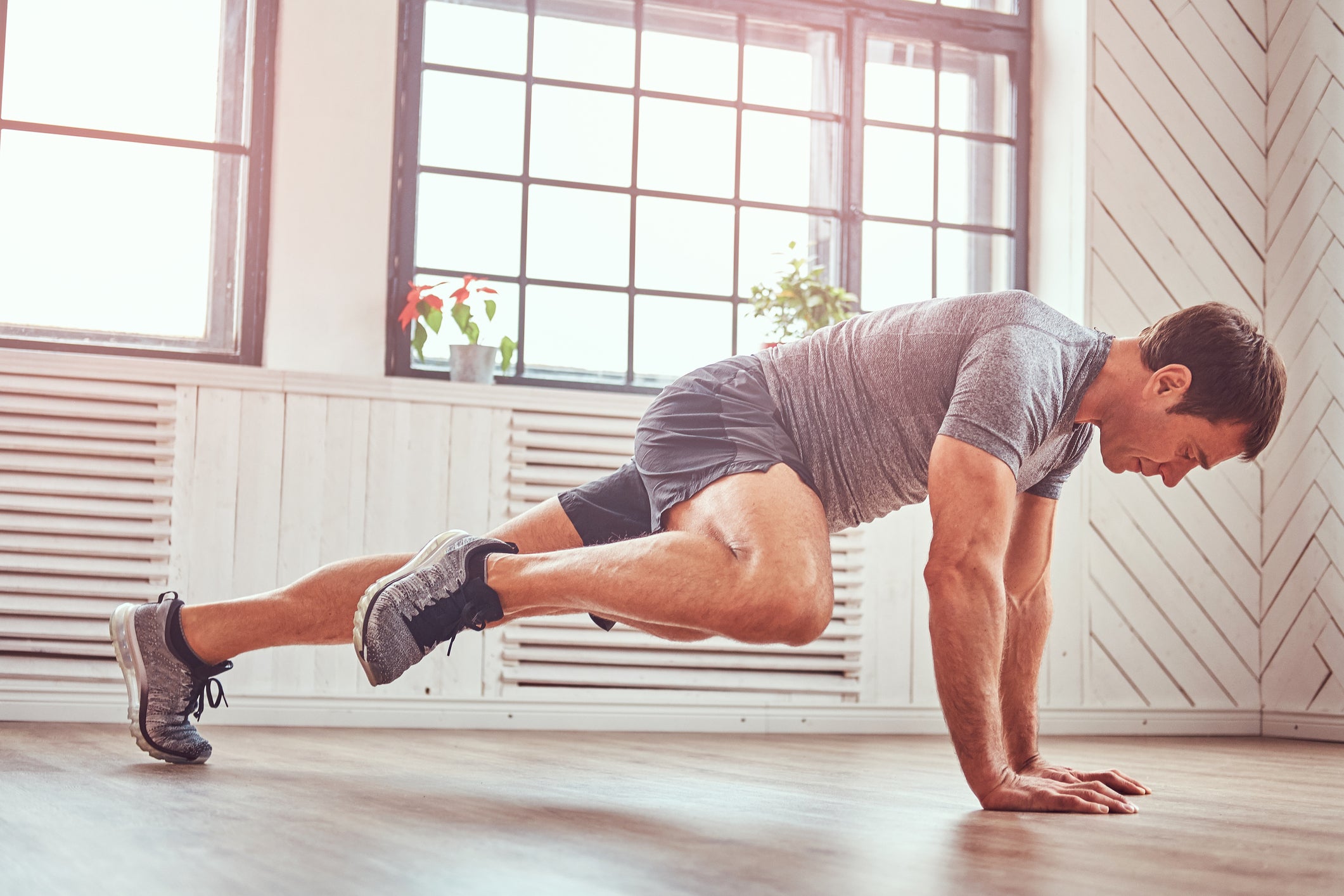 The press-up is a great way to strengthen your chest, shoulders and triceps without any equipment – and there are plenty of variations to adjust the difficulty, such as the spiderman press-up demonstrated here (Getty)
Bodyweight workouts
Strength training doesn’t just mean lifting weights. The term covers any act of overcoming resistance, whether that’s stretching a resistance band or performing bodyweight moves such as squats and press-ups.
The latter option is the most accessible and affordable way to get a taste for strength training. And with consistency and technique being the two most important factors for strength training progress, accessible workouts like the one below from experienced coach Darren Ellis can be invaluable for building an exercise habit.
Complete 1-2-3-4-5-6-7-8-9-10 repetitions of:
Bodyweight squats or sit to stands from a chair Press-ups, kneeling press-ups or wall press-ups
For the flow of the workout, start by performing one squat then one press-up. Next, progress to two squats followed by two press-ups. Continue adding one repetition each round until you reach 10.
Resistance band workouts
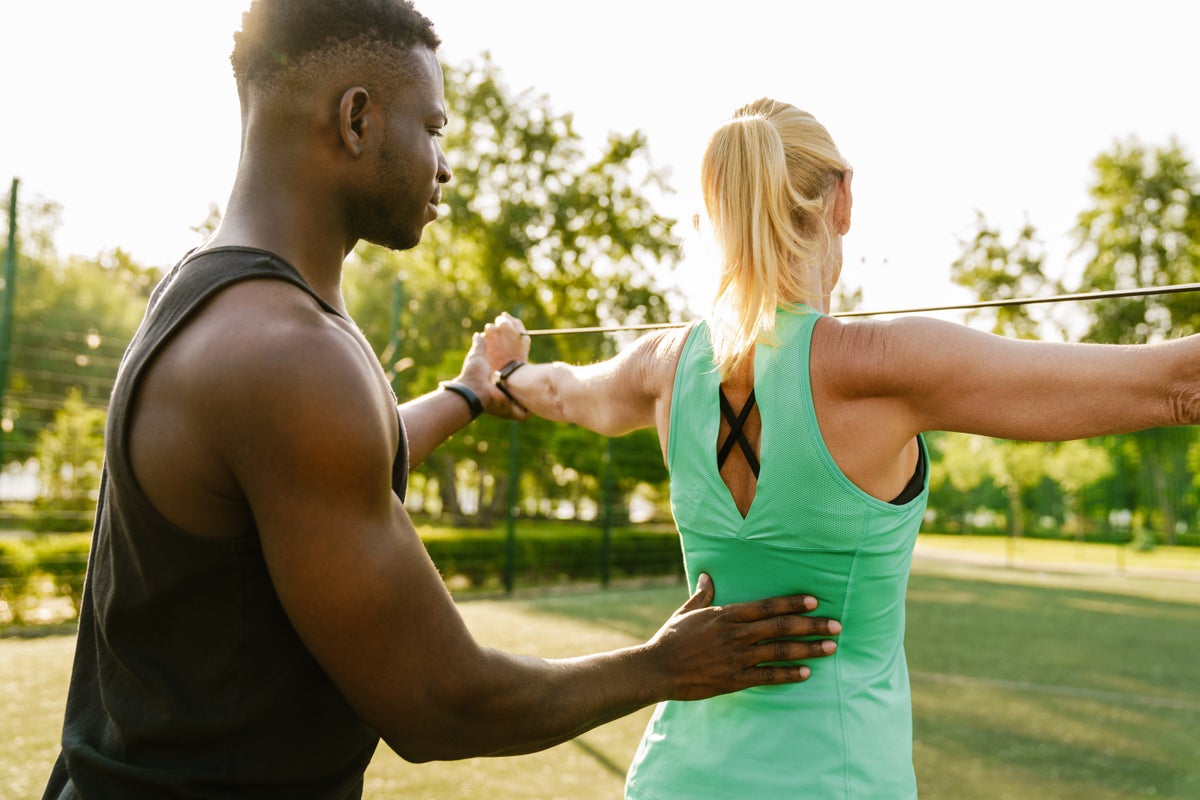
“Traditional gym settings are not needed to see results,” ACSM authors state. “Utilising tools such as elastic bands, bodyweight exercises and home-based routines yield marked benefits in strength, hypertrophy and physical function.”
Resistance bands are a handy way to make your workouts more challenging and broaden your exercise horizons. Beyond adding extra resistance to bodyweight exercises, they also allow you to perform new moves such as bent over rows, helping you recruit the muscles in your back.
The video above shows a sample two days per week strength training plan that uses just one resistance band.
A higher target number of repetitions – in this case, 12-15 per set – is handy for beginners because it provides plenty of opportunity to practice your technique. As you become more confident with the common strength training exercises, you may then look to lift heavier loads for fewer repetitions.
Read more: I specialise in coaching people aged 40-plus – do these six things for immediate results
Dumbbell workouts
“From just two sessions of resistance training a week, you will have better blood sugar, better bone density, better cognition and better motor control,” says certified strength and conditioning coach Danny Matranga.
“Physically, you’ll have more muscle, probably less body fat, and less pain in your joints. And aesthetically, you’ll probably look way better in your clothes – you’ll see areas like your arms, thighs, glutes and tummy start to change.”
He created the dumbbell workout in the video above to hit all major muscle groups using just four compound (or multi-muscle) exercises.
“When you’re a novice, you can go into the gym and do a pushing exercise and a pulling exercise for your upper body, something like a squat for the front of your legs, something like a deadlift for the back of your legs, and then you can walk away after four exercises having trained every single muscle in your body,” he says.
Read more: Expert warns why this daily habit is shortening your life – even if you exercise
Kettlebell workouts
You can use a kettlebell like a dumbbell in many ways, performing controlled movements such as squats, rows and presses. But because the handle is placed away from the weight’s centre of gravity, this tool also lends itself to dynamic exercises that develop muscle power, or the ability to generate force quickly – one of the first physical attributes to deteriorate as you age.
The kettlebell swing is one of the best exercises for developing power. Strength coach Dan John names it among his three essential exercises for anyone new to kettlebell training – alongside the press-up and goblet squat.
This workout in the video above, which he dubbed “The humane burpee,” incorporates all three into a fun circuit that ticks several fitness boxes.
“The humane burpee is the best single-kettlebell workout,” John tells me. “Every quality you want to chase is going to be in there somehow. You get sweaty, you get stronger, and you’re going to become a little bit more mobile too.”
![The American College of Sports Medicine new stance on strength training states that ‘non traditional training [such as using resistance bands, kettlebells and suspension trainers] is highly effective’.](https://www.vitaminrush.com/wp-content/uploads/2026/05/Dr-Andy-Galpin-a-world-leading-human-performance-expert-says-the-3x5-plan-is-a-simple-and-effective..jpeg) The American College of Sports Medicine new stance on strength training states that ‘non traditional training [such as using resistance bands, kettlebells and suspension trainers] is highly effective’. (Getty/iStock)
The American College of Sports Medicine new stance on strength training states that ‘non traditional training [such as using resistance bands, kettlebells and suspension trainers] is highly effective’. (Getty/iStock)
What next?
There are many joys to training at home or outside. But if you have successfully navigated the steps above, you might feel ready to join the gym.
This can be handy as a third space away from your home and work – once you step through the door, it tells your body that it’s time to exercise. It also expands your workout options, providing a wide range of equipment for you to play with.
To start with, machine-based exercises like the ones in this beginner gym workout can be a good way to build confidence. Then, once you have developed a good base level of strength, mobility and stability, the world is your oyster.
Read more: Four things you can do to reduce inflammation and cut heart disease risk, according to the experts