




Table of Contents
Table of Contents
Ask Anything
Top Questions
What are the Dietary Guidelines for Americans?
The Dietary Guidelines for Americans are federally developed nutrition recommendations designed to promote healthy living. They are issued jointly by the U.S. Department of Health and Human Services and the U.S. Department of Agriculture, mandated by Congress, and updated every five years. The guidelines provide dietary advice for the general public and are used to guide federal nutrition and health programs, policymakers, and health care providers.
What were some key changes in the 2025 Dietary Guidelines for Americans?
The 2025 Dietary Guidelines for Americans, released in early 2026, introduced several notable changes compared with earlier versions. Most significantly, the publication emphasized a simpler message—“Eat real food”—and included many of the same recommendations advanced by Health and Human Services Secretary Robert F. Kennedy, Jr., as part of his “Make America Healthy Again” initiative. It prioritized whole, nutrient-dense foods, including full-fat dairy and animal proteins, which were prominently featured in a redesigned, inverted food pyramid.
How did the 1977 Dietary Goals for the United States influence American dietary trends?
The 1977 Dietary Goals for the United States, also known as the McGovern Report, had a significant impact on American dietary trends by promoting a shift toward a low-fat, high-carbohydrate diet. The report recommended that Americans increase their consumption of complex carbohydrates while reducing their intake of fats, sugars, cholesterol, and salt. It also encouraged people to consume less meat and eggs and switch from whole milk to nonfat milk. The emphasis on reducing fat intake and increasing carbohydrates became a dominant nutritional framework in the United States, shaping dietary guidelines for several decades.
The Dietary Guidelines for Americans (DGA) is a set of federally developed dietary recommendations that promote healthy living through nutrition guidance. Issued jointly by the U.S. Department of Health and Human Services (HHS) and the U.S. Department of Agriculture (USDA), the guidelines are congressionally mandated and published every five years. According to the U.S. Code, the report “shall contain nutritional and dietary information and guidelines for the general public, and shall be promoted by each Federal agency in carrying out any Federal food, nutrition, or health program” and “be based on the preponderance of the scientific and medical knowledge which is current at the time the report is prepared.”
U.S. governmental bodies, including the USDA, have issued dietary guidance to Americans in some form since 1894. Over time these have evolved from general nutrition advice into recommendations on diet and physical activity aimed at preventing chronic disease. Although early guidance primarily targeted consumers, the DGA now serves as a key policy document for lawmakers, health care providers, and operators of federally funded nutrition programs. The format has also shifted over time—becoming lighter on text and heavier on visuals, some of which are familiar to generations of American schoolchildren, and then returning to lengthier documents that require an executive summary to aid in the digestion of the information. The 2025 guidelines have returned to original form: slimmer and more consumer-focused than its predecessors.
The guidelines are not written in a vacuum. They reflect broader historical events, cultural trends, and political movements in the United States, from world wars and the Great Depression to contemporary initiatives such as the “Make America Healthy Again” movement of the second administration of U.S. Pres. Donald Trump.
In the more than 125 years since federal dietary guidance first appeared, the overriding message of the recommendations has changed and evolved, often with new recommendations contradicting the thinking of earlier guides. Yet there are a few commonalities between the 1894 and 2025 guidelines: Americans are urged to eat more protein and less sugar.
Read on for a brief history of the recommendations, to see examples of the USDA’s visual aids, and to get links to archival copies of the guidelines.
1894: Foods: Nutritive Value and Cost
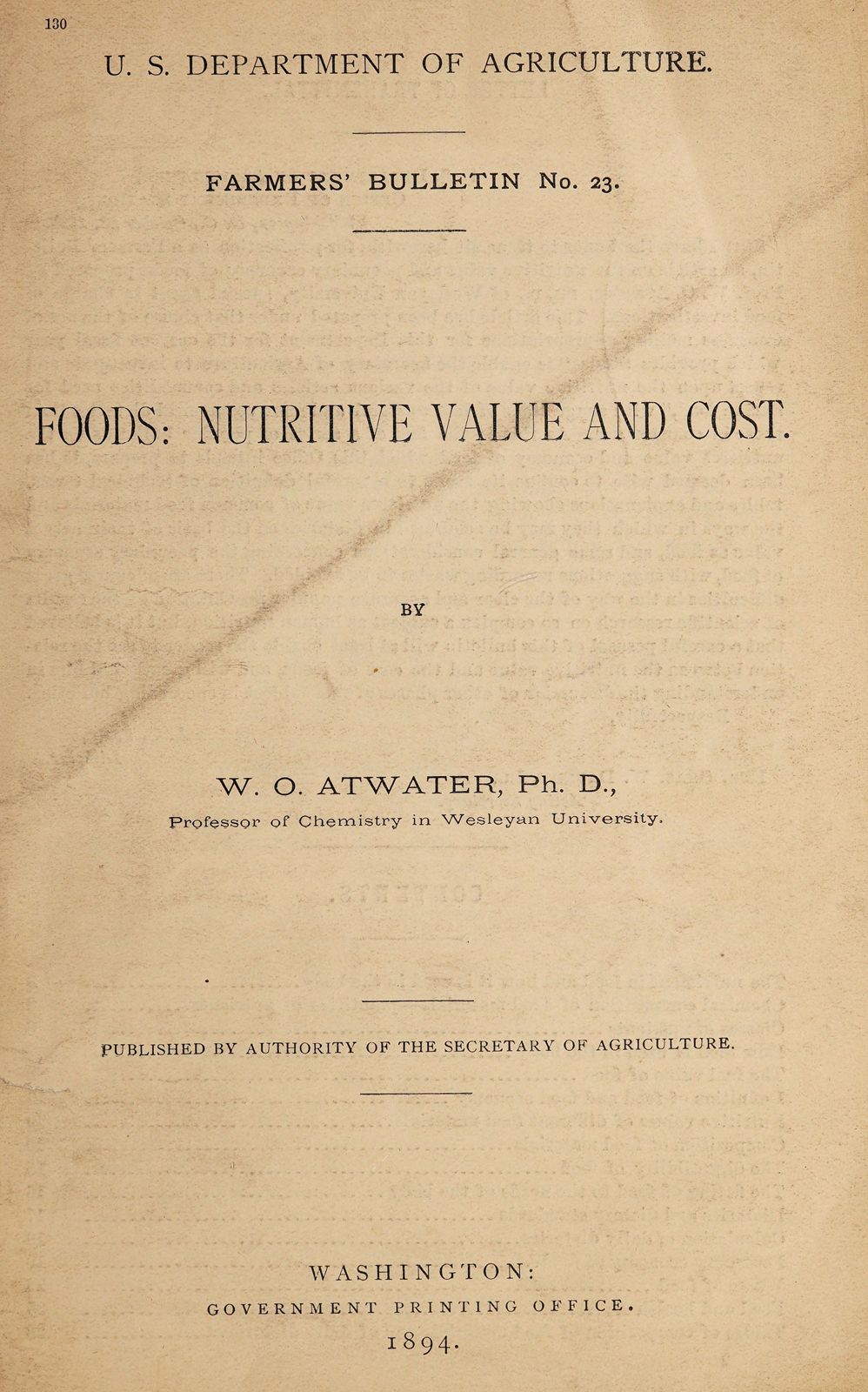
Foods: Nutritive Value and Cost was a congressionally funded report published by the U.S. Department of Agriculture, issued by department director A.C. True, and written by W.O. Atwater, professor of chemistry at Wesleyan University. It formed part of a federal research program funded by Congress “to investigate and report upon the nutritive value of the various articles and commodities used for human food.” The bulletin examined nutrition in common foods (especially meat, bread, and milk), explained how the body uses food as fuel, outlined dietary standards, and considered the economy of food, food waste, and connections between food and health. It provided a dense, scientific discussion of the cellular makeup and nutritional value of foods, focusing on protein, fat, carbohydrates, and “ash,” or mineral matter remaining after burning or cooking food. Acknowledging the limits of available research, the report noted that “the studies of dietaries thus far made are not sufficient for entirely reliable inferences regarding the eating habits of the people at large,” yet concluded that existing evidence showed “the food which we actually eat…has relatively too little protein and too much fat, starch, and sugar.”
1917: Food for Young Children and How to Select Foods
Food for Young Children provided dietary guidelines for children between the ages of 3 and 10 and reminded its audience of mothers that “meals for children should be served attractively…to inculcate a sense of neatness and order.” The guide identified five food groups—fruits and vegetables; dairy, meat, and legumes; cereals and starches; sugars; and fats—a dietary framework that would recur in many later guides. Questions of food costs remained central, and the authors suggested that it was reasonable to swap foods within the same group—say, apples for oranges—to meet a household budget. In its discussion of fruits and vegetables, a relatively new term appeared: vitamins. As the author explained, “Vitamins has not yet become a very familiar term. It stands for certain substances which have only recently been discovered and are believed to be necessary for the satisfactory development of the body and for its protection from certain diseases.” The guide also offered practical advice in the form of meal and snack strategies, as well as menus and recipes.
Go beyond the basics with trusted, in-depth knowledge for professionals, students, and lifelong learners.



With How to Select Foods, authors Caroline Hunt and Helen Atwater shifted their focus to adult diets and family meal planning. Published in three volumes, the series explained the nutrients the body requires, discussed cereal foods, and described foods rich in protein. In volume 1 of How to Select Foods, the authors reiterated the same five major food groups outlined in Food for Young Children and framed the volume around a practical and necessary question for Americans during the restrictions and hardships of World War I: “How can the housekeeper tell whether or not she is providing the food which her family needs and is getting the best possible returns for the money she spends?”
1933: Diets at Four Levels of Nutritive Content and Cost
From its opening sentence, Diets at Four Levels of Nutritive Content and Cost grounded dietary guidance in the economic realities of the Great Depression: “The present economic situation has focused attention upon national as well as individual planning for the best use of food resources.” By the end of 1933, more than 12 million people in the United States were unemployed, and the four proposed levels of eating—restricted diets for emergency use, adequate diets at minimum cost, adequate diets at moderate cost, and liberal diets—were designed to provide options for all income levels. Restricted diets leaned heavily on flour, milk, and potatoes, supplemented with small amounts of protein from lean meat and eggs, whereas liberal diets emphasized dairy products, vegetables, and lean meat. The guidelines also addressed retail food costs, presented data about calories, protein, calcium, vitamins, and iron in common foods, and included charts estimating the yearly quantities of food needed for persons of different ages, sexes, and activity levels.
1943: National Wartime Nutrition Guide
In 1943, amid World War II, the USDA released the National Wartime Nutrition Guide, marking a turn toward a simple—both in text and graphics—and straightforward pamphlet that outlined the “Basic 7” food groups: green and yellow vegetables; oranges, tomatoes, grapefruit, and raw salad greens; potatoes and other fruits and vegetables; milk and milk products; meat, poultry, fish, and eggs; bread, flour, and cereals; and butter and fortified margarine. Americans were reminded that all other food items—such as sugars, sweets, fats, and oils—provide calories but few nutrients. The guide’s warning against sweets and fats is the only time that nutrients, vitamins, and minerals are mentioned, making the text simple and highly accessible to readers. All this guidance was delivered in a colorful graphic that introduced the first food wheel to Americans. A postwar revised version was published in 1946 as the National Food Guide and added recommended numbers of servings for each food group.
1956–70s: Food for Fitness: A Daily Food Guide
In 1956 the USDA further simplified its recommendations with the Food for Fitness guide, reducing both the number of food groups and the complexity of its visuals: Presented more as a flowchart, it replaced the illustrated wheel of the 1940s. The seven food groups of the National Food Guide were condensed to four by combining all fruits and vegetables—regardless of color or form—into one group. As in 1946, the new guide included recommended numbers of servings and emphasized consuming more fruits and vegetables than meat. Sugar, fats, and oils were not mentioned. Simple and direct, the “Basic 4” guide was the go-to guide well into the 1970s.
1977: Dietary Goals for the United States
In 1977 the U.S. Senate Select Committee on Nutrition and Human Needs published Dietary Goals for the United States. Also known as the McGovern Report, for the committee’s chair, South Dakota Sen. George McGovern, the report is identified by the USDA as the federal government’s first true set of dietary guidelines and the direct precursor to the DGA. In the opening sentence of his foreword, Senator McGovern articulated the overarching purpose of the report: “To point out that the eating patterns of this century represent as critical a public health concern as any now before us.” He continued:
If we as a Government want to reduce health costs and maximize the quality of life for all Americans, we have an obligation to provide practical guides to the individual consumer as well as set national dietary goals for the country as a whole.
To achieve these goals, the authors recommended that Americans increase their consumption of complex carbohydrates while reducing overall intake of fats, sugars, cholesterol, and salt. These changes were to be achieved by increasing the consumption of fruits and vegetables, decreasing the consumption of meat and eggs, and substituting nonfat milk for whole milk. The 1977 report’s recommendations started the low-fat, high-carb diet trend that would affect the American food industry for decades to come.
The USDA published a leaflet in 1980—The Hassle-Free Guide to a Better Diet—that specified recommended daily servings for each food group. The 1979 guide differed from its 1950s predecessor by adding a fifth food group: fats, sweets, and alcohol.
1980–2000: Nutrition and Your Health: Dietary Guidelines for Americans
The 1980 and 1985 editions of the DGA were markedly simpler than the 1977 McGovern Report, but the findings were more of the same: For optimal health, to prevent chronic disease, and to maintain an ideal weight, Americans should avoid saturated fat and cholesterol, limit salt, sugar, and alcohol consumption, and eat a variety of foods that provide complex carbohydrates and dietary fiber. Both guides included a chart with ideal body weights for men and women and provided some guidance on how to safely lose weight. In 1984 the USDA and the American Red Cross published a return to the food wheel with a “A Pattern for Daily Food Choices.” This version of the food wheel included the same five food groups as The Hassle-Free Guide to a Better Diet and recommended a diet that prioritized breads, grains, cereals, and vegetables.
“Food Guide Pyramid” (1992)Possibly the most recognizable of the visual guides provided by the Dietary Guidelines for Americans, the Food Guide Pyramid was included in the 1995 and 2000 publications.(more)
Dietary guidelines for the 1990s largely continued the high-carbohydrate, low-fat framework established in the 1980s. The authors argued that the typical American diet contained excessive calories and fat and lacked sufficient amounts of complex carbohydrates and dietary fiber. These poor eating habits were linked to rising obesity rates, and some research had associated them with increased risks of heart disease, stroke, diabetes, high blood pressure, and certain forms of cancer.
The 1995 Dietary Guidelines for Americans is notable for two reasons. First, it was the inaugural edition of the DGA issued under a congressional mandate following the passage of Public Law 101-445 (1990), which required the secretaries of HHS and the USDA to publish updated dietary guidance every five years. Second, it included the Food Guide Pyramid (first published earlier in the decade), perhaps the best known of all the visual nutrition guides. The pyramid retained the same five core food groups from the food wheel, with an additional category for fats and sweets, and its hierarchical design visually emphasized complex carbohydrates as the foundation of a healthy American diet.
The DGA for 2000 greatly expanded the advice and guidelines of the 1995 guide, focusing foremost on physical activity and its health benefits before diving into the details of the food pyramid—the same one issued in 1995—and directives to make foods derived from plants the foundation of healthy eating.
2005–20: Dietary Guidelines for Americans
The USDA revamped the healthy-eating visual guide again for the 2005 edition of the DGA. Though the overall pyramid shape remained, stairs were added—visually signaling the important role that physical activity played in the recommendations. As detailed in the executive summary and throughout the document, the guidelines paired recommendations for diet and physical activity to reduce risk for chronic disease. Key dietary recommendations prioritized fruits, vegetables, and whole-grain products and continued to encourage low-fat or fat-free dairy products.
ChooseMyPlate (2011)A visual representation of food proportions, from the U.S. Department of Agriculture.(more)
As outlined in its executive summary, the 2010 DGA was grounded in two core principles: maintaining calorie balance through a combination of diet and exercise and prioritizing nutrient-dense foods and beverages. The full document expanded these ideas across more than 90 pages for policymakers, but for consumers the recommendations were distilled into a much-simplified visual tool—ChooseMyPlate—which illustrated the relative breakdown between fruits, grains, vegetables, protein, and dairy that should be included in each meal. The 2015 guide largely extended this framework, emphasizing an active lifestyle combined with a diet rich in fruits and vegetables, whole grains, lean or plant-based proteins, and low-fat dairy, with limited amounts of saturated fats, added sugars, and sodium.
MyPlate (2020)The Dietary Guidelines for Americans continued to use the MyPlate graphic into the 2020s.(more)
For many decades DGA recommendations remained largely consistent; however, the 2020 DGA acknowledged an evolution in dietary thinking, highlighting three important shifts in its approach to guidance:
Healthy choices to combat chronic disease applied not only to individuals already affected but to all individuals, regardless of health status
A new emphasis on dietary patterns—the combination of foods and beverages consumed over time
A lifespan approach that encouraged healthy dietary patterns tailored to each stage of life
Despite these shifts in framing, the recommended food groups—whole fruits and vegetables, whole grains, lean protein, and low-fat or fat-free dairy products—remained unchanged. The 2020 DGA also continued to use the MyPlate visual guide, noting that the nutritional recommendations were grounded in “decades of solid science.”
2025: Real Food “Eat real food”The Dietary Guidelines for Americans released an inverted food pyramid graphic and promoted simple message of “Eat real food” for its 2025 edition, released in early 2026.(more)
“The message is simple: eat real food.” So begins the 2025 iteration of the DGA, released to the American public on January 7, 2026. Published by the USDA and HHS, the guidelines included many of the same recommendations advanced by HHS Secretary Robert F. Kennedy, Jr., as part of his “Make America Healthy Again” initiative—namely, a call for Americans to reduce their intake of processed foods, refined carbohydrates, added sugars and sodium, chemicals, and added fats. The DGA instead urged the prioritization of whole, nutrient-dense foods as a means to combat chronic diseases exacerbated by poor diet, and it pledged a commitment to support American farmers and ranchers producing whole foods.
Specific dietary guidelines for adults include:
Prioritize protein at every meal
Consume full-fat dairy products
Eat five servings of fruits and vegetables per day
Incorporate healthy fats into diets
Focus on whole-grain carbohydrates
Limit processed foods, sugars, and refined carbohydrates
Limit alcoholic beverages
At just 9 pages—compared with 149 in 2020—the 2025 DGA marked a significant shift in both length and visual presentation. It introduced a new food pyramid, one purposely turned on its head, that subverted the previous one, which placed grains and complex carbohydrates at the base. In the new visual guide, red meat, other animal proteins, and full-fat dairy products were prominently positioned at the top, signaling their revised role within the dietary recommendations for Americans.