



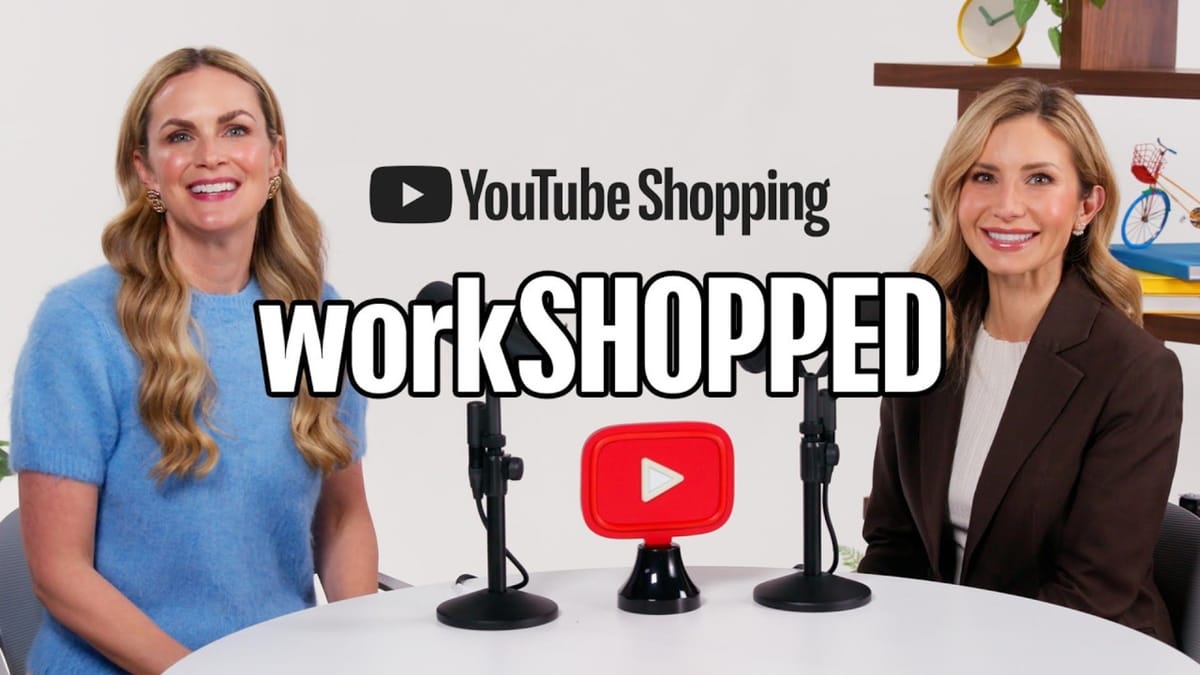
Lisa Howigi, the founder and CEO of BK Beauty, joined Lauren Sinsky, head of content and community at YouTube Shopping, on April 29, 2026, for the workSHOPPED podcast series published by Creator Insider – a YouTube channel focused on sharing product and technical information with the broader creator community. The conversation surfaces a number of specific and measurable insights about what actually drives sales through YouTube Shopping, how brands identify productive creator partnerships, and why subscriber count is a poor proxy for commercial impact.
The episode is the latest in a podcast series that YouTube Shopping has used to document real-world creator experiences with its affiliate and merchant infrastructure. For the marketing community, it offers concrete data points and tactical detail that sit alongside the broader platform-level studies PPC Land has been tracking across the past year.
The origins of BK Beauty and a slow build
Howigi began publishing on YouTube in 2011 or 2012, roughly 12 years before the April 2026 episode, making makeup tutorials and product reviews aimed primarily at women over 40. According to Howigi, the channel did not chase growth in the early period. “I was a very slow and steady grower,” she said. After three years, the channel had approximately 20,000 subscribers. For the first three years, there were no affiliate links, no ads, and no monetisation of any kind.
The inflection point came when Howigi considered closing the channel after a three-week absence from posting. A viewer wrote asking if she was okay – a signal, as she described it, that even a modest audience represented a genuine community. The next video she uploaded performed well above her typical baseline. Shortly after, she introduced affiliate marketing. It was in year four or five that the concept for BK Beauty emerged, with roughly a year of brand development before the formal launch, announced through a video on her channel.
BK Beauty’s core product is makeup brushes. The category was deliberate: brushes appear in virtually every makeup video, which means Howigi could demonstrate her own product while also reviewing and linking other brands, without the two activities conflicting.
When YouTube Shopping launched – Sinsky placed the rollout at approximately 2023 – Howigi expected the new product-tagging feature to cannibalise the affiliate commission income she had been generating from description box links. The opposite happened. According to Howigi, YouTube Shopping functioned as supplemental revenue. “The people that weren’t shopping the links in the description found this as a much easier way to shop,” she said.
The distinction is meaningful for brands and agencies evaluating where to direct creator budgets. The product-tagging layer within YouTube Shopping appears to activate a different segment of the viewing audience – those who do not engage with description links but will interact with a product when it surfaces as a timestamped tag during video playback. Howigi described the mechanic directly: “Tagging the products in YouTube Shopping, timestamping them so that as I’m talking about the product, it pops up and then at that point, they can make a decision on, okay, I want to order this or I don’t, but I know I can come back to it later.”
This is consistent with data YouTube published in January 2025 and covered by PPC Land, showing that videos in the United States with product tags that had timestamps enabled alongside description links saw 43% more clicks on products than videos with description links alone.
How Howigi selects products – and the three filters
Howigi uses three filters when deciding what to feature. First, the product must be something she personally uses and would recommend. Second, it must be easily accessible – available online and not sold out. Third, it must be sold through retailers her audience trusts. Sephora, Ulta, and Nordstrom are the retailers she links to most frequently.
She checks the YouTube Shopping catalogue when she moves outside the beauty category, to verify that a retailer is participating in the programme before deciding whether to feature an item. Within beauty, those three retailers typically cover everything she needs, so the affiliate catalogue check serves as a secondary step rather than a primary filter.
The practical implication for brands is that listing on those specific retail platforms increases the likelihood of organic creator inclusion in affiliate-driven content, independent of any paid sponsorship arrangement.
The Nordstrom anniversary sale: half the views, double the revenue
Howigi discussed two videos in particular, both of which generated unusually high affiliate revenue relative to their view counts. The first was a Nordstrom anniversary sale video. The Nordstrom anniversary sale, she explained, works by offering new products – not items that have been sitting in inventory – at marked-down prices, with prices rising again after the sale period ends.
The video performed well above her typical revenue benchmark. According to Howigi, it “more than doubled” what her highest revenue-generating videos with twice as many views had earned. Half the views, more than double the sales.
Several factors explain the outcome. Timing was the first: she published the video on the first day of the sale, which she identified as the highest-demand date. Getting content live on that date is technically difficult for the Nordstrom sale because product access is restricted before launch day. Her solution was to use screen recordings so that viewers could see the items before she had physically tried them on, combined with a deliberate focus on staples – jeans, basic t-shirts – that she knew shoppers were likely to be seeking regardless of specific style preferences.
Price point was the second factor. She deliberately sought items that felt elevated but remained accessible, using her own sales analytics to inform the range. The analytics, she noted, had previously surprised her: her audience consistently skewed toward higher-price purchases than she had assumed, buying luxury beauty rather than drugstore alternatives.
Structure was the third. The video was chaptered. In the opening, she told viewers which product categories she was covering and where to find each section. “If you don’t want to watch this whole thing, but you know, you’re looking for jeans, look down in the chapters,” she said in the video. The explicit navigation instruction reduced friction for viewers who had a specific purchase in mind, while keeping the overall runtime accessible.
Beyond the single video, Howigi outlined an approach of planning content across the entire duration of a sale rather than concentrating it in one piece. The Nordstrom sale and the Sephora savings event – which she described as “our Super Bowl” for beauty creators – both run for two to three weeks, with different access dates for shoppers at different loyalty tiers. Her model involves mapping content to each of those key dates, using different thematic angles: initial recommendations, products purchased, items she would buy again.
The Sephora savings event and content buckets
For the Sephora savings event video she discussed – the second high-performer – Howigi described working from four or five content “buckets.” The first was her personal product recommendations. The second was staples: products her audience stocks up on during sales, including mascara, foundation, concealers, and lip liner. The third was prestige or luxury items that viewers want but hesitate to buy at full price, where a discount of 15% to 20% shifts the purchase decision. The fourth was her own wish list.
Those buckets, she said, generate enough material for multiple videos across the full event window. She also asks her audience via community posts which products they want reviewed in advance, allowing her to test and form an opinion before the sale opens rather than reviewing cold.
Cards and end screens play a supporting role. During Sephora savings event videos, she links to her own prior Sephora event content – even videos from a year earlier – because the products she recommended in previous years are typically still available and still valued. YouTube’s back-tagging feature allows old videos to remain monetised through the affiliate programme, meaning historical content continues to generate commission income when viewers arrive through those card links.
Microcreators outperform accounts with millions of subscribers
The episode’s most direct data point for marketing professionals concerns the relationship between subscriber count and commercial performance. Howigi described observing the pattern directly through BK Beauty’s own analytics. When creators with millions of subscribers have mentioned BK Beauty products, she said she often could not identify any measurable impact on sales. When creators with 20,000 subscribers mentioned those same products, the brand saw a sudden spike – orders arriving and emails from customers citing that specific creator.
“We’ve had creators with millions of subscribers share us. And I couldn’t tell you if there was an impact on sales that day,” she said. “We’ve had creators with 20,000 subscribers and we’re all of a sudden like, what’s happening today? Who’s sharing us?”
This observation matches the scale-versus-engagement distinction that underpins YouTube’s own commercial research. A study published by YouTube and Kantar in March 2026 found that YouTube creator marketing achieves a 2.3 times higher long-term return on ad spend than paid social, with 79% of Gen Z respondents expressing trust in creator recommendations. The data pointed not just to scale but to the depth of the relationship between creator and audience as the operative variable.
Howigi identified this as the reason she approached Nikki LaRose – now a collaborator on a BK Beauty product line – when LaRose had only 30,000 subscribers. “I could see the engagement on her videos. I could see how her audience responded,” Howigi said. The collaboration has since grown significantly. Their first product set launched approximately three years before the April 2026 episode.
A second collaborator, Angie Hot and Flashy, produced the same pattern: measurable sales spikes each time she mentioned BK Beauty’s 101 brush, and emails from customers directly citing her recommendation.
The dual role of creator and merchant
Howigi occupies an unusual position in the YouTube Shopping ecosystem. She is simultaneously a content creator with an affiliate strategy and a merchant whose products can be tagged by other creators in the affiliate programme. YouTube expanded the Shopping affiliate programme to creators with as few as 500 subscribers in March 2026, dropping the previous 10,000-subscriber threshold. That expansion widens the pool of creators who can now tag BK Beauty products and earn commission on sales, without any direct outreach or sponsorship arrangement required from the brand.
As a merchant, Howigi described BK Beauty’s approach to creator relationships as generous in terms of product seeding – sending product to creators to develop familiarity before any formal arrangement exists. The paid sponsorship activity has been limited. The primary incentive mechanism is the affiliate commission itself, supplemented by occasional extra incentives offered in partnership with YouTube. The collaborations with LaRose and Angie Hot and Flashy both originated from existing fan relationships rather than outbound prospecting.
Looking ahead, Howigi said BK Beauty plans to expand into additional categories – she referenced colour cosmetics as a potential direction – while she personally intends to reduce paid brand sponsorships in her own content, shifting further toward organic affiliate activity.
A recurring theme across the episode is the use of YouTube Analytics data on actual purchases to plan future content, not just to evaluate past performance. Howigi described seeing products she had not specifically discussed appear in her purchase data – items that viewers bought after browsing from her video without any direct recommendation from her. That data then shapes future content ideas: if a particular mascara sold well, it becomes a subject for tutorial content, or a prompt to investigate the brand further.
The analytics also corrected assumptions. Howigi expected her audience to skew toward drugstore products but found consistent purchasing of luxury and prestige items. Without that data signal, she said, she might have produced content misaligned with actual purchasing behaviour.
For brands monitoring YouTube Shopping as a channel, the implication is that the platform generates purchase data that is specific enough to identify which creators are converting their audiences rather than simply reaching them – a distinction that matters when evaluating whether to formalise an affiliate or sponsorship relationship.
The workSHOPPED episode, published on April 29, 2026, sits within a period of substantial structural expansion in YouTube’s creator commerce infrastructure. YouTube Creator Partnerships unified BrandConnect and the Creator Partnerships Hub into a single platform across seven markets in March 2026, streamlining the workflow for brands identifying and activating creator relationships. A YouTube culture and trends report from October 2025, based on the top 5,000 most-purchased products from the first half of 2025, documented similar patterns to those Howigi describes: niche communities of creators with specific expertise driving purchases in categories like fragrance and home improvement, regardless of subscriber count.
The episode is notable not for announcing a product change but for providing a ground-level account of how the mechanics work from both sides of the creator-merchant relationship. The conversion gap between high-subscriber and high-engagement creators is not new as an observation in the industry – but here it is documented with specific reference to a brand that can track orders, match them to creator mentions, and observe the pattern directly.
Timeline2011-2012: Lisa Howigi begins publishing on YouTube as Lisa J Makeup, initially without any monetisation2014-2015 (approximate): After roughly three years, the channel reached 20,000 subscribers; Howigi introduces affiliate marketing2015-2016 (approximate): The concept for BK Beauty emerges in year four or five of the channel; approximately one year is spent developing the brand before launchApril 2024: YouTube introduces a bulk product tagging tool within the Earn section of YouTube Studio, allowing creators to apply affiliate tags across multiple videos simultaneously2023: YouTube Shopping launches, approximately two years before the episode; Howigi begins using product tagging as a supplement to existing description-box affiliate linksOctober 2024: YouTube Partner Program structure explained publicly, documenting the 3 million channels earning revenue and $70 billion in total creator payouts over three years; PPC Land covered the detailsOctober 16, 2025: YouTube Culture and Trends team releases a report based on the top 5,000 most-purchased products from the first half of 2025, documenting how niche creator communities drive purchases independent of scaleMarch 24, 2026: YouTube Creator Partnerships unifies BrandConnect and the Creator Partnerships Hub into a single platform across seven markets – the United States, India, Indonesia, the United Kingdom, Brazil, Australia, and CanadaMarch 27, 2026: YouTube expands the Shopping affiliate programme to all YouTube Partner Program creators, dropping the previous 10,000-subscriber threshold to 500, across 12 countriesMarch 28, 2026: YouTube publishes a creator marketing study with Kantar, showing 79% Gen Z trust rates for creator recommendations and a 2.3 times higher long-term return on ad spend versus paid socialApril 29, 2026: Creator Insider publishes the workSHOPPED episode featuring Lisa Howigi and Lauren Sinsky, covering affiliate strategy, microcreator performance data, and analytics-led content planning for YouTube ShoppingSummary
Who: Lisa Howigi, founder and CEO of BK Beauty and creator behind the Lisa J Makeup channel, speaking with Lauren Sinsky, head of content and community at YouTube Shopping, on the workSHOPPED podcast series.
What: A detailed account of how BK Beauty has used YouTube Shopping as both an affiliate creator and a merchant, including specific observations that creators with 20,000 subscribers can outperform creators with millions of subscribers in driving direct sales, and that timestamped product tagging supplements rather than replaces description-box affiliate revenue.
When: The episode was published on April 29, 2026, by Creator Insider on YouTube.
Where: The discussion took place in the context of YouTube Shopping’s affiliate programme and the creator economy infrastructure YouTube has been expanding since approximately 2023.
Why: The episode matters to the marketing community because it provides measurable, first-hand evidence that engagement depth – rather than audience scale – is the primary driver of affiliate conversion on YouTube Shopping, with direct implications for how brands allocate creator partnership budgets and how smaller creators position their own value to potential merchant partners.
Share this article
The link has been copied!