




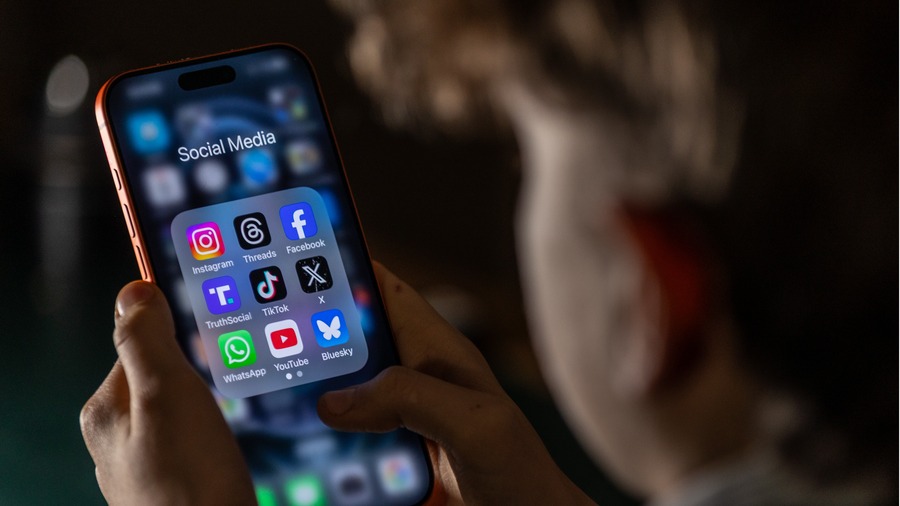
A new investigation by Reporters Without Borders, titled “From Wellness to Politics: How China Infiltrates Taiwan’s Lifestyle Facebook Pages Through Digital Marketing,” offers a window into a broader propaganda network spanning wellness and other lifestyle pages across multiple social media platforms. The investigation found that the firm behind hundreds of such pages is Wubianjie Group, a Chinese digital marketing company headquartered in Qinhuangdao, Hebei province. The method is systematic: pages built around politically neutral lifestyle content, operated at scale, with pro-Beijing messaging inserted periodically. Between injections, the pages revert to recipes and motivational quotes, making the political content difficult to detect, attribute, or counter.
During Taiwan’s 2024 presidential election, pages that had previously focused on health tips, hobbies, and inspirational quotations began carrying politically charged content, raising concerns about coordinated influence operations directed from Beijing.
Wubianjie also runs soft-pornography pages on Facebook that are used to promote sales of drugs for erectile dysfunction. Wang Hong-en, a researcher at the RAND Corporation who has spent years tracking Chinese propaganda networks, drew a direct conclusion from that combination: in China, a firm that simultaneously operates adult content and sells pharmaceuticals without any official relationship or at minimum official tolerance is effectively impossible. The dual operation points to some form of arrangement with Chinese authorities.
The paper trail supports that reading. In June 2020, the Qinhuangdao Broadcasting and Television Station, a CCP-controlled municipal media organ, publicly announced a strategic partnership with Wubianjie. That kind of formal tie between a municipal state broadcaster and a private digital marketing firm is uncommon in China’s tightly managed information environment. Four months later, officials from Hebei province’s propaganda department and cyberspace administration visited the company’s offices.
In September 2025, a video spread on Threads showing a child collapsed on a Taipei metro platform with no bystanders offering help. Users who investigated found the footage had actually been filmed in a subway station in Hangzhou. Wang traced the accounts behind the post to Wubianjie.
Success
You are now signed up for our newsletter
Success
Check your email to complete sign up
Taiwan’s National Security Bureau has formally listed Wubianjie as one of the entities the CCP has used to wage cognitive warfare in Taiwan. Its report, “Analysis of CCP Cognitive Warfare Operations Against Taiwan 2025,” described the company’s approach: build large audiences on Facebook, Threads, and X through non-political or soft content, then insert political messaging at intervals.
A Taiwanese government official working on information security policy, speaking to Reporters Without Borders on condition of anonymity, was direct about the cumulative effect: China’s disinformation operations had produced in some Taiwanese citizens the impression that democracy is synonymous with chaos, making authoritarian rule seem like a tolerable alternative. When political content appears alongside familiar, trusted material, the reader’s defenses are lower.
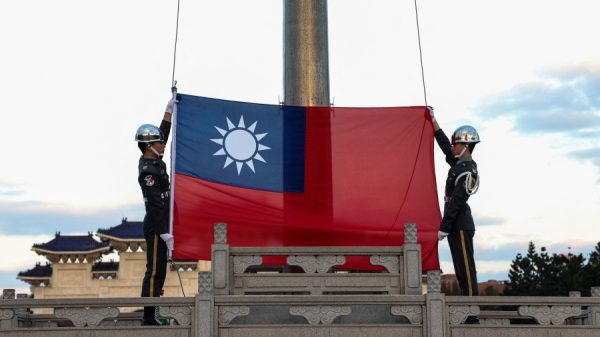 A guard raises Taiwan’s national flag along Democracy Boulevard at Taipei’s Chiang Kai-shek Memorial Hall. (Image: I-HWA CHENG/AFP via Getty Images)
Taiwan’s own voices, repurposed for Beijing’s use
A separate investigation, reported by Reuters and cited by Radio France Internationale, documents a different dimension of the same operation, one that involves no Chinese accounts at all.
Beijing has systematically harvested criticism of Taiwan’s ruling Democratic Progressive Party from Taiwan’s own political figures and online commentators, then amplified and repackaged that content through state media channels and Chinese social media platforms. The content is Taiwanese, the voices are Taiwanese, the faces are recognizable to Taiwanese voters, and the distribution infrastructure is Beijing’s.
Cheng Li-wen, the chairwoman of the Kuomintang, Taiwan’s main opposition party, recorded a video accusing President Lai Ching-te of pulling Taiwan’s 23 million people into a dead end, onto a path to death, through his pursuit of independence. CCP state media pushed the video onto Douyin, the Chinese version of TikTok. From there it circulated to Facebook, YouTube, and other platforms popular in Taiwan. Videos of this kind are sometimes re-edited with traditional Chinese subtitles to obscure the trail back to Beijing.
According to analysis by the Taiwan Information Environment Research Center, known by its acronym IORG, 1,076 accounts operated by CCP state media published approximately 560,000 videos on Douyin in the fourth quarter of 2025 alone. Around 18,000 of those videos concerned Taiwan-related topics. Researchers identified 57 Taiwanese individuals featured across 2,730 of those videos.
IORG published a list of the 25 most prominently featured “Taiwanese representatives” in CCP state media Douyin content. Cheng topped it, making her the Taiwanese figure most frequently deployed by Beijing. The internet personality known as “The Coach,” Chen Chih-han, appeared on the list for the first time, ranking second. The list also included multiple Kuomintang figures: former party chairwoman Hung Hsiu-chu, Taipei mayor Chiang Wan-an, Sun Yat-sen School principal Chang Ya-chung, and legislative caucus leader Fu Kun-chi. Two DPP legislators, Shen Po-yang and Wang Shih-chien, appeared as well, serving as negative examples used to discredit the ruling party. They were the first ruling-party figures other than the president to appear on the list.
IORG noted that Cheng’s repeated public statements affirming “I am Chinese” and endorsing what she calls the “1992 Consensus,” a disputed political framework implying cross-strait unity under a single Chinese identity, closely mirrored the position that Xi Jinping, the CCP’s general secretary and China’s top leader, articulated at a 2026 meeting with Kuomintang representatives. That alignment made her Beijing’s preferred Taiwanese face for promoting the idea of a unified Chinese national identity.
A fitness celebrity whose content Beijing turned into a propaganda template
Chen Chih-han, “The Coach,” occupies a distinct category in IORG’s analysis. His significance in Beijing’s calculations, researchers found, exceeds that of most professional political commentators and elected legislators.
His content spans three thematic clusters that directly serve Beijing’s messaging goals: suspicion of the United States, hostility toward Japan, and what IORG describes as a Taiwan-failure narrative. A video Chen posted after visiting mainland China, in which he marveled that China had surpassed Taiwan and upended his worldview, was processed by CCP state media into a three-act propaganda template: hearing about China’s rise, witnessing it personally, then expressing astonishment. That template has since been applied to other figures and other content.
He is a local celebrity with views that happen to serve Beijing’s purposes. His Taiwanese audience trusts his authenticity. Beijing benefits from that without having to build it.
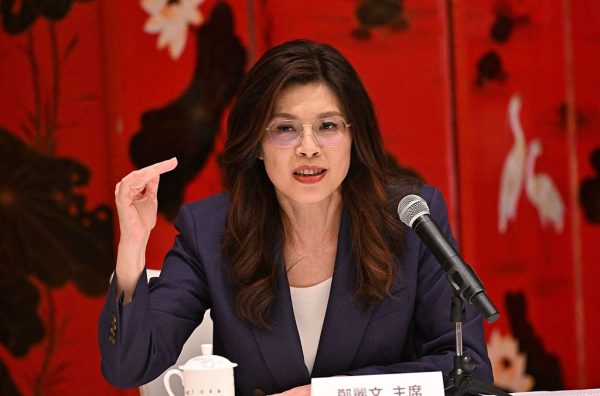 Taiwan’s Kuomintang Chairperson Cheng Li-wen speaks during a press conference in Beijing on April 10, 2026. China’s President Xi Jinping met Taiwan’s opposition party leader Cheng Li-wun in Beijing on April 10, telling the visiting delegation he had “full confidence” that Taiwanese and Chinese people would be united. (Image: ADEK BERRY / AFP via Getty Images)
Media literacy is necessary but insufficient to counter the threat
The DPP’s office responsible for China affairs held a press conference in late March warning that the CCP’s information operations, now enhanced by artificial intelligence capable of generating and rewriting content at volume, deploying convincingly human-seeming accounts, and synchronizing messaging across platforms simultaneously, had escalated from disinformation into systematic erosion of democratic institutions.
The party’s prescription was media literacy: cultivating the habit of verifying before sharing, learning to recognize emotionally manipulative framing, and staying alert to content from unidentifiable sources or content that exaggerates conflict.
Taiwan Black Bears, a civil society organization focused on civilian defense preparedness, offered a franker diagnosis: Taiwan currently lacks the funding, institutional mechanisms, and cross-agency coordination needed to mount an effective defense against information warfare at the scale and sophistication the CCP has now achieved. Civil society, the organization argued, must shift from reactive analysis, documenting operations after the fact, to proactive counter-narrative work.
The DPP framed Taiwan’s predicament in terms that extend beyond the island. Beijing, the party argued, uses Taiwan as a laboratory for information operations and exports successful methods to other democracies once they have been tested and refined. The cognitive warfare techniques deployed in Taiwanese election cycles have direct analogues in operations documented in Europe, Southeast Asia, and North America.