




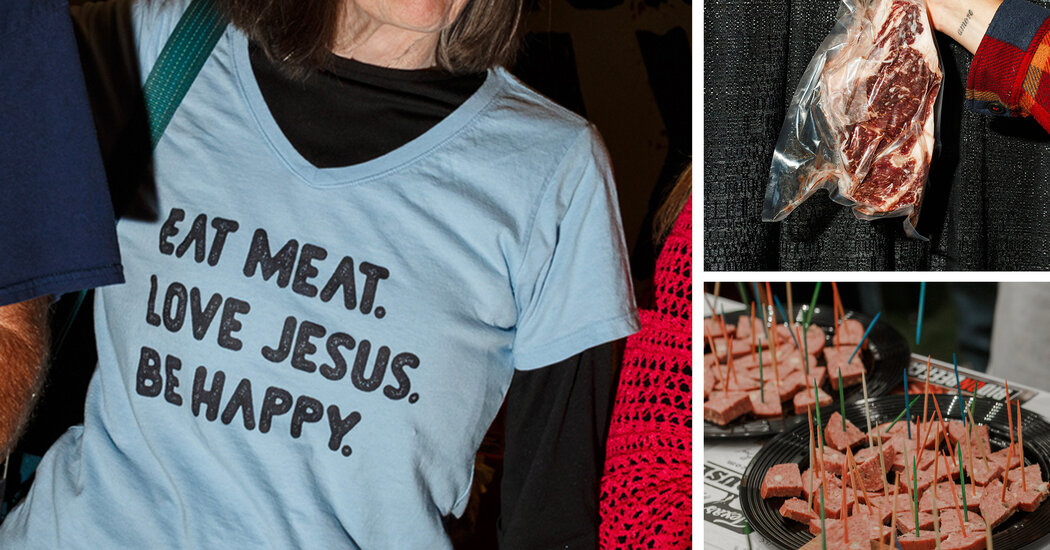
Lisa Moss roamed the halls of Meatstock with a butter keychain dangling off her bag and a pin on her jean jacket that read: “I <3 steak.” She carried a bag of air-dried steak with her, just in case she needed a snack.
Ms. Moss, 57, and her husband, Phil Moss, had flown from Alberta, Canada, to Meatstock, the three-day carnivore convention in Gatlinburg, Tenn. They were among more than 1,400 attendees who came to see their superstars — influencers who went by handles like “Steak and Butter Gal” and “2 Krazy Ketos” — and to meet other like-minded people who follow a carnivore diet of primarily or solely animal products, often forgoing fruits and vegetables entirely.
“I’ve had people say that to me — ‘Don’t you want to just be normal?’” Serena Musick, a carnivore influencer, said during a panel on carnivore cooking tips.“If being normal means that you can’t exercise, and being normal means you can’t stand up without your knees or back hurting, then I don’t want to be normal,” she added.
Talking to one another over brisket dipped in butter and cups of raw milk, they shared what they called their “testimonies,” describing how they believed the diet had healed a wide array of ailments, including arthritis, mental illness and diabetes. One attendee carried a pair of jean shorts that were nearly twice as wide as his waist, to show off the weight he’d lost since “going carnivore.”
Most doctors would disagree with the attendees’ enthusiastic claims about the diet’s benefits. They have urged people to eat less red meat, warning that consuming too much raises cholesterol and increases the risk for heart disease. And they have stressed that fruits and vegetables are essential to prevent chronic illnesses.
Those perspectives are of little interest to many at Meatstock. After shunning traditional diet advice, they have gone on to lose faith in conventional medicine and health guidance more broadly. It’s not just a diet, they said — it’s a mind-set.
“It’s rethinking, relearning what we’ve all been taught,” said Ms. Moss, who adopted the carnivore diet seven years ago and wore a hat bearing the word “Tinfoil.”
Followers of the carnivore diet remain a niche community, but their worldview is gaining more legitimacy. Health Secretary Robert F. Kennedy, Jr. has said he follows a carnivore diet, which he has claimed could eliminate dangerous body fat. When Mr. Kennedy unveiled a new food pyramid this year, steak earned a top spot. Several of his prominent allies spoke at the convention, including Calley Means, his close adviser; Zen Honeycutt, founder of the advocacy group Moms Across America; Vani Hari, a food activist known as “The Food Babe”; and Alex Clark, the host of a popular wellness podcast.
While many of the attendees said they weren’t particularly interested in politics, their statements often echoed the rhetoric of Mr. Kennedy’s “Make America Healthy Again” movement. They were eager to trade prescription drugs for added helpings of beef and painted mainstream medicine as trying to profit off patients.
Attendees crammed into conference rooms for presentations on raw meat and food addiction, as well as a seminar that questioned whether high cholesterol could actually lead to heart disease. (It can.)
In the exhibit hall, women in bonnets sold raw cheese and butter, advertised as “for cats and dogs” to skirt restrictions on selling those products to humans. People drifted between booths selling meat-centric items like tallow lotions and a cereal made of ground beef. Non-edible offerings included a holistic health class for home-schooled teens and a tool to block radiation from cell phones.
Veronica Eggleston, 24, said that she had become increasingly attentive to what she puts into or on her body since she adopted the carnivore diet in high school. She replaced her traditional sunscreen with a tallow-based product, for example.
Ms. Eggleston, who attended the conference with her mother, said that one of the hardest parts about adhering to the diet was the pushback she received from friends and co-workers.
“It’s so nice to not feel weird, to be in a space where I’m not constantly getting questions or personal attacks,” said Ms. Eggleston.
Many of the attendees also said they were there to find community. Some even walked around with cutting boards that they asked others to sign, like high school yearbooks.
“There just seems to be such a camaraderie here,” said Karen Chandler, 65. “That’s felt really good for me, because I’ve been kind of out there by myself.” Ms. Chandler was sitting next to Christy Desautels, 59, whom she had befriended on the bus from the airport. They two were now talking over lunch — plain burger patties heaped high on silver trays.
Another attendee, Adi Lavi, 34, seemed concerned with matters beyond friendship: She walked around the exhibit hall, wearing a bag that said “Ask me about carnivore dating.”
She had become a carnivore while in a relationship with someone who “believes in conventional medicine,” she said. That divide was one of the main reasons they broke up. Now she was starting a matchmaking service, just for carnivores.