



RICHMOND, Va. (CN) — A former colonel of the Salvadoran army asked the Fourth Circuit for immunity Tuesday on claims he ordered the 1982 extrajudicial murder of Dutch reporters.
Gert Kuiper, the brother of slain producer and editor Jan Kuiper, seeks monetary damages from Mario Reyes Mena over his claimed role in an ambush that left four Dutch reporters and several guides dead. The ambush occurred during the country’s Civil War between the American-backed government and its army, the Salvadoran Security Forces, and the guerrilla fighters of the Soviet-supported Farabundo Martí National Liberation Front, from 1979 to the signing of the Chapultepec Peace Accords in 1992.
Kuiper sued Reyes Mena, who now resides in Virginia, under the Torture Victims Protection Act. A lower court denied the former colonel’s motion to dismiss the claim, ruling that he is not entitled to conduct-based foreign-official immunity under the Foreign Sovereign Immunities Act for his role in a* jus cogens* violation. International law does not recognize an act that violates jus cogens — i.e., general international norms — as a sovereign act. Acts including torture, slavery, arbitrary detention and, according to the Fourth Circuit’s ruling in Samantar v. Yousuf, summary executions are among the acts that violate international norms.
Reyes Mena framed himself as an actor of a sovereign government who carried out a military operation authorized by the government.
“Our courts should not be used to judge El Salvador’s Civil War strategies,” attorney Kang He of McGuireWoods, representing Reyes Mena, told the three-judge panel. “Much like Salvadoran courts should not judge the military strategies that the Union used to win the American Civil War.”
U.S. Circuit Judge Paul Niemeyer, a Ronald Reagan appointee, asked how Reyes Mena could be acting on behalf of the country, given that it has now pushed to prosecute Reyes Mena.
“Just because a new regime that comes in, in hindsight, decides to launch prosecution against a prior regime, it doesn’t make the conduct itself unofficial,” He said. “At the time, it was authorized and ordered by the Salvadoran government.”
Kuiper argued extrajudicial killings cannot qualify as official acts for purposes of conduct-based foreign official immunity because no sovereign state could legitimately condone such acts.
He said his client doesn’t seek to overrule the circuit’s rulings in Yousuf and other cases concerning jus cogens violations but rather to separate them from the facts of the current case. Reyes Mena argued that, unlike in Yousuf, which centered on the conduct of a member of the unrecognized Somalian military force, Reyes Mena acted on behalf of a recognized government.
U.S. Circuit Judge Steven Agee, a George W. Bush appointee, pressed He on his client’s view of the doctrine, which the lower court relied on.
“Do you believe that the jus cogens norm is a principle of American law?” Agee asked. “So the decisions that have applied it in your view are simply wrong?
He said he didn’t think the jus cogensdoctrine could apply to civil law.
“We believe that it’s a legal fiction that a sovereign can never authorize conduct that leads to a jus cogens violation,” He said.
The United Nations Truth Commission concluded after the war that primarily the Salvadoran government accounted for the 75,000 civilians killed. Among the civilians were teachers, union leaders, university students, human rights activists, priests, nuns and journalists. The Committee to Protect Journalists says 26 journalists were killed in the two years before the ambush.
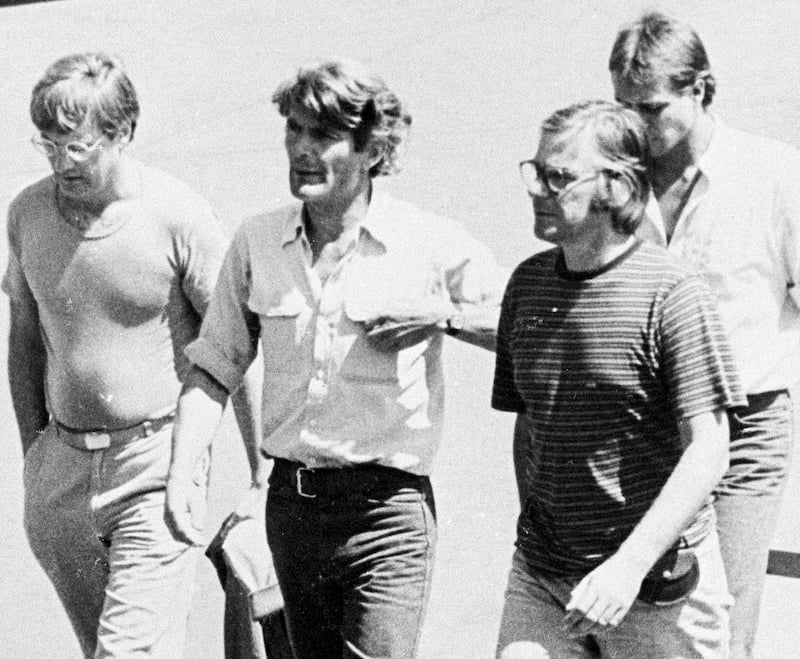
Jan Kuiper and his three colleagues from Interkerkelijke Omroep Nederland, a Dutch radio and television broadcaster affiliated with the Protestant Church in the Netherlands, planned to cover the vast human rights abuses committed by the Salvadoran government. According to Kuiper, Reyes Mena received word of their presence in a nearby area controlled by the opposition forces before sending out a patrol, which shot and killed the reporters along with several local guides.
The Salvadoran government initially attempted to cover up the ambush, telling U.S. military personnel that the killings weren’t an ambush but were rather a defensive response to guerrilla aggression and that it didn’t know the group it killed contained foreign reporters.
The Salvadoran government enacted an amnesty law in 1993, shielding the forces of both militaries from civil liability. The Salvadoran Supreme Court declared the law unconstitutional in 2016.
Decades after the ambush, the Salvadoran attorney general helped indict Reyes Mena over his role in the killings in 2022. Reyes Mena has remained in the United States to avoid potential accountability in his home nation. Neither the current Salvadoran government nor the United States has advocated for his immunity.
Attorneys representing Reyes Mena did not respond to a request for comment. U.S. Circuit Judge Roger Gregory, a fellow Bush appointee, completed the panel.
“We are grateful to the Fourth Circuit panel for the opportunity to present our arguments today,” attorney Jason Hipp of Jenner & Block, representing Kuiper, said. “We believe those arguments are firmly in keeping with the court’s precedent on the limits of foreign-official immunity, and we look forward to moving this case forward. Our client, Mr. Kuiper, has waited many years for his day in court, and we are hopeful that day is now closer.”
Subscribe to our free newsletters
Our weekly newsletter Closing Arguments offers the latest about ongoing
trials, major litigation and rulings in courthouses around the U.S. and the world,
while the monthly Under the Lights dishes the legal dirt from Hollywood,
sports, Big Tech and the arts.