




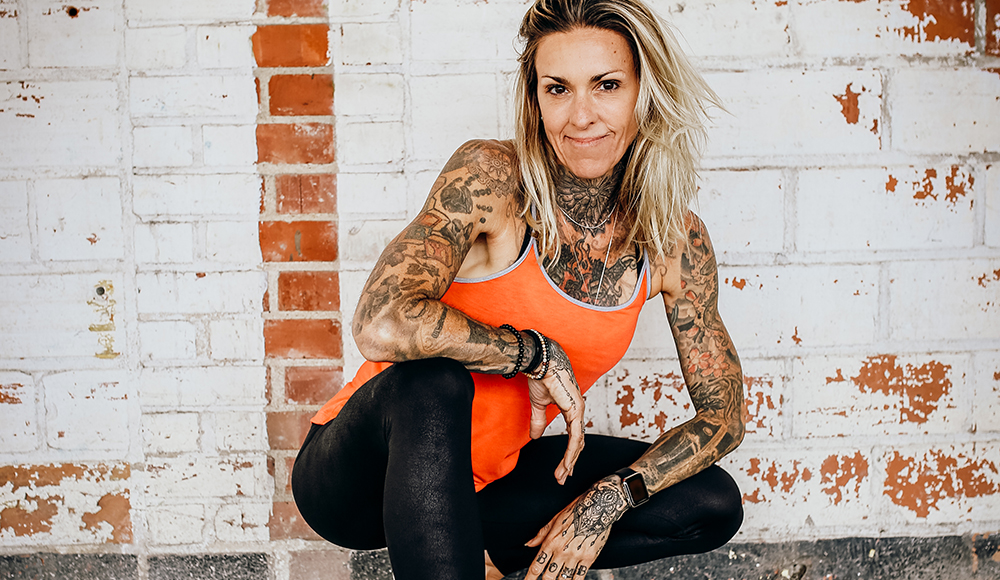
On any given morning in Santa Cruz, you might walk into one of Carina Reid’s Toadal Fitness classes expecting a workout, and leave feeling like something much deeper just shifted.
There’s sweat, sure. Music, energy, intensity. But there’s also something harder to define. Something emotional. Something human. That’s because Reid isn’t just training bodies, she’s building resilience.
From someone once described as “least likely to recover”, to a multiple Best Trainer award recipient, Reid’s path into fitness wasn’t linear. It was hard-won, shaped by addiction, recovery, and the slow, often invisible work of starting over.

“Things really started to shift when other people started seeing something in me before I could see it in myself,” she says. “For the first time, I actually wanted to live more than I wanted to give up.”
That shift didn’t come all at once. In fact, early recovery looked anything but dramatic. Reid remembers being given her first assignment after treatment: step outside for five minutes.“It sounds small,” she says, “but at the time, it felt like everything.”
That’s where her understanding of resilience began, as a series of tiny, almost imperceptible steps forward. “I realized resilience isn’t about doing something huge all at once,” she says. “It’s about continuing to show up in small ways when everything in you wants to run.”
As a child, Reid says she was hyperactive and constantly told to sit still. But movement was the one place she felt like herself.
“It didn’t become something deeper until I brought it into my sobriety,” she says. “This time, it became part of how I survived and rebuilt myself.”
Two decades later, she credits movement as one of the reasons she’s still sober. But what she’s built since goes far beyond personal healing.
Today, Reid has become one of Santa Cruz’s most magnetic fitness instructors (and winner of multiple GoodTimes Best Of awards) because of how people feel in her presence.
“I think what people respond to is that it’s a space where they can come exactly as they are,” she says. “They don’t have to pretend or be anything more than they are in that moment.”
In her classes, vulnerability isn’t something to avoid.
“Movement has a way of bringing things to the surface,” she explains. “Sometimes things people have pushed down for years.”
Reid is right there with them, fully engaged with her students.
“There’s something really powerful about being seen,” she says. “Not just as someone in a class, but as a human being.”
Reid pays close attention to how they carry themselves, their energy, and what might be happening beneath the surface.
That’s also how she knows when to push and when to support.
“It might sound vague, but honestly, I feel it,” she says. “When you’re really connected to someone, you can sense what they need.”
Reid describes a moment she sees again and again: someone on the edge of giving up, convinced they have nothing left.
“And then something shifts,” she says. “It happens so fast, you could miss it. But in that moment, they find something in themselves to keep going, not because I told them to, but because they felt it.”
That, she says, is where real change begins.
“Fitness isn’t surface-level,” she says. “It’s personal. It’s emotional. It’s about what happens when you can’t hide from yourself anymore.”
She pauses, then adds something that feels both simple and radical:
“It should be fun. It should be something where you celebrate what your body can do, not something where you feel like you’re always fixing yourself.”
That philosophy extends into the community Reid has helped build.
“The community gave me my life back,” she says. “It’s my heartbeat. It’s everything.”
In her early recovery, it was the people around her who showed her what it meant to be supported, to matter, to belong. Now, she’s helping create that same space for others.
“I really believe movement and community together are one of the most powerful combinations there is,” she says. “You don’t need to have it all figured out to start. It can be really small. Even just showing up at the parking lot.”
Because, as she’s learned firsthand, transformation doesn’t begin with perfection. It begins with willingness.
And sometimes, just five minutes is enough.
Visit FuelPhitness.com to learn more about Carina Reid’s work.
Elizabeth Borelli is a local wellness coach, author and workshop teacher. To learn more about the stress relief strategies and her upcoming Thriving Through Menopause Ayurvedic Based Wellness Workshop, visit ElizabethBorelli.com