




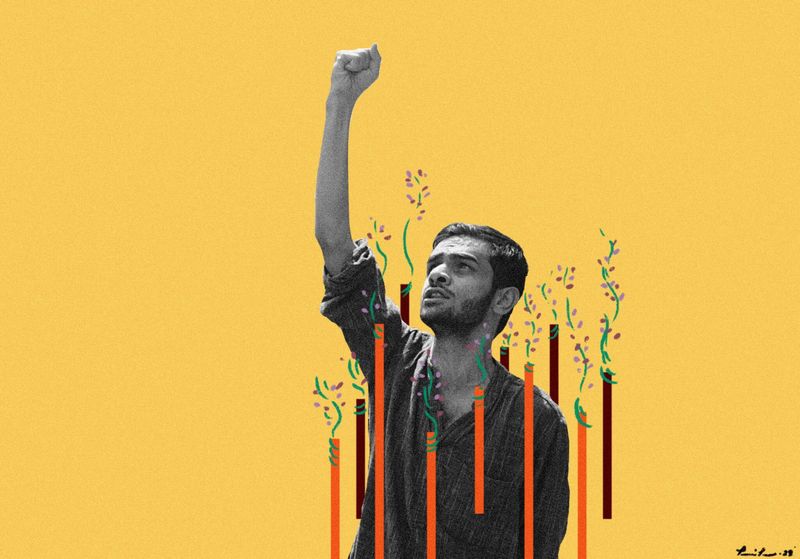
It was a remarkable phenomenon in a “democracy” that had become practically comatose – and was cynically smothered – in the Delhi riots.
Umar Khalid is perhaps India’s most famous political prisoner. It is undoubtedly an ironic distinction for a brilliant, widely-loved young man, but, to be fair, he has serious competition. Of course, Stan Swamy, who at 80-something was denied a sipper even as he struggled to sip water because of his advanced Parkinson’s, is already dead, and Saibaba, a wheelchair-bound quadriplegic, who was alleged to be a danger to the State, had the grace to die just after he was released because of insufficient evidence.
The Bhima-Koregaon prisoners have even acquired a macabre and bitter international celebrity. But there are others – many others, thousands even, who languish in jail, often without even having been charged – which is also, I suppose, a kind of distinction for the world’s “largest democracy”.
Umar Khalid is accused of being complicit in the violence associated with the 2020 Delhi riots. This is a remarkable accusation in many ways. One of facts is that he is on record as eschewing violence – explicitly and unambiguously – in a manner that even Justice Bela Trivedi would have found difficult to deny, provided she and her cohort of judicial eminences could have found the courage to glance at the evidence before denying him bail and consigning the gifted young man in the prime of his youth, to another few years in prison.
That is bad enough, but should be seen alongside the fact that the people who actually gave calls for violence right before the Delhi riots, on live television – Anurag “Goli Maro” Thakur, Parvesh Verma and Kapil Mishra – are currently ministers of some sort, and, as of April 29, have explicitly been exonerated by the Supreme Court, of the charge of having incited violence.
Even more remarkably, Kalaskar, the hitman who was actually convicted in the matter of Dabholkar’s murder, and implicated in the murder of Govind Pansare, has been granted bail by the high court.
All of this, seen in bitter conjunction, suddenly makes the preferred tagline of the tourism department seem very appropriate – it is “Incredible India” after all.
Also read: Umar Khalid: A Prisoner of Conscience
So, on the fifth anniversary of Umar’s incarceration without trial, his numerous friends and admirers have put together a volume called Umar Khalid and his World, which is an anthology of writings both about, but also by Umar Khalid. There are several pieces by Umar on various aspects of our current political predicament, the seemingly irresistible slide into some indigenous version of what can only be, but still must not be, called fascism. The incarceration of Umar Khalid – and indeed, of countless other “anti-nationals” – is itself a symptom of the phenomenon, and there is a wide range of reflections on the gathering dark.
On a more personal note, there is Ramachandra Guha’s remarkable evaluation of Umar Khalid as a fellow scholar, who has so gratuitously been denied the opportunity to fulfil his potential, and so enrich his society – us. And, beyond that, there are reflections on the meanings of the phenomenon of Shaheen Bagh, and a small selection from the creative outpourings that were inspired by that spectacular democratic upsurge against the flagrantly hypocritical Citizenship Amendment Act.
It was a remarkable phenomenon in a “democracy” that had become practically comatose – and was cynically smothered – in the Delhi riots. One might well have expected a volume like this to be depressing, a melancholy meditation on our dark times. It is strangely uplifting. It offers glimpses, both in Umar’s words, and in those of his friends and admirers, of that stubborn vitality which might, just might, save our India one day.
Of course it is wrong, criminally wrong, to use preventive detention in this shameless – and, curiously, shameful – fashion, but that is something that should hardly need to be said. Still, going by the evidence – unlike the courts that have persistently denied him bail – perhaps it does need to be said loudly and unambiguously to all those people who are complicit, up and down the institutional chains of command and hierarchy, through sins of commission and omission, in this outrageous incarceration.
Also read: Eight Facets of Umar Khalid, the Scholar, Citizen and Prisoner
After all, it would hardly be possible without the collaboration of dozens of petty and not so petty cogs in the official machine. The entire Section Seven of The Trial ought to be required reading for the functionaries of the Kafkaesque machinery of repression; meanwhile, it is Gautam Bhatia’s Stenographer for the Prosecution – Unpacking the Order Denying Bail to Umar Khalid that should, likewise, be of particular interest to the judges who have played such a prominent role in this long-running charade of justice.
So, indeed, shame is one of the signs under which one must reflect on the matter of Umar Khalid’s justice – the meanings of that carceral phenomenon, and what it tells us about the state that drives it. The precise characterisation of our fascism-like condition should be a matter of urgent scholarly attention, and this volume is an important contribution to that missing discussion.
But beyond the state, and far more alarming, there is the society that can accommodate that outrage – and not be outraged. One has become used to the idea that murderers and rapists abound in the halls of power, amid the ranks of the people who rule our destinies. However, the long-term effect of this compact with criminality is the coarsening of our social consciousness, the loss of the merest moral sense.
Anomie, as Durkheim called it, but even that seems too distant and abstract. Pick up any of the million instances in our national lives on any one day, the cruelty and the cynicism, and stay with it. Sometimes they come with names – Akhlaq or Hamid – but often they are just battered bodies, pulped by eager wielders of steel rods and stones. This, ladies and gentlemen, is what we have become. So, shame it is. But beyond it, the missing shame is impunity. This derives from the statute and afflicts the personnel who administer “legal” regimes in which such outrages can be perpetrated.
Perpetrated not secretly, as in the dark and “undemocratic” tyrannies, but in full public view. The elaborate legal regime in which the “force of law” is increasingly giving way to the ‘Law of Force’ has been brilliantly analysed by the sociologist Thomas Blom Hansen. I can offer only the merest summary here, but would strongly recommend reading The Law of Force (2021). Crucial to Hansen’s argument is something he calls “the performance of public anger”. This “anger”, we know, can take many forms – it can mean trashing the studio where Kunal Kamra is doing a comedy performance, it can mean disrupting a seminar, or a screening, which certain “angry” people disapprove of. It can mean louts seeking to disrupt a sombre meeting of scholars reflecting on Umar Khalid at the Bangalore International Centre, as it happened last week. Since Section 295A of Indian Penal Code – or Section 299 in Bharatiya Nyaya Sanhita – makes it an offence to cause hurt to a religious group or community, this duly and dutifully manifested “anger” becomes a proof that an offence has indeed been committed. So, the statute “merely” seeks to inhibit the possibility of violence that is implicit in that “anger”.
And if anyone should seek to doubt that violent possibility, the implicit threat of violence can always be acted out, particularly in connivance with the police. Perfect.
The final sign under which I wish to consider the matter of Umar Khalid – beyond shame and impunity – is the matter of immunity, of “sovereign immunity”. After all, this entire shameful episode could, through its sheer enormity, through the sheer scale of its wrongness, yield some possible positives. It could – and it should – prompt some action on “sovereign immunity”, the legal regime that puts the agents of the state, above and beyond the reach of liability for their myriad sins of omission and commission.
Also read: From JNU to Tihar: Umar Khalid and His World
“Sovereign immunity” is the legal doctrine under which the “sovereign”, i.e. the King, is rendered immune from all civil and criminal responsibility. To put it bluntly, the King can do no wrong. Since the “law” issues from the King, it cannot retrospectively apply to the King. This is, obviously, a medieval doctrine, and has no place in a modern state that purports to be “a republic of laws”.
In fact, the Law Commission of India, in its very first report, recommended the abolition of this outdated doctrine. Predictably, the State did nothing about it. In this respect, “sovereign immunity” joins the list of disgraceful legislation that includes “sedition”, “preventive detention”, restrictions on freedom of speech, and many other survivals of colonial laws in a proudly anti-colonial, postcolonial and now allegedly “decolonising” country.
“Sovereign immunity” seeks to protect the state-as-sovereign. But, to my lay mind, it appears that there is a crucial further step from that, to extending the immunity of the state outwards, to its functionaries. So, if the functionaries act illegally – by incarcerating people for years with insufficient evidence – either it must own the illegality, and so be liable for compensating the people who have been wrongly deprived of their liberty, or the state must disown the people who acted thus illegally, under the assumption that they were protected by the “sovereignty” of the State.
At what point does the immunity bestowed by the state to its agents end, after which they become personally liable? Obviously, all this must function under the ambit of the law and so the lawful state may empower its agents to execute lawful actions. Immunity covers these orders and these actions, but the immunity itself must operate under the law – unlike the doctrine of sovereignty, which places the sovereign above the law.
So “sovereign immunity” is a curious hybrid, and doesn’t make sense in a republic of laws – in which the law and the constitution – the 1950 Constitution, the “Ambedkar” constitution – is sovereign. And the agents of the state who execute these everyday outrages – incarcerate without evidence, manufacture (and destroy) evidence, destroy countless lives – must be held personally liable, held subject to the laws that derive from the constitution, and not inhabit some superior realm that exists above it. I dream of scaffolds climbing up Raisina Hill.
This article went live on May sixth, two thousand twenty six, at one minutes past four in the afternoon.
The Wire is now on WhatsApp. Follow our channel for sharp analysis and opinions on the latest developments.